There have been explosions near a military factory in Iran and there are suspicions that Israel was behind what appear to be drone attacks. The possibility has raised tensions, not only in the Middle East, but also in other areas of the world. Iran has supplied Russia with drones in the Russian war against Ukraine and that support has alienated (further) relations between Iran and the West. But it also comes as a very right-wing government in Israel has come to power that is dedicated to preventing Iran from developing a nuclear weapon. The Guardian reports:
“There was no immediate confirmation about who was responsible, but the attacks appear to fit a pattern of strikes against strategic sites across Iran that have been attributed to Israel in recent years. A fire erupted at a fuel refinery in the north-west of Iran at about the same time as explosions were heard in Isfahan, at 11.30pm local time.
“Drones have played an increasing role in a shadow war being fought between Iran and Israel over the skies of Iraq and Syria, in the Persian Gulf, the Red Sea and even the eastern Mediterranean, where tankers have been set ablaze by both sides since early 2019.
“However, the stakes have been highest in Iran itself, where Iran’s nuclear programme has been the target of repeated sabotage attempts. The country’s top scientist was assassinated in 2020 and the Natanz nuclear facility was struck one year later by a blast that damaged its centrifuges. The Karaj facility was struck the same year. An attack in 2022 damaged a drone facility, destroying at least 120 craft.”
Iran is already facing widespread domestic discontent triggered by the death of a woman, Mahsa Amini, in the custody of Iranian authorities on a charge of not wearing proper headcoverings. Suzanne Kianpour notes the significance of the protests which have been going on for the last three months:
“But what’s happening in Iran is not a political movement as much as it is a civil rights movement. Women don’t have basic human rights. In many parts of their existence, a man must make decisions for them, according to the law. And yet they are highly educated. The slogan of the revolution — “zan, zendegi, azadi” or “woman, life, liberty” — is not about politics but about equality.
“In the early days of the protests fueled by Mahsa Amini’s death, I was speaking with a U.S. intelligence official who said the regime would crack down on the protesters and they’d dissipate as in the past. But everyone I spoke with inside Iran said this time is different”
In addition, violence has been breaking out in Israel as well as the Israeli government has been responding to internal pressures to allow greater control to settlers in the Occupied Territories. The Israeli military conducted a raid on a refugee camp near the city of Jenin which resulted in the deaths of nine Palestinians on 26 January. That attack was followed by Palestinian attacks on Israelis leaving a synagogue which resulted in the deaths of seven Israelis.
There have also been large protests in Israel against the government’s plans to restrict the authority of the Israeli judiciary. Yesterday, nearly 100,000 Israelis protested against these plans. According to CBS News:
“To secure his sixth term as Israel’s prime minister, Benjamin Netanyahu has formed a coalition with extremist political parties that support the introduction of more severe anti-Palestinian legislation, including banning the Palestinian flag in public spaces and expanding Jewish settlements in the West Bank that are illegal under international law. Some coalition members also support amendments to Israeli laws that protect the rights of women, LGBTQ people and other minority groups…
“Netanyahu’s government has also proposed reforms to the country’s supreme court that could undermine the independence of the nation’s judiciary, allowing politicians to potentially overrule court decisions. That, critics say, is a direct threat to Israel’s democratic system of checks and balances and could benefit Netanyahu himself as he faces an ongoing trial over alleged corruption.”
The overall situation is incredibly volatile and we need to keep an eye on how these things develop. The US, moreover, needs to pay close attention to how the new Israeli government actually implements its policies, many of which contradict long-standing US concerns in the region. The Israeli government is taking actions which threaten its staus as a democracy as well as the possibility of some agreement between the Israelis and the Palestinians.
My wife, Priscilla, told me about aNational Public Radio broadcast on the movie, Casablanca. She knows that that movie is my all-time favorite. The broadcast provided an insight into the movie about which I was unaware: that some of the most memorable characters in the film were themselves refugees from Nazi Europe.
“But Casablanca is more than just a love story. It is a film about, and stocked with, the waves of refugees fleeing Nazi-occupied Europe during wartime. And many of the actors playing those roles were, in fact, refugees.
“‘When people speak here, the accents are real,’ says Leslie Epstein, the son and nephew of screenwriters Philip and Julius Epstein. ‘That gives it a kind of authenticity. In a sense, they’re playing themselves.'”
Virtually every scene in the movie is brilliant, and my heart aches when the camera focuses on Ingrid Bergman’s face as Sam begins to play “As Time Goes By”–for almost a full minute Bergman’s face says everything one needs to know about her and Rick (Humphrey Bogart) without needing to utter a single word.
And there are few scenes in cinematic history that convey the power of nationalism than the singing contest between the Germans and the French.
But the final scene always make me choke up. I understand that there were discussions about how to end the movie right up until the end of filming, with some arguing that Rick and Ilsa should stay together (something which would have never worked in the social climate of the mid-1940s). To my mind, the conclusion is perfect.
Oxfam has published its annual global economic report, entitled “Survival of the Richest: How we must tax the super-rich now to fight inequality”. It is a depressing read. It documents the ongoing process of extreme concentrations of wealth in the global economy, a process thats began in the 1980s and has accelerated in recent years. The summary is damning:
Since 2020, the richest 1% have captured almost two-thirds of all new wealth – nearly twice as much money as the bottom 99% of the world’s population.
Billionaire fortunes are increasing by $2.7bn a day, even as inflation outpaces the wages of at least 1.7 billion workers, more than the population of India.
Food and energy companies more than doubled their profits in 2022, paying out $257bn to wealthy shareholders, while over 800 million people went to bed hungry.
Only 4 cents in every dollar of tax revenue comes from wealth taxes, and half the world’s billionaires live in countries with no inheritance tax on money they give to their children.
A tax of up to 5% on the world’s multi-millionaires and billionaires could raise $1.7 trillion a year, enough to lift 2 billion people out of poverty, and fund a global plan to end hunger.
The concentration of wealth is simply staggering:
The richest 1% hold 45.6% of global wealth, while the poorest half of the world have just 0.75%.
81 Billionaires hold more wealth than 50% of the world combined.
10 billionaires own more than 200 million African women combined.
More importantly, the process is not simply a natural consequence of market capitalism–it is a process that has been facilitated by the political power associated with great wealth. Specifically, the tax systems of most countries in the world are structured to provide significant tax relief to the rich through loopholes, tax havens, and lax tax enforcement. Evan Osnos has written an essay for the New Yorkerwhich outlines the ways the Getty family has evaded taxes through the creation of trusts. Osnos begins by highlighting how rich families have increased their wealth in recent years:
“And yet, in recent times, the fortunes of many prominent American clans have soared. Between 1983 and 2020, the net worth of the Kochs, who prospered in fossil fuels and became right-wing mega-donors, grew twenty-five-fold, from $3.9 billion to $100 billion. The Mars-family fortune, which began in the candy business, grew by a factor of thirty-six, to $94 billion. The Waltons, of Walmart, expanded their fortune forty-four-fold, to $247 billion. The financial triumph of such clans helps explain how the imbalance of wealth in the United States has risen to levels unseen in a century. In 1978, the top 0.1 per cent of Americans owned about seven per cent of the nation’s wealth; today, according to the World Inequality Database, it owns eighteen per cent.”
Osnos points out how the tax system has favored the rich: “According to Emmanuel Saez and Gabriel Zucman, economists at the University of California, Berkeley, the average tax rate on the top 0.01 per cent has fallen by more than half, to about thirty per cent, while rates for the bottom ninety per cent have climbed slightly, to an average of twenty-five per cent.” He goes on to an important conclusion:
“Scholars of wealth and taxes say that the golden age of élite tax avoidance has contributed to the turbulence in American politics, by hardening social stratification; reducing public resources for education, health, and infrastructure; and eroding trust in America’s mythologies of fairness and opportunity. Edward McCaffery, a tax professor at the U.S.C. Gould School of Law, said, ‘Tax, which is supposed to be a cure, is in fact one of the problems. This is a pattern that recurs throughout history. Capital keeps getting more and more unequal, until there’s a crash.’”
The Institute for Policy Studies provides an informative list of the ways the tax system is manipulated in the US:
The U.S. is host to an estimated $5.6 trillion in trust assets. Much of these assets belong to the uber-wealthy — both international and domestic — and are held in trust in states subservient to the trust industry. The concept of the “offshore” tax haven has very much washed ashore.
U.S. trust-subservient states enable illicit wealth hiding and tax avoidance. As the International Consortium of Investigative Journalists’ Pandora Papers investigation revealed, some U.S. states have aided international kleptocrats to avoid accountability at home and hide their ill-gotten wealth abroad. These states also enable wealthy Americans to avoid federal taxation, cheating the U.S. out of revenue with which it could combat poverty or invest in infrastructure. Trusts, therefore, affect every U.S. citizen and resident.
Three key ingredients — low or no taxes, secrecy, and trust longevity — make certain U.S. states particularly attractive to wealth defenders. These states pass laws to cut or abolish taxes or hide trust records from prying eyes. More than two thirds of states allow trusts to last for at least 150 years or forever. Additionally, more than a third of states allow trusts to be established by the person benefiting from the trust, shielding their assets from creditors and tax authorities.
There is a significant correlation between regressive state taxation systems, which hurt the poorest residents, and trust-subservient state laws. Of the 13 states captured by the trust industry we have profiled here, eight are among the 15 most regressive tax states in the country. These states often cut taxes for the wealthiest residents and instead rely on the low and middle class, who pay a disproportionate amount of their income in taxes.
The trust industry says it simply helps its clients obey laws — but in reality it often writes the laws. As our report shows, the trust industry is the driving force for trust deregulation. Trust and estate lawyers regularly lobby state legislatures and sometimes work in official capacities with states to write legislation favorable to the industry. In small states with part-time or “citizen” legislatures, there is no countervailing power that matches the clout of the financial services industry. And this trust deregulation is often bipartisan.
The trust industry offers little benefit to states. Contrary to what trust and estate lawyers may claim about increased economic development and boosted state revenue, states largely do not benefit from trusts. Though billions may be held in trust in a state, state coffers — and the public — will never see it. States charge only small fees to trust companies; the trust industry creates very few jobs; and trust owners have no reason to physically move to or even visit the states where they have established trusts.
States are engaged in a rapid race to the bottom, so federal action is needed. States may see a few jobs created by the trust industry and determine that is worth the detrimental effect of trusts on the rest of the country. It is in the federal government’s interest, therefore, to curb state laws that enable illicit wealth hiding and tax avoidance.
This process cannot end well. The consequences of the concentration of wealth after the financial crisis in 2008-09 was a series of elections that led to populist and nationalist leaders such as Donald Trump in the US and Boris Johnson in Great Britain. We are now in the second phase of this political process–more violent political expressions such as the riots in the US on 6 January 2021, the protests in China against the Covid restrictions, and the violence in Brazil most recently. These violent protests were not well-organized and the third phase of the protests against the concentration of wealth will likely see the emergence of political parties dedicated to more radical redistributions of wealth.
Science published a very interesting paper on how the scientists at Exxon/Mobil accurately anticipated climate change caused by the burning of fossil fuels as early as 1977. Researchers reviewed “32 internal documents produced in-house by ExxonMobil scientists and managers between 1977 and 2002, and 72 peer-reviewed scientific publications authored or coauthored by ExxonMobil scientists between 1982 and 2014.” The researchers found that Exxon/Mobil scientists were remarkably prescient about the consequences of using fossil fuels:
“In summary, climate projections reported by ExxonMobil scientists between 1977 and 2003 were accurate and skillful in predicting subsequent global warming. Some projections suggested slightly too much warming and others not quite enough, but most (63 to 83%, depending on the metric used) were statistically consistent with subsequently observed temperatures, particularly after accounting for discrepancies between projected and observed changes in atmospheric CO2 concentrations. ExxonMobil’s projections were also consistent with, and as skillful as, those of academic and government scientists. All told, ExxonMobil was aware of contemporary climate science, contributed to that science, and predicted future global warming correctly. These findings corroborate and add quantitative precision to assertions by scholars, journalists, lawyers, politicians, and others that ExxonMobil accurately foresaw the threat of human-caused global warming, both prior and parallel to orchestrating lobbying and propaganda campaigns to delay climate action, and refute claims by ExxonMobil Corp and its defenders that these assertions are incorrect.”
The scientific conclusions, however, were at variance with the interests of Exxon/Mobil as a profit-seeking enterprise and the researchers analyze the public statements of the company thast either denied or downplayed the conclusions of the science:
“ExxonMobil has often specifically claimed or suggested in public that climate models are ‘unreliable’. In 1999, for example, ExxonMobil Corp’s chief executive officer (CEO) Lee Raymond said future climate ‘projections are based on completely unproven climate models, or, more often, sheer speculation.’ In 2013, his successor, Rex Tillerson, called climate models ‘not competent’. In 2015, he stated: ‘We do not really know what the climate effects of 600 ppm versus 450 ppm will be because the models simply are not that good’. The company’s own modeling contradicts such statements”
The discrepancy between what Exxon/Mobil knew to be true and what it professed to be true is striking. Professor Suban of Harvard points out: “We now have airtight, unimpeachable evidence that ExxonMobil accurately predicted global warming years before it turned around and publicly attacked climate science and scientists. Our findings show that ExxonMobil’s public denial of climate science contradicted its own scientists’ data.” And it is painful to recognize that nearly 50 years of possible alternatives to climate change were lost because of the climate denying strategy, not only by Exxon/Mobil but by virtually every major corporation involved in the selling of coal, oil, and natural gas.
After months of negotiations, it appears as if a ruling coalition has been achieved in Israel. It has been a very difficult period of time in Israeli politics: there have been five elections in the last four years, and none of them has achieved political stability. The newest coalition consists of six parties and they have agreed that Benjamin Netanyahu should serve as Prime Minister, just 18 months after he left the position under a cloud of suspicion. He is currently on trial on “charges of bribery, fraud and breach of trust”.
The BBC characterizes the new coalition as “the most right-wing in Israel’s history”:
“Mr Netanyahu’s coalition partners reject the idea of a two-state solution to the Israel-Palestinian conflict – the internationally backed formula for peace which envisages an independent Palestinian state in the West Bank alongside Israel, with Jerusalem as their shared capital.
“The leader of the Religious Zionism party, which in alliance with two other far-right parties won the third largest number of seats in the knesset (parliament), wants to see Israel annex the West Bank and has been given wide powers over its activities there….
“Israeli opposition politicians, as well as its attorney general, have warned that reforms planned by the incoming government – including giving MPs the right to overrule Supreme Court decisions – threaten to undermine Israeli democracy.
“Coalition partners have also proposed legal reforms which could end Mr Netanyahu’s ongoing trial on charges of bribery, fraud and breach of trust. Mr Netanyahu denies any wrongdoing.
“Israeli opposition and civil rights groups have expressed particular alarm at the inclusion of the far-right in the new government.
“Otzma Yehudit (Jewish Power) party leader Itamar Ben-Gvir is known for his anti-Arab comments and has called for the relaxation of rules on when security forces can open fire in the face of threats. Once convicted of incitement to racism and supporting a terror organisation, he is set to become national security minister with authority over the police in Israel and the West Bank.
“The other far-right partner in government, Avi Maoz of the anti-LGBT Noam party, has called for Jerusalem’s Gay Pride event to be banned, disapproves of equal opportunities for women in the military, and wants to limit immigration to Israel to Jews according to strict interpretation of Jewish law.”
The news has received mixed responses, but some US Jews have expressed concern over the rightward swing that violates many precepts of liberal democracy. The New York Timesoutlines the concerns over one member of the new coalition, Itamar Ben-Givr:
“Future ministers in Mr. Netanyahu’s cabinet also include several far-right Jewish settlers who have a history of homophobia, antagonism toward Israel’s Arab minority and opposition to secular aspects of public life.
“One, Itamar Ben-Gvir, was barred from serving in the Israeli Army because he was considered too extremist. He admires a hard-line rabbi who wanted to strip Arab Israelis of their citizenship, and for years, he displayed a portrait in his home of an extremist Jewish settler who shot dead 29 Palestinians in 1994 in a mosque in the West Bank city of Hebron.
“Despite criminal convictions for incitement to racism and support for a terrorist group, Mr. Ben-Gvir is set to be minister for national security, overseeing the police.”
The new coalition signals little intention to revive the moribund peace process between Israel and the Palestinians. The Biden Administration has been reticent to express strong concerns about the coalition, and it appears as if the US will wait to see how the coalition actually governs. But we should all be concerned about the future of Israeli liberal democracy.
Protests against the lockdown policies in China continued over the weekend, and it’s not clear how the protests will evolve. The Chinese government has been following a “zero Covid” strategy which tried to control the pandemic by tightly restricting the movement of Chinese citizens. The lockdowns have been damaging both economically and politically. The strategy did in fact keep the death rate rather low, but it is not clear that it can be effective over the long term as new variants of the disease keep emerging and as the vaccines being used in China are significantly less effective than the mRna vaccines developed in the US and Europe. Indeed, Covid cases are increasing quite dramatically in China:
The Chinese government has a difficult decision. It has already loosened some of the lockdown requirements but there doesn’t seem to be afollow on policy of implementing a more effective vaccine strategy to replace the lockdowns. National Public Radio indicates that China is ill-prepared for an outbreak of covid:
“China has inadequate hospitals, with fewer than fourintensive care beds per 100,000 people — about a quarter of the rate in the United States. Chinese experts estimate if Beijing was to lift lockdowns immediately, the overwhelming number of hospitalizations would collapse its medical system.
“And while overall coronavirus vaccination rates are officially high, the rate among the elderly is low; nearly 40% of people over 80 have not had a booster yet. Researchers say made-in-China vaccines for COVID-19 are less effective than mRNA vaccines provided in other countries….
“Xi Chen, a public health expert at Yale University, says that’s a big problem, and points to what happened in Hong Kong in the spring as a cautionary tale.
“‘”Hong Kong was around a very similar booster rate when the omicron wave hit,’ Chen says. ‘More than 6,000 people died.’
“With a population of 7.4 million, Hong Kong, for a period, had the highest recorded COVID-19 fatality rate on Earth. The same could happen in mainlandChina, only on a much bigger scale, he says.
The Chinese government is therefore rolling the dice. By loosening the restrictions on movement, it will buy some time to relieve the growing resentment over the zero-Covid policy. But if the variants of the Covid virus bypass the protections of Chinese vaccines, then China will either have to accept a higher death rate or turn to the West for mRNA vaccines. Both of those alternatives may threaten the legitimacy of the government still further.
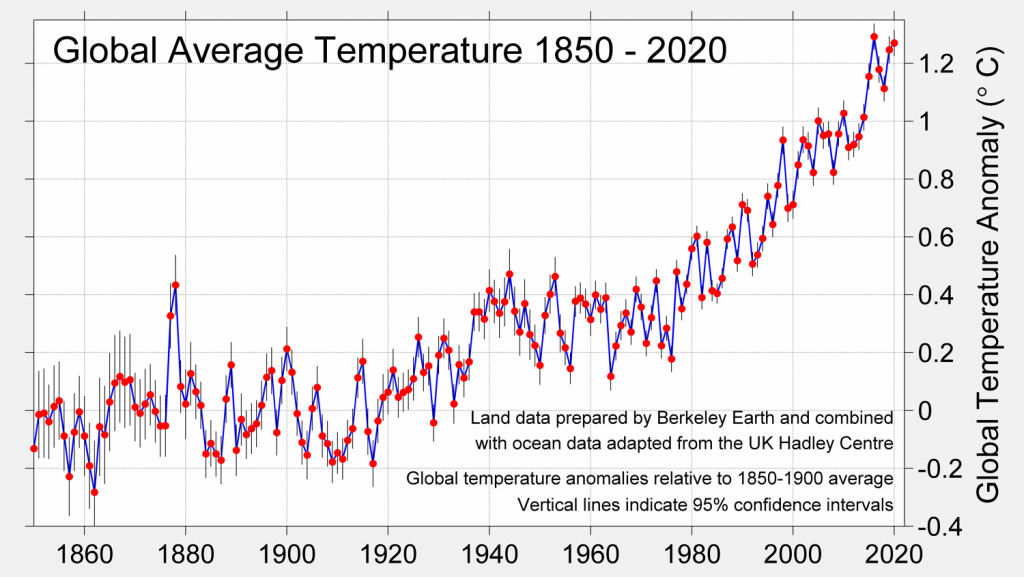
The United Nations Conference of Parties (COP) finished its last session in Egypt on measures to address climate change. In many important respects, it was a miserable failure: no agreements were reached on effective limitations on greenhouse gas emissions other than a weak resolution that reiterated the language of last year’s conference in Glasgow to a “phase-down of unabated coal power.” Without any agreement on limitations on fossil fuel emissions, the world has accepted that the 1.5° C target for global temperature increases will not be met. Global temperatures have already increased 1.1°C over pre-industrial levels and emissions continue to rise.
Even with an increase of less than 1.5°C the world is experiencing serious climate events such as wildfires, droughts, loss of biodiversity, floods, and intolerable nighttime elevated temperatures. For example, the floods in Pakistan earlier this year covered almost 30% of the country’s territory, leading to an estimated $40 billion economic loss and deaths in the 1500s.
Economic and political conditions make 2022 an inauspicious year to combat fossil fuel emissions. The war in Ukraine has led to dramatic shifts in energy consumption and some states, like India and China, have gone back to burning coal which is more accessible and cheaper than less destructive emissions from sources such as natural gas. And the economic losses associated with the COVID pandemic have amplified demands for economic growth even at the expense of the environment. It is impossible to predict when these pressures will abate.
The cruelest irony of the climate crisis is that some of its most damaging effects will be felt in areas and in countries that have poor populations that emit a small fraction of the emissions emitted by richer countries. This disparity has stymied previous COPs because poorer countries think that richer countries should pay higher costs to avert climate change. There was a symbolic victory on that issue in COP27. After a marathon session of 40 hours, the delegates finally agreed to create a “loss and damage” fund to subsidize the efforts of poorer countries to adapt to the effects of climate change. Reuters notes:
“The deal for a loss and damage fund marked a diplomatic coup for small islands and other vulnerable nations in winning over the 27-nation European Union and the United States, which had long resisted the idea for fear that such a fund could open them to legal liability for historic emissions.
“Those concerns were assuaged with language in the agreement calling for the funds to come from a variety of existing sources, including financial institutions, rather than relying on rich nations to pay in.
“But it likely will be several years before the fund exists, with the agreement setting out only a roadmap for resolving lingering questions including who would oversee the fun, how the money would be dispersed – and to whom.”
The world doesn’t have much time to take action to forestall serious disruptions. Apparently, some believe that we have more time than is actually the case.
All sides are treading very carefully because of the enormous implications of a Russian attack. Polish President Duda was reported to have said “We have no evidence at the moment that it was a rocket launched by Russian forces…..However, there are many indications that it was a missile that was used by Ukraine’s antimissile defense.” US President Biden was similarly cautious. According to The New York Times:
Asked by a reporter whether the missile “was fired from Russia,” Mr. Biden replied, “There is preliminary information that contests that.”
“I don’t want to say that until we completely investigate,” he said. But “the trajectory” of the missile made it unlikely “that it was fired from Russia,” he added.
A Kremlin spokesman, Dmitri S. Peskov, reiterated Moscow’s rejection of responsibility for the blast and complained that some had been all too ready to blame Russia — noting that the U.S. response had been a welcome exception.
“One should never rush to pronounce judgments and statements that can escalate the situation, still more so at such crucial moments,” he said.
“In this case,” he added, “it makes sense to pay attention to the restrained and far more professional response of the American side and the American president.”
Ukrainian President Zelensky insisted that the missile was not Ukrainian, but the investigation at this point is inconclusive.
The incident raises concerns that have been omnipresent since the war began last February. There are events in war that trigger unanticipated responses and the one that has been of most concern was the possibility that the war in Ukraine could escalate into a war between Russia and NATO. What happens next will be critically important, even if the evidence conclusively proves that Ukraine fired the missile in self-defense. Hardliners in Ukraine, Russia, and the US might exploit the ambiguities of this incident to justify escalation of the conflict.

 World Politics News