Archive for the ‘World Politics’ Category
President-elect Trump roiled the waters in Europe when he declared that NATO was “obsolete”. Since 1949, NATO has been the defensive alliance that united the strategic interests of Europe with those of the US. At that time, the pre-eminent threat was the Soviet Union and the coherence of NATO doctrine was pretty straightforward. But since the dissolution of the Soviet Union, many–not just Mr. Trump–have wondered whether NATO still has a mission. One should remember, however, that alliances are very difficult to build from scratch and it may be the case that a similar threat to the Soviet Union is not the only justification for a defensive alliance.
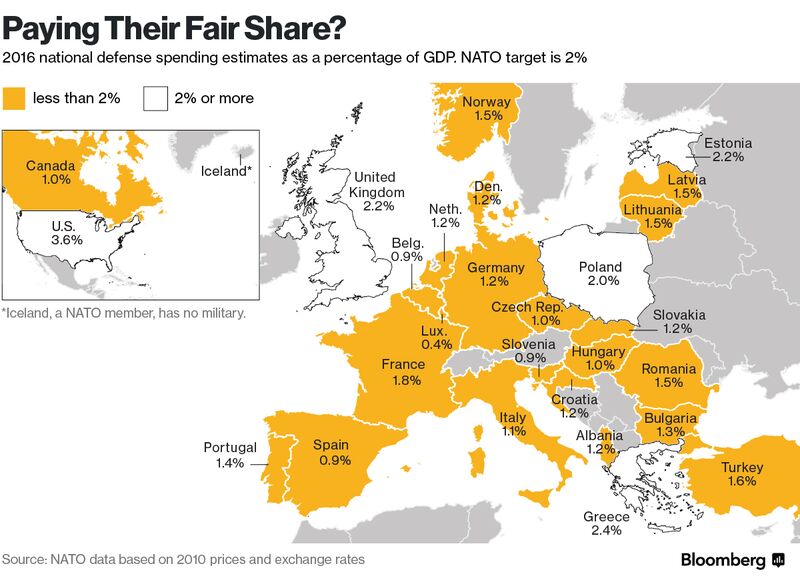
The Washington Post has an article on the 9 top foreign policy issues facing the Trump Administration as it takes office: Daesh (the Islamic State), Afghanistan, North Korea, Ukraine, China and Trade, European alliances, the Iranian nuclear deal, Israel and Palestine, and the US-Mexican relationship. Interestingly, it does not include the South China Sea, nor does it mention the rise of authoritarian regimes in the world. Most glaringly, it does not include climate change. Apparently, protecting international law, defending democracy and saving the planet are not serious issues. But, as with all lists, there are kibitzers.
Stephen Rose has written an essay for the Washington Monthly looking carefully at the voting choices made by various income classes in the US in the recent presidential election. His analysis suggests that the main source of support for Mr. Trump came not from the lower classes, but from the white middle class who felt disenfranchised from the economic process that favored the upper middle and elite classes. Mr. Trump’s victory is actually due to people who were actually fairly well-off, but who felt that they were not as well-off as they should have been. If the analysis is accurate, then satisfying that group might be significantly more difficult than the explanation proffered by those who believe that it was the lower middle classes who propelled Mr. Trump.

Climate change will have highly variable effects across the planet, but researchers at the University of Massachusetts at Amherst believe that the Northeast US will experience a higher rate of temperature increase than in many other parts of the US. Moreover, the researchers suggests that sea levels could rise by as much as 10 feet near Boston by the end of the century, putting about 30% of the city underwater. Globally, the US National Oceanic and Atmospheric Administration (NOAA) and the National Aeronautic and Space Administration (NASA) have declared 2016 to be the hottest year on record, making it the third year in a row to set a new record. According to the Washington Post, “NASA actually found a bigger leap upward of temperatures in 2016, measuring the year as .22 degrees Fahrenheit warmer than the prior record year of 2015. The agency also noted that just since the year 2001, the planet has seen ’16 of the 17 warmest years on record.’”
(AVERAGE OF 32 CLIMATE MODEL SIMULATIONS)
HOW TO READ
80 percent of all models indicate reaching 2˚C in these years.


SOURCE: Northeast Climate Science Center, UMass Amherst
On Friday, President-elect Trump will become the 45th President of the US. There is perhaps no greater responsibility on the leaders of nuclear-armed countries (the US, Britain, France, China, Russia, India, Pakistan, North Korea, and Israel) than to have very clear thoughts about the potential use of those weapons. It is too soon for the Trump Administration to have a well-formulated nuclear policy, but the statements made by Mr. Trump during the campaign suggest that he needs to pay a great deal of attention to the matter. Zack Beauchamp has written an essay for Vox outlining the many contradictions and inconsistencies in Mr. Trump’s statements about nuclear weapons.
Representative democracy and market capitalism are both institutions that operate within the ideology of liberalism. But in many respects these institutions operate in conflict with each other: democracy emphasizes the fundamental political equality of each person; market capitalism operates by emphasizing the essential differences we all have with respect to innovation, efficiency, and privilege of access to capital. The conflicts between the two institutions are usually obscured when economies are growing. But when economic growth slows down, as it has in the US and Europe since the Great Recession of 2008-09, the conflicts become more obvious. Unfortunately, democracy is the more fragile of the the two and is often the victim of slow economic growth.
British Prime Minister Theresa May gave a speech today in which she confirmed that she will guide Great Britain to a “hard” Brexit. Many had hoped that Britain would manage to keep some ties with the European Union, gaining some concessions to the uniform policies on worker mobility within the Union. But May indicated that so such concessions would be requested and that the British departure from the Union will be complete. She held out the hope of a more limited relationship along the lines of the recent agreement between the EU and Canada, but only gave the country two years to forge such an agreement (the arrangement with Canada took seven years to negotiate).
The World Economic Forum in Davos, Switzerland is typically an annual conference of economic leaders committed to the process of globalization. This year, for the first time, the leader of China, President Xi Jinping, attended the conference and made a major speech extolling the virtues of globalization. The Trump Administration, on the other hand, did not send any high level representatives. The reversal of roles is striking since the US has traditionally been the most enthusiastic proponent of globalization in the world. The critical question is whether China will begin to shoulder some of the global costs of globalization. The US refused to do so after World War I with disastrous consequences. Only after World War II did the US decide to commit its power to maintaining a world order in which globalization could thrive.
Ukraine is bringing a suit against Russia in the International Court of Justice (ICJ) for its annexation of Crimea, its funding of separatists in eastern Ukraine, and for the downing of a civilian airliner. The ICJ is the UN’s highest court and the charges are all violations of the UN Charter, and the rulings of the ICJ are final and not subject to appeal. It is doubtful, however, that Russia will even contest the charges or show up in court. Most likely, it will simply ignore the court as the US did in Nicaragua’s case against the US for mining its ports in 1986.
Ipsos Public Affairs is a think tank that regularly conducts public opinion polls. Its most recent poll asked people all over the world whether they thought their country was going in the right direction and what their major concerns were. The results were fascinating: there was a wide divergence among countries about what the major concerns were. People in China had a much more favorable view of the direction their country was heading than any other country, by a very wide margin.

The US-based Global Financial Integrity (GFI) and the Centre for Applied Research at the Norwegian School of Economics have issued a report on unreported capital flows between poor and rich countries. The common view of that economic relationship is that rich countries send development aid to poor countries to help them overcome poverty. The actual relationship is quite different. According to the report: “since 1980 developing countries lost US$16.3 trillion dollars through broad leakages in the balance of payments, trade misinvoicing, and recorded financial transfers.” The negative flows occur because so much money flows through offshore banking centers and other untallied flows that are unrecorded in official transactions. According to The Guardian: “In other words, for every $1 of aid that developing countries receive, they lose $24 in net outflows.” The drain on the GDPs of poor countries is huge as indicated in the graph below.

Rajan Menon has written an essay for The American Conservative which gives a very good insight into the way President Trump may address the Iranian nuclear deal. During the campaign, Mr. Trump was highly critical of the arrangement, as was his Secretary of Defense, Gen. Matthis. Menon, however, does not believe that President Trump will immediately scrap the agreement. He does think that President Trump will likely have very frosty relations with Iran.
Ishaan Tharoor has written a very thoughtful essay for The Washington Post on the forces eroding the liberal world order. The liberal world order, essentially erected by the US in 1945, was built upon the liberal ideology developed in Europe in the Enlightenment. It consists of three cardinal institutions: representative democracy, market capitalism, and human rights and constitutional law. The commitment of liberal states seems to be weakening and non-liberal states, such as Russia or China, are filling in the vacuum. We are not yet talking about a contest between liberal and non-liberal world orders since the non-liberal states have not yet advanced an alternative set of non-liberal institutions. But the disintegration of the consensus surrounding the liberal world order suggests that the future will be turbulent with clear rules and norms of interaction.
The Guardian is reporting that Iran is moving large numbers of Shia Muslims into parts of Syria in which the previous populations were primarily Sunni Muslims. The population moves are designed to help solidify Iranian influence in Syria as well as to buttress the authority of Syrian President Assad who is now considered likely to survive the civil war which was fought to oust him. Iran has been coordinating activities to facilitate the transfer of populations through Hezbollah, a political group supported by Iran and one with significant influence in both Syria and Lebanon. If successful, the moves will definitely strengthen Iran’s influence in the region, to the detriment of Turkey, Israel, and the US.

Foreign Policy has a very good essay on thinking about President-elect Trump’s foreign policy. The essay argues that Mr. Trump lacks a grand strategy and the it is rather guided by three operational tenets:
“The Trump Doctrine, as gleaned from his pre-inaugural statements about world affairs, is not a grand strategy. Rather, it is a collection of principles — some operational, some philosophical — that will likely guide U.S. foreign policy over the next four years. These principles are united by three core attributes: first, a focus on short-term tactical wins rather than longer-term foresight; second, a “zero-sum” worldview where all gains are relative and reciprocity is absent; third, a transactional view of American foreign policy that is devoid of moral or ethical considerations. We dub this emergent approach ‘tactical transactionalism.’”
I think that even this analysis concedes far too much to Mr. Trump about his foreign policy views. But it is probably a good way to begin thinking about how things will unfold over the next few years.
Income inequality is difficult to appreciate since people very rarely associate with others who have widely discrepant incomes. It is even more difficult to comprehend income inequality across generations. An advocacy group, Young Invincibles, has gone through Federal Reserve Bank data to make intergenerational comparisons and the conclusions are striking. The report presents the data that concludes: “Our analysis of income shows Millennials earn less not just because they are earlier in their career, but also because of an intergenerational decline in wages. As seen in Table 1.1, young adult workers today earn $10,000 less than young adults in 1989, a decline of 20 percent.” The “American Dream” has always been based on the assumption that children will always have a higher quality of life than their parents.
Table 1.1 – Millennials Earn Less than Boomers
25-to-34 year-olds 1989 2013 Percent Change
All $50,910 $40,581 -20%
China Times, usually regarded as representing the official point of view of the Beijing government, ran an editorial about the comments made by the nominee for Secretary of State, Rex Tillerson, about US policy toward China’s claims in the South China Sea. As posted earlier, Tillerson said: “We’re going to have to send China a clear signal that first, the island-building stops and second, your access to those islands also is not going to be allowed.” The editorial’s language was strikingly bellicose:
“China has enough determination and strength to make sure that his rabble rousing will not succeed. Unless Washington plans to wage a large-scale war in the South China Sea, any other approaches to prevent Chinese access to the islands will be foolish.
“The US has no absolute power to dominate the South China Sea. Tillerson had better bone up on nuclear power strategies if he wants to force a big nuclear power to withdraw from its own territories.”
On this particular matter, there are some reasons to believe that the Global Times is actually just testing Mr. Trump and not reflecting actual policy. It is hard to tell which interpretation is valid.
Ian Bremmer is the head of The Eurasia Group and a very astute and intelligent analyst. He has written a short essay on how the 2016 US Presidential election has damaged American foreign policy. Soft power is an important asset to any state and the US often served as an example of how a democratic state can persist. The questions about some of the aspects of the 2016 election has raised serious doubts in the minds of some outside observers as to whether the US can continue to serve as that example.
In his confirmation hearings, the nominee for Secretary of State, Rex Tillerson, was asked whether the US would adhere to its commitment to the G20 group to phase out all tax subsidies for the fossil fuel industry. Tillerson’s response was: “I’m not aware of anything the fossil fuel industry gets that I would characterize as a subsidy.” Actually, according to Oil Change International:
“As of July 2014, Oil Change International estimates United States fossil fuel subsidies at $37.5 billion annually, including $21 billion in production and exploration subsidies. Other credible estimates of annual United States fossil fuel subsidies range from $10 billion to $52 billion annually – yet none of these include costs borne by taxpayers related to the climate, local environmental, and health impacts of the fossil fuel industry.”
According to the US Self-Review of tax subsidies for the Oil & Gas industry for the G20, which is a more conservative estimate, the oil and gas companies receive almost $8 billion in direct tax subsidies. The subsidies are the result of intensive lobbying by the fossil fuel industry. According to ThinkProgress:
“Under Tillerson, Exxon’s political spending greatly increased, growing from a little over $700,000 in 2004 to $1.5 million in 2016. And, according to OpenSecrets, each year, around 90 percent of that money went to Republican candidates, the same candidates more likely to vote against ending fossil fuel subsidies (in 2012, for example, only two Republican senators voted for the Repeal Big Oil Tax Subsidies Act).”

The National Academy of Sciences (NAS) was tasked in 2009 to determine what is known as the “social cost of carbon” (SC-CO2). The NAS defines the social cost of carbon as: “…an economic metric intended to provide a comprehensive estimate of the net damages – that is, the monetized value of the net impacts, both negative and positive – from the global climate change that results from a small (1-metric ton) increase in carbon-dioxide (CO2) emissions.” The SC-CO2 is a value used by the federal government to determine the need for a variety of environmental rules and is currently set at about $36 per ton of carbon dioxide. The NAS has released its report and finds that the value needs to be significantly refined. It is unlikely, however, that the Trump Administration will engage in that effort.

France will be holding a national election this spring and the two leading candidates for president are former Prime Minister Francois Fillon and Marine Le Pen, the candidate from the National Front Party. Le Pen holds views quite similar to those of US President-elect Trump. She wants closer relations with Russia to fight what both she and he call “radical Islamic terrorism” and she wants to erect trade barriers to protect French workers from imports from low wage countries. Her chances for winning the election have certainly been buttressed by Trump’s election and the Brexit vote.
Professor William Nordhaus, an economist at Yale University, has just published a paper (“Projections and Uncertainties About Climate Change in an Era of Minimal Climate Policies“) that “it was no longer practicably feasible to keep the level of warming to within two degrees Celsius above pre-industrial levels, the point at which climatologists believe the world will start to experience particularly dangerous climate change”. The paper argues that “A target of 2.5º C is technically feasible but would require extreme virtually universal global policy measures.” The conclusions fly in the face of the goals of the recent Paris Agreement which seeks to limit temperature increases to 1.5º C, a level that current temperatures are already close to achieving.
Rex Tillerson, President-elect Trump’s nominee for the Secretary of State, stated in his Senate confirmation hearings that “China should be denied access to islands it has built in the contested South China Sea”. Statements at a confirmation hearing do not constitute policy and one should be careful not to over interpret Tillerson’s comments. But there is little question that Beijing is likely to regard the comments as especially provocative and worrisome. One should also not be surprised that the former CEO of ExxonMobil would have strong views on the South China Sea given that many believe that the region contains huge reserves of oil and gas.

Spiegel has published a staff report on how Chancellor Merkel is preparing for German-US relations under a Trump Administration. Merkel made very few direct comments about Mr. Trump during the American presidential campaign, but many of her public statements have made reference to the need to protect “liberal” institutions and values. The article suggests that Merkel anticipates great difficulties in working with the US, particularly on the issue of Russian activities in eastern and central Europe.
Timothy Garton Ash is perhaps the most astute analyst of European affairs alive today. He has written a review of several books for the New York Review of Books that captures a great deal of what is going on in the world, particularly on the issue of the disintegration of the liberal world order. His analysis of the phenomenon of populism is perceptive and trenchant:
“Populism….is inimical to pluralism. Its target is pluralist, liberal democracy, with those vital constitutional and social checks and balances that prevent any ‘tyranny of the majority’ from prevailing over individual human rights, safeguards for minorities, independent courts, a strong civil society, and independent, diverse media.”
The essay ultimately argues that the true meaning of liberalism needs to be resuscitated in order to nullify the destructiveness of the new nationalism.
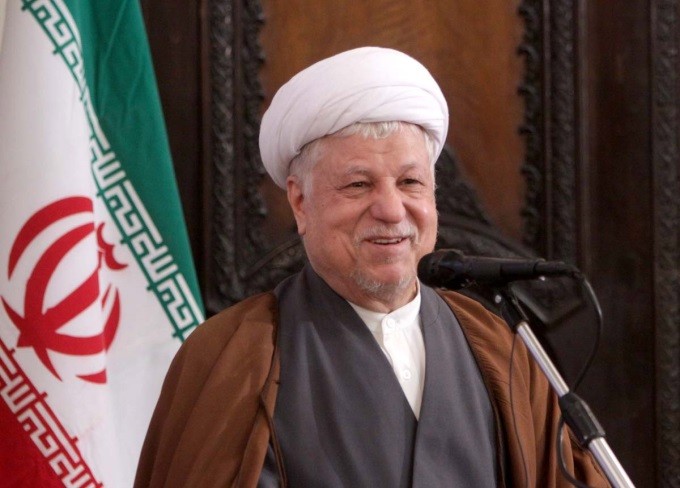
Iranian former president Ali Akbar Hashemi Rafsanjani has died, and with his death the moderate reform wing of Iranian politics has lost perhaps its leading figure. Rafsanjani was one of the most prominent proponent of the Islamic Revolution in Iran in 1979 but he sided with the Green Movement, the movement against hard-line Islamic rule, in 2009. The strength of the reform movement was evident in the crowds–estimated at about 2 million–that packed the streets for his funeral.
Ali Akbar Hashemi Rafsanjani
Between 1980 and 2014 the U.S. lost 6.7 million manufacturing jobs and President-elect Trump was elected largely because he promised to bring these jobs back. But manufacturing employment is not the same thing as manufacturing. In fact, the US remains a pre-eminent manufacturing country in the world. According to Mark Muro, writing in MIT’s Technology Review:
“In fact, the total inflation-adjusted output of the U.S. manufacturing sector is now higher than it has ever been. That’s true even as the sector’s employment is growing only slowly, and remains near the lowest it’s been. These diverging lines—which reflect improved productivity—highlight a huge problem with Trump’s promises to help workers by reshoring millions of manufacturing jobs. America is already producing a lot.”

Jobs are not being outsourced anymore–they are being eliminated by robots and automation. Amazon is a classic example of how this transformation is playing out:
“The world’s largest e-commerce retailer said it has 45,000 robots in some 20 fulfillment centers. That’s a bigger headcount than that of the armed forces of the Netherlands, a NATO member, according to World Bank data. It’s also a cool 50 percent increase from last year’s holiday season, when the company had some 30,000 robots working alongside 230,000 humans.”
It is not clear how this transformation can be slowed down, but the political dissatisfaction with which it is associated is toxic to democracy.
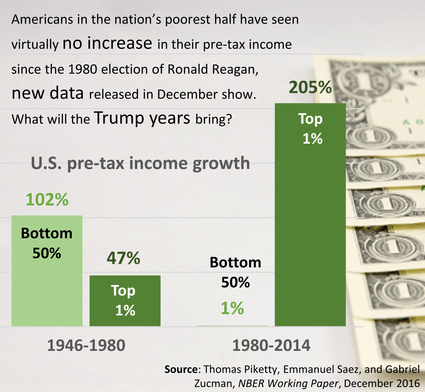
Thomas Piketty, Emmanuel Saez, and Gabriel Zucman have published a new paper with the National Bureau of Economic Research. I cannot provide a link to the paper that will work for everyone but the NBER will send you a copy of the paper (Thomas Piketty, Emmanuel Saez, Gabriel Zucman, Working Paper 22945, http://www.nber.org/papers/w22945) if one is requested. The paper looks at the distribution of income in the US since 1913 looking at pre- and post-tax income to capture the effects of government subsidies such as food stamps, etc. Their conclusions suggest that the government re-distributional programs do not compensate for the loss of earned incomes:
“We estimate the distribution of both pre-tax and post-tax income, making it possible to provide a comprehensive view of how government redistribution affects inequality. Average pre-tax national income per adult has increased 60% since 1980, but we find that it has stagnated for the bottom 50% of the distribution at about $16,000 a year. The pre-tax income of the middle class—adults between the median and the 90th percentile—has grown 40% since 1980, faster than what tax and survey data suggest, due in particular to the rise of tax-exempt fringe benefits. Income has boomed at the top: in 1980, top 1% adults earned on average 27 times more than bottom 50% adults, while they earn 81 times more today. The upsurge of top incomes was first a labor income phenomenon but has mostly been a capital income phenomenon since 2000. The government has offset only a small fraction of the increase in inequality. The reduction of the gender gap in earnings has mitigated the increase in inequality among adults. The share of women, however, falls steeply as one moves up the labor income distribution, and is only 11% in the top 0.1% today.”
The decline in income for the poor and middle class is real and not addressed by current social and economic programs.
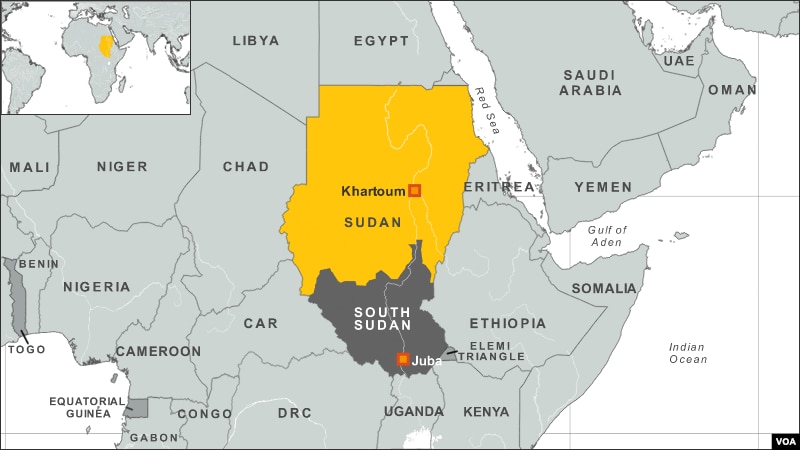
South Sudan was created in 2011 and is the planet’s newest country. It was created in an attempt to stop the violence against the people in the south from their own government in Khartoum. But the country has been plagued by violence since 2013 and almost 50,000 people have been killed and 2.3 million displaced. The violence in South Sudan is largely explained by the political competition between two leaders, Salva Kiir, the leader of the Dinka ethnic group, and Riek Machar, the leader of the second largest ethnic group, the Nuers. The rivalry between the two leaders has continued despite the attempts of other African states to mediate the crisis. It seems unlikely that the dispute will be settled soon.
Jewish Community Centers in Florida, Tennessee, Delaware, New Jersey, and South Carolina were targeted by bomb threats today. Authorities have yet to determine whether these threats were coordinated by an individual or a group, but the possibility of a systematic effort to intimidate Jewish people cannot be discounted. As such, the threats represent yet another danger to the American polity. The surge of ethnic, racial, and religious nationalism in the US continues abated.

