Archive for the ‘World Politics’ Category
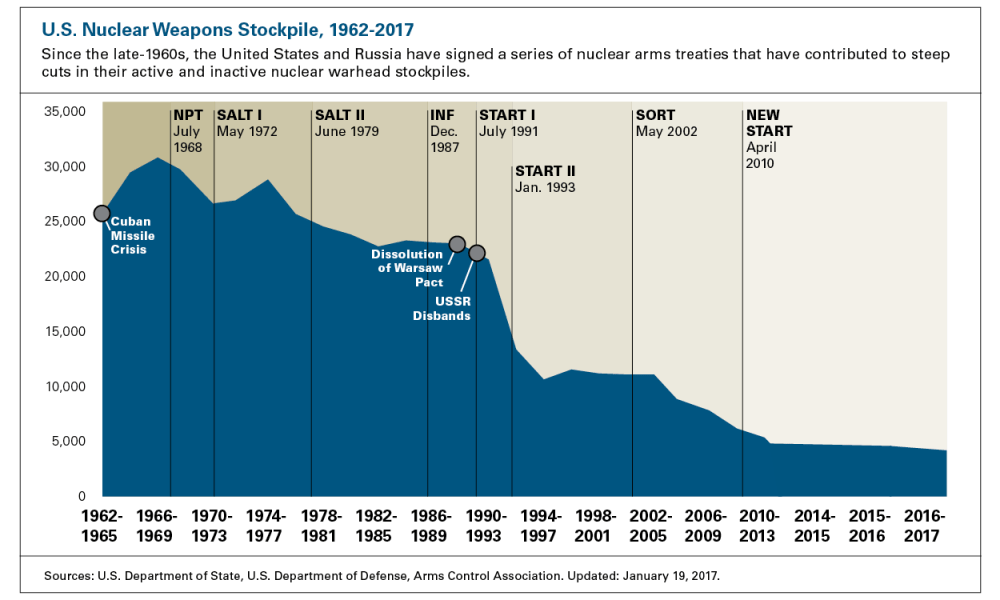
NBC News is reporting that at a meeting in July with top military staff, US President Trump indicated that he wanted a ten-fold increase in the number of nuclear weapons possessed by the US. The report also states that Mr. Trump’s request “rattled” the military staff and represented a return to the arsenal the US possessed in the 1960s, at the height of the Cold War. The US never needed 30,000 nuclear weapons, even at that time. That number merely reflects a mindless arms race between the US and the then-Soviet Union in which both sides thought that a willingness to spend and build weapons was a measure of credibility. The actual number of nuclear weapons to deter a nuclear attack in a world in which the delivery of nuclear weapons is assured, even after a devastating nuclear attack, is probably on the order of about 200 weapons–enough to destroy completely the country that launched the first strike. The comments, if accurately reported, suggest a terrifyingly dismal understanding of nuclear deterrence and, again if accurately reported, justifies the Secretary of State calling the President a “moron”.
The rescheduled Kenyan elections were thrown into disarray when the leading opposition candidate, Raila Odinga, announced that he would not run. The Presidential elections held last August were nullified by the Kenyan Supreme Court because of election irregularities. A new election between Odinga and the current President, Uhuru Kenyatta, was scheduled for 26 October but Odinga dropped out because he did not believe that enough has been done to assure the integrity of the new election. It is not clear what the next step will be. Odinga’s National Super Alliance (NASA) party may find a new candidate, or Kenyatta may run unopposed. Odinga has called for national protests and the uncertainty will roil Kenya for some time into the future.
Raila Odinga

Israel has announced that it intends to build 4,000 new homes in settlements in the Occupied West Bank. The plans include homes in Hebron which has not been part of the settlement process as of yet. According to The Daily Star:
“…..if the Hebron housing is approved it would be the first time for the southern West Bank city since 2002.
“Hebron is home to around 200,000 Palestinians, with about 800 settlers living under Israeli army protection in several heavily fortified compounds in the heart of the city.”
The Trump Administration responded to questions about the proposal:
“A U.S. official said ‘while we are not going to respond to every announcement or report, our policy toward settlements remains unchanged.
“‘The administration has made clear that unrestrained settlement activity does not advance the prospect for peace. At the same time the administration recognises that past demands for a settlement freeze have not helped advance peace talks.'”
Most states regard the building of settlements in Occupied Territories to be a violation of Article 49 of the Fourth Geneva Convention which reads:
Article 49
Individual or mass forcible transfers, as well as deportations of protected persons from occupied territory to the territory of the Occupying Power or to that of any other country, occupied or not, are prohibited, regardless of their motive.
Nevertheless, the Occupying Power may undertake total or partial evacuation of a given area if the security of the population or imperative military reasons so demand. Such evacuations may not involve the displacement of protected persons outside the bounds of the occupied territory except when for material reasons it is impossible to avoid such displacement. Persons thus evacuated shall be transferred back to their homes as soon as hostilities in the area in question have ceased.
The Occupying Power undertaking such transfers or evacuations shall ensure, to the greatest practicable extent, that proper accommodation is provided to receive the protected persons, that the removals are effected in satisfactory conditions of hygiene, health, safety and nutrition, and that members of the same family are not separated.
The Protecting Power shall be informed of any transfers and evacuations as soon as they have taken place.
The Occupying Power shall not detain protected persons in an area particularly exposed to the dangers of war unless the security of the population or imperative military reasons so demand.
The Occupying Power shall not deport or transfer parts of its own civilian population into the territory it occupies.
Occupied West Bank

Andrew J. Nathan has written a very nuanced essay entitled “The Chinese World Order” for the current issue of the New York Review of Books. The essay reviews several recently written books on the rise of China and the extent to which China represents a serious threat to either American interests or to the liberal international order once supported by the US. Nathan importantly addresses the major issue concerning China’s return to global power: what concessions should both sides make to each other as a new balance of power is established in the world? Unfortunately, he does not answer the question, but poses the risks of the recalibration of power in the world system:
“Some have suggested that the US scale back its position in Asia to accommodate China’s desire for greater military influence in its own region. In his 2011 book On China, Henry Kissinger proposed that the two sides agree on a ‘Pacific Community’—’a region to which the United States, China, and other states all belong and in whose peaceful development all participate.’ Graham Allison’s ideas for how to avoid war are equally anodyne: ‘Understand what China is trying to do,’ ‘Do strategy,’ and ‘Make domestic challenges central.’
“Other strategists have been more specific, proposing that the US and China establish a mutually acceptable security balance by making concessions to each other over Taiwan, the Senkakus, military deployments, and offensive and defensive missile systems. Through such an approach, Washington and Beijing could demonstrate that each does not seek to threaten the other’s core security interests.4
“The difficulty with such proposals is that Beijing is likely to interpret them as asking it to accept an intrusive American presence just when the shifting power balance should allow that situation to be corrected. And on the US side, yielding preemptively to Chinese ambitions would destroy its credibility with all of its allies, not only in Asia but elsewhere as well. The resulting destabilization would not serve American or Chinese interests.
The question we all face is whether the Americans and the Chinese are wise enough to respect each other’s interests without compromising their own central interests. A difficult political task in any circumstance.

Catalan President Carles Puigdemont has asked for talks with Madrid on Catalonian independence. He thus avoids an immediate crisis over Catalonian secession. Addressing the Catalonian parliament in Barcelona, Puigdemont said: “We propose the suspension of the effects of the declaration of independence for a few weeks, to open a period of dialogue.” Whether both sides can now back off from a major crisis remains to be seen. But the last few days have seen major pushbacks to Catalonian independence by many Catalan protestors as well as by the European Union which stated that Catalonia, if independent, could not be a part of the Union.

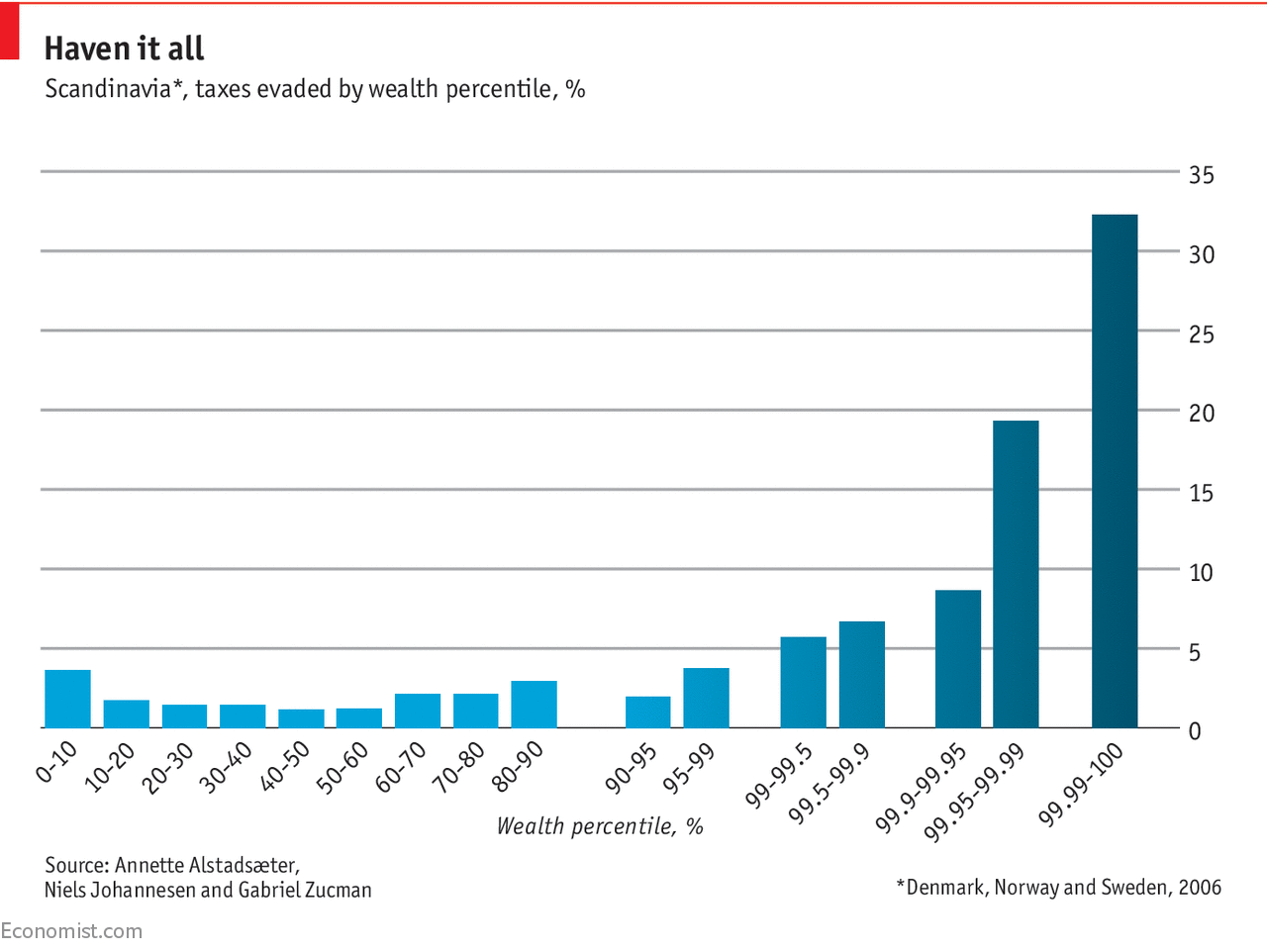
A new study by three economists, Annette Alstadsæter, Niels Johannesen and Gabriel Zucman, has provided more detailed information on tax dodging in the world. Using leaked information from two sources (from accounts held in Switzerland by the bank, HSBC, and from a Panamanian law firm, Mossack Fonseca), the economists were able to determine the degree of income hidden from tax authorities by individuals in Denmark, Norway and Sweden. The Economist summarized the conclusions of this paper in this way:
“First, tax evasion is extremely concentrated. The average Scandinavian household paid around 3% too little in taxes in 2006; the richest 1% of households, with net assets of at least $2m, underpaid by around 10%. The truly rich, though, behave truly differently. The top 0.01% of households, with net assets of over $40m, short-changed the taxman by a whopping 30%.
“Second, the numbers imply that previous estimates of wealth inequality, often based on tax data, have understated the problem. And the Scandinavian statistics may provide a conservative estimate of worldwide tax-dodging: only around 2% of Scandinavian household wealth is held in offshore accounts, compared with the global average of 4%.”
Unfortunately, globalization has made tax evasion more possible, but it favors the owners of capital far more than those who earn their incomes through labor.
Iran is emerging as a central preoccupation of the Trump Administration, yet there is little sustained analysis of Iranian intentions or capabilities beyond flat assertions that Iran is “hostile” to the US. There is little question that many of Iran’s current policies are at odds with American objectives, but there are also important points of agreement that have never been exploited: Iran is as hostile to the Taliban in Afghanistan as is the US and Iran also shares concerns over the Wahhabist interpretations of Islam propagated by Saudi Arabia that seems to fuel many extremist groups. Kenneth Pollack is a centrist on Middle Eastern issues and he has written an well-informed and nuanced interpretation of Iran’s foreign policy objectives that deserves careful attention.
US-Turkish relations continue to deteriorate as Turkey arrested two workers in the US consulate in Ankara on suspicion that they had ties to Fethullah Gulen, a Turkish cleric living in exile in the US and who is suspected of leading a coup against President Erdogan last year. In response, the US announced that it would not issue any new travel visas from that consulate to Turks who wish to travel to the US. TUrkey reciprocated by making a similar announcement to US visitors to Turkey. The Turkish currency, the lira, fell on hearing the news, as did the Turkish stock market.
Dexter Filkins has written an impressive essay on the tenure of Rex Tillerson as US Secretary of State for the New Yorker magazine. It is a long and detailed essay, but is particularly well-informed and touches on many aspects of the complicated relationship between multinational corporations, such as ExxonMobil, and home and host governments. It also provides some important insights into the internecine warfare that seems to be endemic to the current Administration. If, as I suspect, that Tillerson leaves the State Department fairly soon, the essay will provide an important context to how to interpret what might come after he leaves. This essay complements an earlier essay in Foreign Policy by Derek Chollet which was published before the current controversy,
There were hundreds of thousands of Catalans in Barcelona protesting the independence movement supported by the regional government. The protests are a clear sign of how divided the region is on the issue of independence. Spanish Prime Minister Mariano Rajoy is playing a hardball game against the secessionists, threatening to remove the autonomous status of the region if independence is declared. Pro-independence Catalans, however, continue to believe that Catalonia should declare independence.
Pro-Spain Protesters

The Urban Institute has published a study on wealth inequality in the US and it shows that it is worsening significantly over time. Additionally, the report breaks down both wealth and income inequality by race and ethnicity and the discrepancies among these groups is even more distorted. The summary from the report reads as follows:
Average wealth has increased over the past 50 years, but it has not grown equally for all groups. Between 1963 and 2016,
- families near the bottom of the wealth distribution (those at the 10th percentile) went from having no wealth on average to being about $1,000 in debt,
- those in the middle more than doubled their wealth,
- families near the top (at the 90th percentile) saw their wealth increase fivefold,
- and the wealth of those at the 99th percentile—in other words, those wealthier than 99 percent of all families—grew sevenfold.
These changes have increased wealth inequality significantly. In 1963, families near the top had six times the wealth (or, $6 for every $1) of families in the middle. By 2016, they had 12 times the wealth of families in the middle.
The trend toward greater income and wealth inequality cannot be sustained politically or economically indefinitely. At some point, the legitimacy of the system will be completely undermined.

One reason why wealth inequality has deepened so significantly can be found in the chart below. Those that had enough money to buy stocks have been greatly enriched. Unfortunately, most Americans do not own stocks directly. Moreover, globalization has repressed wage growth as the balance of economic power has shifted away from labor and more to those owning capital.

The Catalonian independence referendum did not mysteriously appear. As this chart from Zero Hedge indicates, the independence movement has a very long and deep history. Estat Catalá even has its own Facebook Page. The chart also highlights the historical tension between the regional sentiments and the fascist leanings of the central government although the current Spanish government does not fall into that category.

As Congress begins to debate tax reform and President Trump begins to unravel President Obama’s Climate Change Program, it is instructive to read Oil Change International’s report on fossil fuel subsidies. The summary of the report suggests that significant revenue could be generated by ending tax subsidies for the fossil fuel industries:
- The United States federal and state governments gave away $20.5 billion a year on
average in 2015 and 2016 in production subsidies to the oil, gas, and coal industries,
including $14.7 billion in federal subsidies and $5.8 billion through state-level incentives.
At the state level, this is likely a significantly conservative estimate, given limits to
available data.
- Repeated proposals by the Obama White House to remove some of the most damaging
federal subsidies were thwarted in large part due to the cozy relationship between
Congress and the fossil fuel industry. In the 2015-2016 election cycle oil, gas, and coal
companies spent $354 million in campaign contributions and lobbying and received
$29.4 billion in federal subsidies in total over those same years – an 8,200% return
on investment.
- The cost of federal fossil fuel subsidies to American taxpayers is equivalent to the
projected 2018 budget cuts from Trump’s proposals to slash 10 public programs and
services, including supports for America’s most vulnerable children and families.
Misplaced priorities, not a scarcity of resources, are driving this administration’s efforts
to balance the national budget at the expense of the most vulnerable.
The fossil fuels industries receive significantly greater subsidies than do the industries producing renewable energy.
/cdn.vox-cdn.com/uploads/chorus_asset/file/9395827/OCI_US_Fossil_Fuel_Subs_2015_16_comparison.jpg)
The White House press secretary, Sarah Sanders, indicated today that President Trump will give a speech this week addressing what he perceives as the threats from Iran. Sanders said:
“The president isn’t looking at one piece of this. He’s looking at all of the bad behavior of Iran. Not just the nuclear deal as bad behavior, but the ballistic missile testing, destabilizing of the region, Number One state sponsor of terrorism, cyber attacks, illicit nuclear program”. Sanders added that Trump “wants to look for a broad strategy that addresses all of those problems, not just one-offing those. That’s what his team is focused on and that’s what he’ll be rolling out to address that as a whole in the coming days.”
That list is long and apparently Mr. Trump will start out by refusing to certify that the Iranian nuclear deal does not serve the US national interest. There were no clues about what the new policy toward Iran will consist of.
New polls suggest that Americans increasingly believe that global warming is actually occurring. For the first time in many years, even a majority of Republican voters believe that global warming is occurring. But the split between Democrats and Republicans on the issue remains quite large.


A Russian official, Anton Morozov, said today that North Korea intends to test a long-range ballistic missile capable of reaching the American homeland sometime in the very near future. Morozov is a member of the Russian Parliament and his party is known for its intense nationalism. North Korea has tested 14 missiles this year, and a missile aimed at the US would have to fly over Russian territory, a trajectory which would complicate American efforts to shoot down the missile. The Russians have recently stepped up efforts to strengthen North Korean military defenses.
The Washington Post is running an article that asserts that US President Trump plans to decertify the Iranian nuclear deal and will make a speech next week arguing that the deal is not in the US national interest. As indicated in an earlier blog post on 3 October, Trump’s Defense Secretary Mattis has testified before the Senate Armed Service Committee that the US should uphold the agreement. The Post is suggesting that Trump would refer the matter to the US Congress which would then have 60 days to decide whether to reimpose sanctions on Iran. None of the other partners to the agreement (China, France, Germany, Great Britain, Iran, and Russia) appear to be willing to renegotiate the agreement. Under those circumstances it is not clear what would happen to the agreement. If the Congress does not reimpose sanctions, then the agreement would probably stand. If the US decides to reimpose sanctions, then Iran would likely pull out as well.
There is a curious contradiction coming out of this news. If the US does pull out of the agreement without any clear evidence that Iran has violated the terms of the agreement, then the rest of the world will likely ask whether the US can be trusted to honor its word. This doubt will undoubtedly affect North Korea’s perception of any deal that the US might offer to defuse the current nuclear impasse. I suspect that North Korea would not sign any agreement with the US if it pulls out of the Iranian agreement. Which leaves war as the only option for for sides.
One of the reactions to the Catalonian independence referendum has been an increase in Spanish nationalism, a political force that had been somewhat dormant in Spain because of its association with Spain’s fascist past. The reaction may be simply a response to a fear that Spain will be pulled apart–there are other separatist movements in Spain, such as sentiment in the Basque region–, but it may also be part of the nationalist movements responsible for the British exit from the European Union or the rise of the right-wing party, Alternative for Germany, in Germany. Nationalist sentiment is also highly visible in the US, China, Russia, and India, to speak only of some of the great powers. A similar increase in nationalist sentiment preceded World War I in 1914.
Regions in Europe that Have Movements Toward Greater Autonomy or Independence

The US relationship to Puerto Rico is difficult to articulate. The US gained control over the island in the Spanish-American War of 1898 and anyone born in Puerto Rico is a natural born citizen of the US. But Puerto Ricans cannot vote in federal elections, pay no federal income tax, and have no vote in the US Congress. In the most recent referendum held in Puerto Rico in 2017 on its future, 97% of the voters favored statehood but only 23% of the registered voters actually voted so no action was taken. But the relationship between the US and Puerto Rico has always been shaped by early colonial attitudes prevalent in the US in the early 20th century. Those attitudes were best expressed by Senator Beveridge (Indiana) who said in a speech in 1898:
“The opposition tells us that we ought not to govern a people without their consent. I answer, the rule of liberty that all just government derives its authority from the consent of the governed, applies only to those who are capable of self-government. We govern the Indians without their consent; we govern our territories without their consent; we govern our children without their consent. I answer, would not the natives of the Philippines prefer the just, humane, civilizing government of this Republic to the savage, bloody rule of pillage and extortion from which we have rescued them? Do not the blazing fires of joy and the ringing bells of gladness in Porto Rico prove the welcome of our flag? And, regardless of this formula of words made only for enlightened, self-governing peoples, do we owe no duty to the world? Shall we turn these peoples back to the reeking hands from which we have taken them? Shall we abandon them to their fate with the wolves of conquest all about them? Shall we save them from those nations, to give them a self-rule of tragedy? It would be like giving a razor to a babe and telling it to shave itself. It would be like giving a typewriter to an Eskimo and telling him to publish one of the great dailies of the world.”
The language resonates with the tweet of US President Trump on Puerto Rico: “They want everything to be done for them”. Apparently, some attitudes never change.
Albert J. Beveridge

US Secretary of State Rex Tillerson held an unusual press conference today in which he denied reports from NBC News that he was close to reigning this past summer because of comments President Trump had made to the Boy Scouts of America. Provocatively, however, he did not directly deny having called the President a “moron”. Tillerson has been undermined by the President on several occasions, most recently when Trump tweeted that negotiations with North Korea were not worth pursuing while Tillerson was in China requesting Chinese help in supporting those negotiations. Discord between the President and his aides seems to be endemic, but seemed also to be directed toward an exclusively American audience. President Trump does not seem to be aware of how foreign audiences and foreign diplomats assess that discord–the net effect is to diminish seriously the credibility of the US in world affairs.
Dani Rodrik is one of my favorite economists–he is smart, intellectually nimble and creative, and engaging. He has written an essay whose title initially caught me short: “Why Nation-States are Good”. Economists generally have a low regard for nation-states because they impede the free flow of the factors of production and often distort markets. Rodrik, however, points out the necessary role of nation-states to establish codes of conduct that make economic transactions possible and which allow markets to coordinate activity more efficiently. It is a well-written and provocative essay.
Peace of Westphalia, 1648

On this day in 1957 the Soviet Union launched a satellite, named Sputnik, and ushered in the Space Age. The satellite was quite small and emitted only a small beep that ham radio operators on earth could hear. The scientific merits of the accomplishment, however, were vastly overshadowed by the strategic implications of the satellite. The USSR proved that it could launch what we would later call an intercontinental ballistic missile (ICBM). The reaction in the US was dramatic–immediately Americans began to ask questions about whether the US was scientifically competitive with the Soviets. More importantly, the US lost the strategic invulnerability sustained by the Atlantic and Pacific Oceans as ICBMs would ultimately be perfected so that the American homeland would be open to a Soviet rocket attack with nuclear weapons.

Defense Secretary Jim Mattis testified before the Senate Armed Services Committee and said that Iran is adhering to the terms of the nuclear agreement: “At this point in time, absent indications to the contrary, it is something the president should consider staying in”. The statement puts Secretary Mattis at odds with President Trump who believes that Iran is violating the “spirit” of the agreement by supporting Hezbollah and by its missile program. Neither of those two concerns are covered by the nuclear agreement. The President must certify to Congress whether he believes that Iran is in “material breach” of the agreement by 15 October. If the President decides to leave the agreement, it is not clear how Iran will respond.
Inside Climate News has published an article about new research on the effects of global warming on ocean water temperatures. Ocean temperatures do not fluctuate as widely as land temperatures and are therefore more reliable indices of actual temperature. Unfortunately, reliable records of ocean temperatures only go back a few decades, so it is difficult to draw conclusions. But recent studies indicate that “[t]he excess energy amassed in the oceans since 1992 is roughly equivalent to 2,000 times U.S. electricity generation during the past decade”. Moreover, “[t]he rate at which the oceans are heating up has nearly doubled since 1992, and that heat is reaching ever deeper waters”.

According to the Pew Research Center, “more than 80 countries either have an official religion or favor one or more religious groups over others”. A fifth of the 199 countries surveyed have an official religion and another fifth have a “preferred” religion. The majority of states with an official religion are Muslim and the majority of states with a preferred religion are Christian. There are some states that repress religion: “In 10 countries, the state either tightly regulates all religious institutions or is actively hostile to religion in general. These countries include China, Cuba, North Korea, Vietnam and several former Soviet republics – places where government officials seek to control worship practices, public expressions of religion and political activity by religious groups”.

Iran has sent tanks and an artillery brigade to bolster Iraqi troops at a border crossing near the Kurdish autonomous area in Iraq. Iran thus joins Iraq and Turkey in an attempt to seal off the Kurdish area after the independence referendum passed with 92% approval. Iraq has closed off air traffic into the Kurdish region and is working hard to prevent movement in and out of it. Iran and Iraq are also holding military exercises together as a show of strength to the Kurds who support independence. With such unified opposition, it is hard to see how the Kurdish independence meeting can succeed.
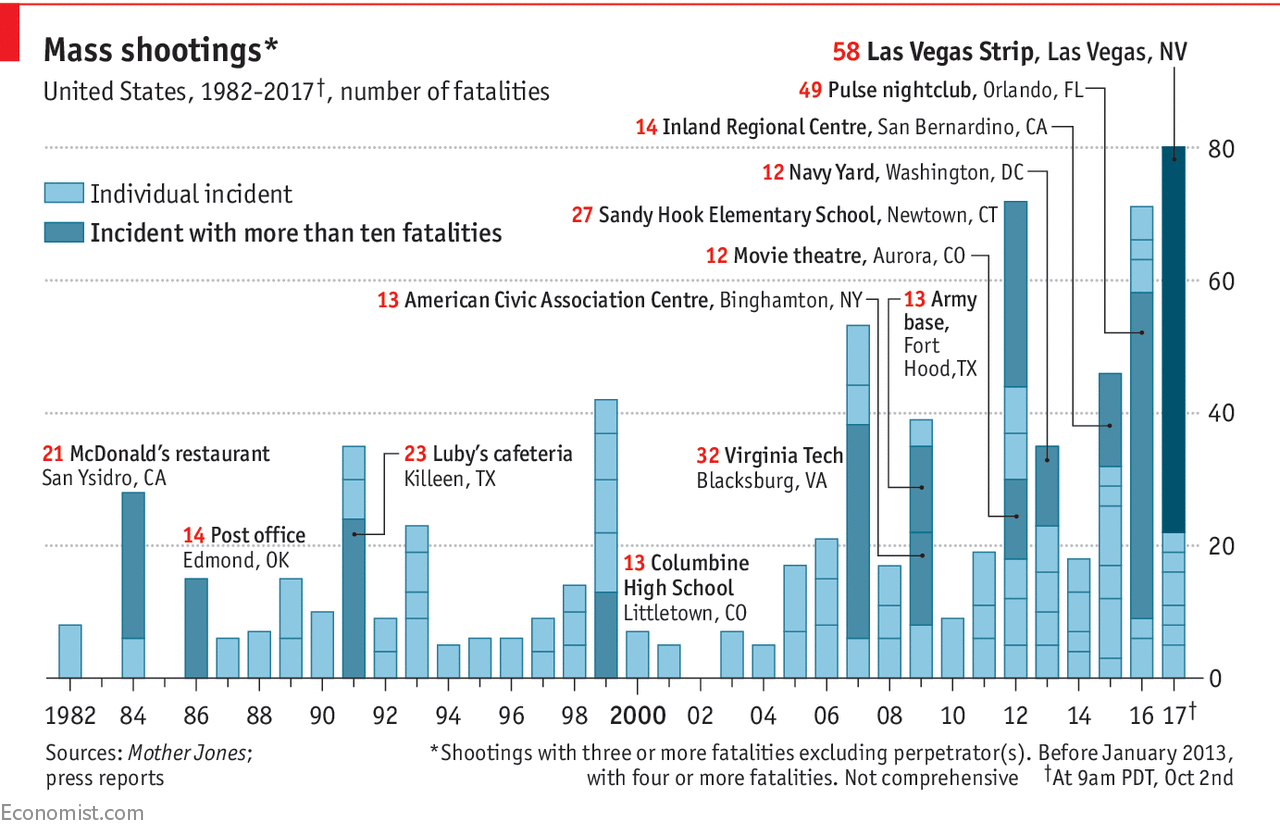
The tragedy in Las Vegas is horrific and defies analysis–there is so much we do not know and will never know. But it makes us aware of how deeply embedded violence is in many societies. And it will, one hopes, provide an opportunity for Americans to discuss more openly the phenomenon of domestic terrorism. The US spends, literally, billions of dollars on the issue of foreign terrorism, but many more Americans are killed by their fellow citizens than are killed by non-citizens. We should hope that this latest tragedy will force us to answer the question of why it is so easy for these acts of mass murder to occur.
/cdn.vox-cdn.com/uploads/chorus_asset/file/9371549/Domestic_terrorism_incidents_by_type.png)
Mass Shootings in the US, 1982-2017
There is a lot of soul-searching in Spain as the violence in Catalonia subsides to a degree. The significance of Catalonia to the entire Spanish economy has been highlighted to a high degree and the violence used to repress the referendum has shattered the legitimacy of the central government. According to The Guardian:
“With 7.45 million people, the region accounts for 16% of Spain’s population. Its €215.6bn (£191bn) economy, larger than that of most countries in the eurozone, generates more than one-fifth of Spanish GDP, while Catalonia’s exports of €65.2bn represent more than one-quarter of the national total. At about €37bn, foreign investment in Catalonia accounts for more than one-quarter of inward investment to Spain.”
Even though the European Union has verbally supported the Spanish government, the President of the Catalonian region, Carles Puigdemont, has asked for the EU to investigate the behavior of the Spanish government. The UN is likely to investigate human rights violations by the Spanish government.

 World Politics News