Please forgive me because I want to make a comment about US politics that some will regard as partisan. But I honestly believe that I would be making this point even if my brother was President of the US. President Trump retweeted some videos of presumed hostile acts being committed by Muslims. These videos were posted by a group in Great Britain, “Britain First”, which has a record of being deeply anti-Muslim. Mr. Trump’s Press Secretary, Sarah Sanders, was asked whether the President had verified the authenticity of the videos before he retweeted them. CNBC quotes Ms Sanders’s response:
“Whether it’s a real video, the threat is real”
This response is unacceptable. It is unacceptable from anyone who wishes to be taken seriously. I believe that truth does matter. That proposition does not mean that people cannot make mistakes–I accept the fact that truth is not always accessible. But I do expect people to try to the best of their ability to ascertain that they are making decisions–and in the President’s case, decisions that literally affect millions–on the basis of events that actually happened. We can disagree about how to interpret those events, but we have to agree that something happened. If we do not hold people to this standard, then we will all be hostages to the imaginations of people who may not have our best interests in mind.
“Above all, don’t lie to yourself. The man who lies to himself and listens to his own lie comes to a point that he cannot distinguish the truth within him, or around him, and so loses all respect for himself and for others. And having no respect he ceases to love.”
― Fyodor Dostoyevsky, The Brothers Karamazov
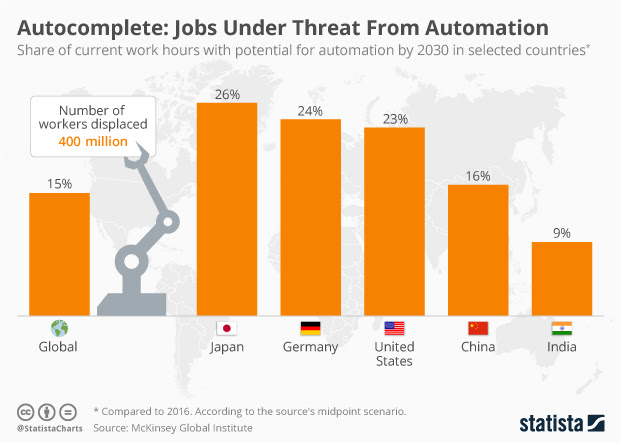
The world is going through a massive shift in work patterns, one that is in many respects similar to the transition brought about by the industrial revolution. Many jobs are being automated, a process facilitated by the development of Artificial Intelligence (AI) and robots. The McKinsey Global Institute has published a report that documents the trend:
“Taking these factors into account, our new research estimates that between almost zero and 30 percent of the hours worked globally could be automated by 2030, depending on the speed of adoption. We mainly use the midpoint of our scenario range, which is automation of 15 percent of current activities. Results differ significantly by country, reflecting the mix of activities currently performed by workers and prevailing wage rates.”
Like the industrial revolution, new jobs will undoubtedly be created. But the transition will be difficult. The new jobs will require a high degree of technical skills and will not absorb workers without advanced degrees in some technical fields. The key question is whether societies will pay for advanced training and to figure out what jobs to offer those who do not wish to develop such skills pr cannot afford to make that personal investment.
Seventy years ago, the UN passed resolution 181 which called for the creation of three zones in the British mandate of Palestine: a Jewish Zone, an Arab Zone, and an internationalized city of Jerusalem. It is a day of celebration in Israel a state for which many Jews had demanded since the end of the 19th Century. Palestinians, however, regard the day as a catastrophe (nabka in Arabic). The UN plan is still very far from being implemented, and that failure led to one of the most contentious issues in the world. There is no reason to believe that there is any solution in the near future: the borders have dramatically changed in the past and are still being redrawn as demographic and political changes evolve. The current governments of both Israel and the Palestinian Authority do not seem interested in pursuing meaningful negotiations to establish a permanent basis for peace.
Evolution of Control over the Palestine Mandate
Mount Agung in Indonesia has erupted on a relatively small scale so far and there is no way to anticipate whether the eruptions will become more severe. As it is, the eruption is spewing sulfur dioxide and ash over a wide area, both of which have the effect of reducing solar radiation from reaching the planet’s surface. Mount Agung last experienced a “moderate” eruption in 1963 which nonetheless killed 1,600 people. According to Umair Irfan:
“We don’t know yet whether the ongoing eruption in Bali will pump out enough gas and ash to have a measurable impact on the climate, but we do know that the 1963 eruption of Mount Agung knocked down global temperatures between 0.1 and 0.2 degrees Celsius for a year.”
Researchers have calculated how global temperatures could be affected if Mount Agung’s eruptions matched those in 1963. The chart shows a rather dramatic effect on global temperatures and compares the effects of previous eruptions in other volcanoes in the past.
One can watch the eruption in real time via a CCTV connection from this site:
North Korea launched what appears to be an Intercontinental Ballistic Missile (ICBM). We will need to wait for more specific details, but initial reports suggest that it flew to a height of about 3000 miles but only about 500 miles from the launch site. The trajectory suggests that the North Koreans were primarily interested in the re-entry process–an important detail to determine whether a warhead could survive the heat of re-entry into the atmosphere. The trajectory also suggests that the possible range of the missile could be quite extensive, possibly even to the east coast of the United States. The missile was also apparently launched around 3:00 am in North Korea, a timing that hints that the North Koreans are interested in launching missiles when overhead satellites might not be able to pick up images of a launch preparation.
The launch comes after two months of quiet. North Korean testing has historically tapered off at the end of the calendar ear, but many analysts had been hoping that the period of relative quiet suggested perhaps a new North Korean attitude, perhaps because of US threats or Chinese pressure. Those explanations may be partially true, but there is no way for us to know. President Trump issued a very low-key response to the test, saying that the US would “handle it”. It is difficult to interpret the statement, but the ratcheting down of rhetoric is perhaps important. President Trump also consulted with South Korean President Moon so it seems probable that the two allies are coordinating their responses.
What is unknown is the extent to which President Trump considers such tests to be the essential “red line” in terms of a threat to the US homeland. His previous statements indicate that he thinks that allowing the US homeland to be at risk of a North Korean nuclear attack is completely unacceptable. This test indicates that North Korea is very close to that red line, perhaps one that will crossed definitively next year at the latest. Thus, the question is how much lead time President Trump believes he has until he invokes a preventive strike to foreclose that option to North Korea. If and when such a strike occurs, the US will classify the strike as “pre-emptive”. It is important to keep in mind that a pre-emptive strike only exists in the context of an imminent attack by an enemy. I doubt very much that North Korea has any intention of attacking the US homeland–such a attack would be an invitation to suicide. Thus, a US strike to deny the North Koreans from developing the capability to hit the US homeland in the absence of an imminent attack must be classified as a preventive strike. According to the Pew Research Center, Americans are split on the justification for a pre-emptive strike. The Just War tradition does not support a preventive strike.
On this day in 1095, Pope Urban II called for a “crusade” against Muslims occupying what he considered the “holy places” of Christianity. He ordered Christians to retake those lands because “Deusvult!” or “God wills it!”. Christian pilgrims had been traveling to these areas since the 6th Century, but when the Seljuk Turks occupied Jerusalem in 1042 the city was closed to Christians. When the Turks threatened the Byzantine Empire, its leader, Alexius I, appealed to the Pope for help. At the Council of Clermont Pope Urban gave a rousing speech which was not transcribed, but in one of the five versions of the speech written down by others, he exhorted the faithful in this manner:
“All who die by the way, whether by land or by sea, or in battle against the pagans, shall have immediate remission of sins. This I grant them through the power of God with which I am invested. O what a disgrace if such a despised and base race, which worships demons, should conquer a people which has the faith of omnipotent God and is made glorious with the name of Christ! With what reproaches will the Lord overwhelm us if you do not aid those who, with us, profess the Christian religion! Let those who have been accustomed unjustly to wage private warfare against the faithful now go against the infidels and end with victory this war which should have been begun long ago. Let those who for a long time, have been robbers, now become knights. Let those who have been fighting against their brothers and relatives now fight in a proper way against the barbarians. Let those who have been serving as mercenaries for small pay now obtain the eternal reward. Let those who have been wearing themselves out in both body and soul now work for a double honor. Behold! on this side will be the sorrowful and poor, on that, the rich; on this side, the enemies of the Lord, on that, his friends. Let those who go not put off the journey, but rent their lands and collect money for their expenses; and as soon as winter is over and spring comes, let hem eagerly set out on the way with God as their guide.”
One of the more interesting changes in US President Trump’s foreign policy is the shift from being very critical of China as a candidate to a more benign attitude after his meeting with Chinese President Xi in April. There really has not been any change in China’s trade policies which were Mr. Trump’s main concern as a candidate. Moreover, there is little evidence that North Korea’s nuclear policies as a result of China’s influence with the country, although there is always the possibility that China has exerted pressure which is not easily comprehensible. Zack Beauchamp has written an article for Vox which suggests that one possibility for the change is Mr. Trump’s admiration for strong leaders such as Russian President Putin. President Xi certainly fits that profile but that seems to me to be a small price to pay for being able to continue trade and investment policies which can hardly be described as “free”.
“In an economic climate where the top 1% own half the world’s wealth, a new analysis by Credit Suisse suggests that millennials in several advanced economiesare likely going to face the worst income inequality of any generation in recent memory. The report, which focuses on the US, Germany, France, and Spain, shows that millennials are generally saddled with more student debt, less inherited money, and stricter mortgages than previous generations. At the same time, a lucky few are set to become spectacularly wealthy, widening the already large gap between rich and poor.”
This inequality will not automatically “correct” itself. It can only be corrected by political action focused on redistribution. The natural tendency of the market is to further concentrate income and wealth as suggested by Thomas Piketty in his book, Capital in the 21st Century.
In a telephone call to Turkish President Recep Tayyip Erdogan, President Trump announced that the US would no longer send arms to the Kurds in Syria and Iraq. Despite being loyal allies in the fight against Daesh (the Islamic State) and bearing the burden of the ground war, the US has left the Kurds without a major supporter. The decision was made without consultation with the US Defense Department or the State Department whose officials were caught unaware of the change. Dropping a loyal ally could hardly inspire other allies, and I fight it hard to believe that Turkey or Iran will reward the US for abandoning their enemies, the Kurds.
Climate change is difficult to assess since the effects, although global, will only be experienced locally. But researchers have come up with a way to represent visually the changes about which we should be concerned. David Roberts assesses the attempt by the Intergovernmental Panel on Climate Change (IPCC) to demonstrate the risks (“Reasons for Concern”, RFC) of climate change graphically. Roberts explains the graph:
“The thermometer on the right shows temperatures relative to preindustrial levels; the thermometer on the left shows them relative to 1986-2005. The distance between the two blue lines is warming that occurred through 2005. (As that note on the right indicates, warming is up a bit 2003-2012.)”
“Following the IPCC, risks are divided into five buckets or RFCs:
Risks to unique and threatened systems. These are ecological or human systems that are geographically constrained and have a high degree of “endemism” — they are uniquely adapted to a particular geography and climate. The authors cite as examples “tropical glacier systems, coral reefs, mangrove ecosystems, biodiversity hotspots, and unique indigenous communities.”
Risks associated with extreme weather events. This is what it says, i.e., “risk to human health, livelihoods, assets, and ecosystems from extremes such as heat waves, heavy rain, drought and associated wildfires, and coastal flooding.”
Risks associated with the distribution of impacts. This reflects the fact that some groups will be hit earlier and harder than others. Distribution of impacts can be uneven with respect to “geographic location, income and wealth, gender, age, or other physical and socioeconomic characteristics.”
Risks associated with global aggregate impacts. This refers to “impacts to socio-ecological systems that can be aggregated globally according to a single metric such as lives affected, monetary damage, number of species at risk of extinction, or degradation and loss of a number of ecosystems at a global scale.”
Risks associated with large-scale singular events. These are the much-discussed “tipping points,” whereby a series of incremental changes pushes some system over a threshold, at which point it shifts into a period of rapid, discontinuous, and sometimes irreversible change. The iconic example here is “disintegration of the Greenland and West Antarctic ice sheets leading to a large and rapid sea-level rise.”
There is too much information to grasp quickly, but the graph is worth careful study.
“Tehreek-e-Labaik blames the law minister, Zahid Hamid, for wording in an electoral law that changed a religious oath proclaiming Mohammad the last prophet of Islam to the words “I believe”, a change the party says amounts to blasphemy.
“The government put the issue down to a clerical error and swiftly changed the language back.”
Pakistan has ordered the army to put down the protests which have occurred in a large number of cities: Karachi, Islamabad, Lahore, Gujranwala and Faisalabad.
“There can be no safe or dignified returns of Rohingya to Myanmar while a system of apartheid remains in the country, and thousands are held there in conditions that amount to concentration camps. Returns in the current climate are simply unthinkable.
“Myanmar and Bangladesh have clear obligations under international law not to return individuals to a situation in which they are at risk of persecution or other serious human rights violations.
“The fact the United Nations and the international community have been completely sidelined from this process does not bode well for ensuring a robust voluntary repatriation agreement that meets international standards.”
The details of the proposed repatriation have not been disclosed and there is little question that Bangladesh has been heavily burden taking care of the refugees with very little help from the international community. But how such a repatriation could be safely managed is difficult to imagine.
Refugees from the civil war in Syria and other conflict zones in the Middle East and Africa continue to enter Turkey and then try to enter the European Union (EU) through Greece. By agreement with Turkey, the refugees are held in five Greek islands in the Aegean Sea: Samos, Lesbos, Chios, Kos or Leros. The conditions in these refugee camps are deplorable and the processing of the refugees into other states in the EU is painfully slow. As winter begins, the lives of these refugees will only worsen, but there is little evidence that the EU will take the actions necessary to ameliorate the circumstances. Opposition to allowing more refugees is very strong in the eastern and central European states, and the political impasse in Germany hamstrings the most powerful government advocating better treatment of the refugees.
I highly recommend reading the book review in the London Review of Books by Steven Mithen on the new book by the Yale political theorist, James C. Scott, Against the Grain: A Deep History of the Earliest States. Scott’s argument is highly speculative and goes against the grain of the generally accepted understanding of human evolution. He asserts that the shift from hinting and gathering to agriculture was a profoundly negative development, leading to the possibility of centralized government and all sorts of negative health and social effects. The review is highly informed by Mithen’s own work on early human societies and his general knowledge of hunters and gatherers throughout history. It is a detailed read but well worth the effort.
There are times when irony is especially delicious, and what better day for a word treat for an American than Thanksgiving? US President Trump spoke to US soldiers abroad from his Florida resort, Mar-a-Lago, telling them about successes against Daesh (the Islamic State). US News and World Reports describes the speech in these words:
“Trump said the Marines were inflicting ‘defeat after defeat’ on Islamic State, and again credited his change of approach compared to that of the Obama administration.
‘They weren’t letting you win before; they were letting you break even. … They weren’t letting you win.'”
In a completely different part of the world, the leader of Iran, a sworn enemy to President Trump, thanked his troops for their successes against Daesh. According to the Tehran Times:
“Thanking Quds Force Commander General Qassem Soleimani for congratulating him on the fall of Daesh in both Syria and Iraq, the Leader of the Islamic Revolution issued a message in which he said the defeat of Daesh dealt a great blow not only to this sinister and repressive group it also came as greater blow to those who created civil war in the region with the aim of destroying the anti-Zionist groups and weakening independent governments.”
It is a strange world when the enemy of my enemy remains my enemy.
Ratko Mladić, the former Serb commander known as the “butcher of Bosnia” has been convicted of genocide, war crimes and crimes against humanity and sentenced to life imprisonment. The judgment was rendered by the UN tribunal set up at the Hague to adjudicate war crimes in the former Yugoslavia. Mladić was chief of staff of the Serbian forces in Bosnia from 1992-96 during which horrific atrocities were committed against the Bosnian people in an effort to “ethnically cleanse” the region of non-Serbs. He was arrested in 2011 and his trial took over 4 years. He never showed any sign of remorse for the crimes for which he was responsible.
Memorial for Those Slaughtered at Srebenica
The US has finally acknowledged that the treatment of the Royingha in Myanmar constituted “ehtnic cleansing”. The statement by US Secretary of State Tillerson was long overdue and was accompanied by a vague promise that the US “may” impose sanctions on the government of Myanmar. The statement read, in part:
“Those responsible for these atrocities must be held accountable. The United States continues to support a credible, independent investigation to further determine all facts on the ground to aid in these processes of accountability. We have supported constructive action on the Rakhine crisis at the UN Security Council and in the UN General Assembly’s Third Committee. The United States will also pursue accountability through U.S. law, including possible targeted sanctions.”
“Ethnic cleansing” is not a recognized term in international law. But the treatment of the Royinghya is clearly a crime against humanity. We will have to see if the US takes any effective actions against Myanmar.
About a dozen US State Department officials have charged Secretary of State Tillerson with violating the Federal law designed to stop foreign militaries from using Child Soldiers. The Child Soldier Prevention Act (CSPA) was passed in 2008 and requires that countries that conscript children for the military be excluded from US military assistance. An Action Memo for the Secretary dated 21 June 2017 identified the following countries as using children under the age of 18 in their military: Afghanistan, Mali, Democratic Republic of Congo, Iraq, Burma, Nigeria, Somalia, Sudan, South Sudan, Syria, and Yemen. Secretary Tillerson decided to ignore the unanimous recommendations of his staff and excluded Iraq, Burma, and Afghanistan from the prohibited list. The decision triggered off the use of what is known as a “dissent channel” for the State Department officials who opposed Tillerson’s decision. The dissent channel memo can be accessed here. The dissent memo indicates a high degree of opposition to Secretary Tillerson’s decision.
Researchers at the University at Oxford and the University of Leeds have come up with a very interesting index which purports to show rising global temperatures in real time. The researchers spell out the assumptions of the model and what exactly they measured to come up with the index. I lack the credentials to verify the legitimacy of the index, but the data underlying the model seem solid. Its accuracy, however, is probably less important than its ability to remind us that climate change is real.
President Mugabe has apparently resigned, although one cannot be sure that his decision to resign is final. Now the question is what is next for Zimbabwe? According to the constitution, Vice-President Emmerson Mnangagwa should succeed Mugabe, but, given that Mugabe fired Mnangagwa, it is not clear if he is still the legal Vice-President. If he does become President, it is doubtful that the economic situation in Zimbabwe will improve. Mnangagwa is reputed to be as corrupt as Mugabe. There are not any real good choices for the upcoming election in 2018 if those elections are actually held.
Joy in the Streets of Harare After News of Mugabe’s Resignation

/cdn.vox-cdn.com/uploads/chorus_asset/file/9769511/Screen_Shot_2017_11_28_at_5.00.12_PM.png)


/cdn.vox-cdn.com/uploads/chorus_image/image/52647313/nature_cc_reasons_for_concern_graph.0.png)



 World Politics News