Archive for the ‘World Politics’ Category
Stars & StripesThe US Defense Department cannot account for 44,000 soldiers is a newspaper printed for the US military and it is reporting a curious story. whose locations are listed as “unknown”. That number is a small percentage of the 1.3 million personnel listed as active military in the Army, Navy, Marine Corps and Air Force. But, as we saw in Niger, even a small contingent of soldiers can be incredibly important and most members of Congress did not know of the 800 soldiers deployed in that country. And the numbers of soldiers in Syria has recently been determined to be around 2,000 and not the 500 as previously reported. If the Defense Department budget is increased in the upcoming year, perhaps the top priority should be to hire some additional accountants.
Prof. Geoffrey Rugege, is the Vice-Chancellor of the African Leadership University in Rwanda, and he has written an essay on “Ethnicity in the age of globalization”. Rugege acknowledges the toxic politics based on ethnic distinctions in many countries in the world and points out the important role European imperialism had in developing those distinctions. He goes further, however, and argues that globalization forces the world to rethink those distinctions. He argues that
“African states are the creation of European conquest, which restructured continent, and the end resulted in wars of liberation However, the continent itself, and individual states in particular, realize that there are advantages in belonging to the international system of globalization.
“There are benefits in the context of economic and political development. Tensions and conflicts will not be easily resolved, but diverse groups eventually discover common interests, mainly economic, that make ethnic differences a liability and disadvantage in the process development and nation building.”
These objectives are important, but given the ethnic tensions which seem to be growing stronger in states such as Myanmar and the treatment of the Royingha, it seems as if we are moving farther away from them, not closer. The global economy, however, seems to be inexorably bringing everyone in the world together and the overwhelming role of North America and Europe in the global economy seems to be waning. In the production of clothing and footwear, the rest of the world is clearly catching up:
“In 2018, Europe and North America will make up 49.9% of global sales of clothes and footwear, the first time they’ve represented less than half the world total. The majority of sales will instead belong collectively to Asia, Latin America, the Middle East, and Africa, and the trend is expected to continue in that direction.”
Whether our politics will catch up with our economics is an open question. Politics is largely based on nationalism; economics now seems to be completely cosmopolitan.
The news is too depressing for the first snow of the season. So, instead, here’s the newest photo of my granddaughter. The photo should bring a smile to everyone’s faces.

The statistics on wealth inequality in the US continue their worsening trend. Since the 1980s there has been a clear and undeniable concentration of wealth in the upper 1% of the American population. Edward Wolf has released a paper “Household Wealth Trends in the United States, 1962 to 2016: Has Middle Class Wealth Recovered?” NBER Working Paper No. 24085, November 2017 and his analysis is sobering:
“Over this period [1983-2016], the largest gains in relative terms were made by the wealthiest households. The top 0.1 percent saw their average wealth (in 2016 dollars) rise by over 57 million dollars or by 133 percent, that of the top 0.5 percent by over 24 million or 151 percent, and that of the top one percent by over 15 million dollars or by 150 percent. The remaining part of the top quintile experienced increases from 81 to 159 percent and the fourth quintile by 39 percent, while the middle quintile showed no change and the average wealth of the poorest 40 percent fell by $15,800. By 2016, the average wealth of the bottom 40 percent was -$8,900. “
The “trickle-down” process” is quite clearly a “trickle-up” process, from the poor to the rich. This dynamic is no doubt part of the process of political disenfranchisement which has been so evident in American politics recently. Moreover, the concentration of wealth and income restricts, not augments, economic growth. The Organisation for Economic Cooperation and Development estimates that economic growth in the OECD region lost 4.7% of it possible growth between 1990 and 2010 because of income inequality.

Beijing, like other major cities in the world, has a number of issues that compromise the lives of its citizens. Recently, authorities in the city have decided that there are neighborhoods that pose unacceptable risks and have taken measures to move large populations out of poor areas. The move was ostensibly due to fire hazards, but it seems clear to many of the affected residents that the city is simply trying to remove migrant populations in an attempt to make the city more attractive to its wealthier residents. Gentrification is happening all over the world and it is difficult to oppose, but the Chinese promises to better the lives of the poor ring hollow in these actions.
There were large protests throughout Palestinian areas in the Occupied Territories and two of the protesters were killed by Israeli forces. The protests are in response to US President Trump’s decisions to recognize Jerusalem as the capital of Israel. There were also large protests in Egypt, Jordan, Tunisia, Somalia, Yemen, Malaysia and Indonesia. Saeb Erekat, chief Palestinian peace negotiator, declared that the peace process is “over” and that US Vice President, who is scheduled to visit Israel next month, will no longer be welcome. It is unlikely that the protests will change the policies of either the US or Israel, and the peace process was already non-existent. What happens next really depends on the reaction of the rest of the world, and I doubt that the US will be able to influence that reaction in any way.

Today is the anniversary of the Japanese Empire’s attack on the US naval base at Pearl Harbor, Hawaii. It was a surprise attack although it seemed very clear at the time that an attack was going to occur at some point at some place. The US had decrypted telegrams between the Japanese Embassy in Washington, DC and Tokyo and knew that an attack was being planned. But the attack on Pearl Harbor was a complete surprise and destroyed the US Pacific Fleet. The attack completely changed the opinions of much of the American population about what we now call World War II. The US responded to the attack by declaring war against the Japanese Empire the next day, and there was little opposition to that declaration at the time. It was a long time, however, before the US was able to conduct effective naval operations in the Pacific Theater.
The Main Targets at Pearl Harbor were the Battleships USS Arizona


Researchers have taken the numerous climate models being used to predict climate change and compared their predictions over time with current observations. Unfortunately, they have found that the models with the most dire predictions are the ones that track most closely with real data. The findings need more careful analysis, but the implication is that the models we use may be underestimating the effects of human-induced climate change.

The Pew Research Center has published some interesting results on how Indians perceive their relationship to Pakistan 70 years after the partition. Perhaps not surprisingly, the views seem to be growing more negative, but I was struck by how central the issue of Kashmir is to those views. Kashmir has long been a serious issue of disagreement, but its significance has not lessened with time. The most likely explanation is that the issue is a useful political tool for various politicians. If true, then there is little hope for possible reconciliation based upon the interests of the people who live in the contested region.

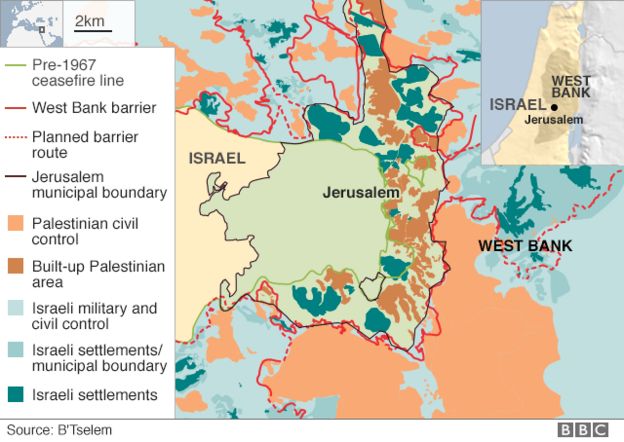
As expected, US President Trump announced that the US would recognize Jerusalem as the capital of the state of Israel and that he intends to move the US Embassy from Tel Aviv to Jerusalem signalling that shift. The announcement was couched in terms of recognizing “facts on the ground”: non-recognition of Jerusalem had not facilitated the peace process in the past and that the Israeli government operates from the city. These characterizations are both true, although it would have been fairer to state that the status of Jerusalem itself had been a major issue of contention holding up the peace process.
Mr. Trump tried to be very clear that the decision would not prejudice future peace negotiations. Politico described his position in these terms:
“Trump was emphatic in declaring that his decision did not represent a shift in U.S. dedication to the peace process or a change in U.S. position on the region’s contested borders or on the possibility of a two-state solution with East Jerusalem as the Palestinian capital.”
The description is disingenuous. First, it ignores the original UN decision to create three entities in the British Mandate of Palestine: a Jewish Zone, an Arab Zone, and and an internationalized city of Jerusalem. According to the UN:
“General Assembly resolution 181 (II) of 29 November 1947 on partition envisaged a demilitarized Jerusalem as a separate entity under the aegis of the United Nations Trusteeship Council, which would draft a statute for Jerusalem and appoint a Governor. A legislature would be elected by universal adult suffrage. This statute would remain in force for 10 years and would then be duly examined by the Trusteeship Council, with citizens’ participation through a referendum.
“The ensuing hostilities prevented implementation of the resolution. Israel occupied the western sector of the Jerusalem area, and Jordan occupied the eastern sector, including the walled Old City. Thus, there came into existence a de facto division of Jerusalem.
“The General Assembly, however, by resolution 194 (III) of 11 December 1948, reaffirmed both the principle of internationalization and existing rights. The Arab States, refusing to recognize Israel, did not accept it. Israel also ignored the resolution and moved to extend its jurisdiction to that part of Jerusalem which it had occupied. On 23 January 1950, Israel declared Jerusalem its capital and established government agencies in the western part of the city. Jordan, for its part, moved to formalize its control of the Old City; however, Jordanian legislation indicated that this action did not prejudice the final settlement of the Palestinian issue”
The UN made this decision because it was clear at the time that none of the parties involved could tolerate the idea of unilateral sovereignty over the city. Despite the promises that the status of the holy sites in Jerusalem would be unchanged by Mr. Trump’s decision, sovereignty allows changes to be made.
Second, President Trump was not clear on that the decision meant in terms of recognizing Israeli sovereignty over the city. He could have used more precise terms like “West Jerusalem” is the capital of Israel which would have recognized the “facts on the ground” since 1948 and not those of the “facts on the ground” since 1967 when Israel occupied East Jerusalem. By not qualifying the boundaries of the city, President Trump is implicitly recognizing Israeli sovereignty over the entire city.
Third, US recognition of Israeli sovereignty over the city does not necessarily mean that other states will do so as well, so in some respects the declaration is meaningless in terms of international law, although the US is regarded by most states as a very important actor in world affairs. I doubt, however, that most states will follow suit.
I suspect that the US decision is not a function of foreign policy at all. It will undoubtedly make the peace process more difficult in the future and the role of the US as a mediator is now irrelevant. No state that supports a Palestinian state now has any reason to accept the US as a good-faith actor. The US role in the Middle East is now consigned to one role and one role only: a possible counterweight to Iranian influence in the region that is so feared by the Sunni states. The Israeli-Palestinian peace process is not an important factor in that dynamic except as it fuels popular opposition to the US. I doubt, however, that the autocrats in Egypt, Saudi Arabia, Kuwait, or the United Arab Emirates really care that much about dissent in the streets.
The US decision is best explained by US domestic politics. President Trump wishes to shore up support among some Christian evangelicals who have long desired Israeli control over the city of Jerusalem (a movement known as Christian Zionism). Christian Zionists hold that the Second Coming of Christ cannot come until Jews rebuild the Temple in Jerusalem. Some regard the Christian Zionists as a major impediment to the Israeli-Palestinian peace process. It may be the case that President Trump wishes to repair the damage to his constituencies done by his support for Ray Moore in the Alabama Senate race.
The move is also consistent with a demand made by one of President Trump’s chief donors, Sheldon Adelson. Adelson contributed more than $43 million to various political campaigns in 2016, primarily to Republican candidates. Adelson is a very strong supporter of Israel.
Joseph Stiglitz is a Nobel Prize-winning economist who has written extensively on the process of globalization. The process has unquestionably generated extraordinary economic growth, but much of that economic growth has been distributed unequally. In particular, globalization has facilitated the move toward production in the lowest wage areas, a move that has helped workers in poor countries. But workers in high-wage areas have been negatively affected. Stiglitz believes that this outcome was deliberate:
“Indeed, it often seems that workers, who have seen their wages fall and jobs disappear, are just collateral damage – innocent but unavoidable victims in the inexorable march of economic progress. But there is another interpretation of what has happened: one of the objectives of globalization was to weaken workers’ bargaining power. What corporations wanted was cheaper labor, however they could get it.”
The political consequence of this unbalanced economic activity is widespread disaffection and the delegitimization of the democratic process as workers believe that their governments have sold them out to the highest bidders.
Turkey has announced that it would sever its ties with Israel if the US recognizes Jerusalem as the undivided capital of Israel. The Turkish declaration is the most extreme of all American allies, but it is difficult to find any US ally that supports the move: European states are unanimously opposed to the move as are all American allies in the Middle East with the exception of Israel. What is most nettling about the proposed change is that it is very difficult to determine an underlying logic or strategy behind the change. If the US does recognize Jerusalem as the undivided capital of Israel then there is little chance of a peace process being revived, the Iranian position in the region will be bolstered, and the Palestinian leadership will be humiliated. Many Israelis (but not all) will be delighted, but it will make the Israeli occupation more difficult and expensive.
Last month, Saudi Arabia claimed that it had shot down a missile fired by Yemeni rebels what had targeted the Riyadh airport. New evidence suggests that the claim was unfounded. The missile apparently flew unimpeded and landed close enough to the airport to frighten people at the airport. The new evidence suggests that the Houthi rebels in Yemen are well-armed, but it also undermines the claims of the effectiveness of anti-missile systems. The US has made anti-missile systems a centerpiece of its ability to defend, not only Saudi Arabia but also Eastern European countries and South Korea, against Iranian and North Korean missiles. It also calls into question the billions of dollars that have been spent on such systems. The New York Times has published a meticulously researched article on the evidence that indicates that the Saudi and US claims were not justified. The issue’s importance was heightened after there were reports that the Yemeni rebels fired a cruise missile at a nuclear reactor being built in Abu Dhabi.

There are some things that happen in world politics that are very difficult to explain. Today we learned that Ali Abdullah Saleh, the former leader of Yemen, was killed. Saleh was a ruthless dictator in Yemen who was overthrown in the Arab Spring in 2012. Ever the opportunist, Saleh joined forces with the Houthi forces who rebelled against the Saudi-backed regime of his successor, Abd Rabbo Mansour Hadi. But last week he blasted the Houthi rebels and was apparently assassinated by them for his treachery. It now seems likely that his supporters will open a new front against the Houthi rebels with support from Saudi Arabia and the United Arab Emirates. A solution to the war in Yemen, which has devastated one of the poorest countries in the world for the last five years, appears even more remote than it was yesterday.
Ali Abdullah Saleh

There is a growing movement in the world to recognize the legal rights of the natural world. The movement has been described in this way:
“Rights of Nature is the recognition and honoring that Nature has rights. It is the recognition that our ecosystems – including trees, oceans, animals, mountains – have rights just as human beings have rights. Rights of Nature is about balancing what is good for human beings against what is good for other species, what is good for the planet as a world. It is the holistic recognition that all life, all ecosystems on our planet are deeply intertwined.
“Rather than treating nature as property under the law, rights of nature acknowledges that nature in all its life forms has the right to exist, persist, maintain and regenerate its vital cycles.
“And we – the people – have the legal authority and responsibility to enforce these rights on behalf of ecosystems. The ecosystem itself can be named as the injured party, with its own legal standing rights, in cases alleging rights violations.”
The movement was first spearheaded in Ecuador and New Zealand followed suit by designating the Whanganui River, a river revered by the Maori, as a legal person. Perhaps the movement should attach itself to the protection of the Bears’ Ears area in the US state of Utah.
Whanganui River

The US and South Korea will conduct an aerial military exercise this coming week. According to The Hill:
“The drill, dubbed “Vigilant Ace,” will take place from Monday to Friday, and feature F-22 stealth fighters and F-35 aircraft. About 12,000 U.S. personnel and 230 aircraft will take part in the drill. The U.S Marine Corps and Navy troops will also participate in the drill.”
The drill will include US F-35 Lightning IIs and F-22 Raptors. The F-35s can fly 1,200 miles an hour and can carry nuclear weapons. The F22s can fly 1,500 miles an hour and can carry Vulcan mini-guns and Sidewinder missiles. The US clearly intends to send the signal to the North Koreans that it is fully capable of devastating North Korea if it does not “denuclearize”. I am quite certain that the North Koreans get the message and will therefore redouble their efforts to develop a nuclear capability to deter such an attack. There are better ways to address the North Korean nuclear status. President Trump’s National Security Adviser, H.R. McMaster, amplified the rhetoric on a Sunday talk show. According to the South Korean Yonhap News Agency:
“U.S. President Donald Trump will “take care of” the growing nuclear threat from North Korea by taking unilateral action if necessary, his national security adviser said Sunday.”
US F-35 Lightning II F-22 Raptors


Last October, Carsten von Nahmen wrote an op-ed piece for Deutsche Welle on the decision by the Trump Administration not to certify the Iranian nuclear deal that I thought was over the top when I first read it. He stated
“But in truth, the damage has been done. The writing on the wall is that agreements made with the United States are not worth the paper on which they are written, because the current American president can — anytime, without due cause — call them into question without offering a realistic alternative.”
Today, however, von Nahmen’s critique seems more plausible. The US has withdrawn from the The New York Declaration for Refugees and Migrants which was passed unanimously in the United Nations last September. The compact was not a legally binding treaty but was designed to serve as a way for states to discuss and regularize the process of migration and addressing the refugee crisis. According to The Guardian:
“In 2016, the 193 members of the UN general assembly unanimously adopted a non-binding political declaration, the New York declaration for refugees and migrants, pledging to uphold the rights of refugees, help them resettle and ensure they had access to education and jobs. The initiative had the enthusiastic backing of Barack Obama.”
The US Ambassador to the UN, Nikki Haley, issued the following statement announcing the reasons for the US withdrawal:
“America is proud of our immigrant heritage and our long-standing moral leadership in providing support to migrant and refugee populations across the globe. No country has done more than the United States, and our generosity will continue. But our decisions on immigration policies must always be made by Americans and Americans alone. We will decide how best to control our borders and who will be allowed to enter our country. The global approach in the New York Declaration is simply not compatible with U.S. sovereignty.”
To assert that a compact with no legal authority violates US sovereignty suggests a degree of diplomatic expertise that is laughable. The withdrawal is also a very mean-spirited act–if the US is questioning its own immigration and refugee policies, there is no reason whatsoever to talk with other states about potentially better policies.
Stanford University’s Center on Poverty and Inequality releases an annual report on poverty in the US. In its 2016 report, the Center did a cross-national study investigating nine different variables in 10 countries: Australia, Canada, Finland, France, Germany, Italy, Norway, Spain, the United Kingdom, and the US. The results were disappointing for the US. According to they study:
“…the U.S. has the lowest overall ranking among our 10 well-off countries, a result that arises in part because it brings up the rear of the pack in three of the six domains covered here (safety net, income inequality, wealth inequality). Even when the comparison set is expanded to include the less well-off countries, the U.S. still ranks a dismal 18th (out of 21 countries), with only Spain, Estonia, and Greece scoring worse.”
Philip Alston, the UN special rapporteur on extreme poverty and human rights, is currently conducting a study of poverty and inequality in the US and is expected to release the findings of this study on 15 December. The Guardian describes the basis for the UN’s investigation:
“With 41 million Americans officially in poverty according to the US Census Bureau (other estimates put that figure much higher), one aim of the UN mission will be to demonstrate that no country, however wealthy, is immune from human suffering induced by growing inequality. Nor is any nation, however powerful, beyond the reach of human rights law – a message that the US government and Donald Trump might find hard to stomach given their tendency to regard internal affairs as sacrosanct.”
The reference to human rights law stems from the US’s ratification of the International Covenant on Civil and Political Rights which guarantees the right to “subsistence”. It is difficult to believe that the US will have any official reaction to Alston’s report. But the rest of the world will be listening very carefully.
Robert Manning, a former State Department official, has written an editorial for The Hill analyzing the logic of a “preventive” war against North Korea (to be clear–an attack does not qualify as “pre-emptive” unless there is clear evidence that an attack is urgently imminent). Manning argues that the logic is quite flawed, but suggests that US President Trump has more or less painted himself into that corner. The US should drop its objective of denuclearization and deal with North Korea as a nuclear power. Such a change in policy might persuade North Korea to pause its testing program long enough to begin sustained negotiations. But Mr. Trump appears to be afraid of the political consequence of being the President that allowed North Korea to threaten the US with nuclear weapons. There was a parallel debate in the US after the Chinese Revolution succeeded in 1949. The politics of the “Who Lost China” debate poisoned American politics for years.
Senator Joseph McCarthy and Roy Cohn (Cohn remains in US politics as an adviser to President Trump) in the 1950s

There are reports that the Trump Administration will announce on Wednesday that the US will recognize Jerusalem as the capital city of Israel while keeping the US Embassy in Tel Aviv. Previous Administrations have refused to make that declaration since the Palestinians regard East Jerusalem as the future capital of their state when it is officially recognized (right now, 135 countries recognize Palestine as a nation-state). Mr. Trump promised to make this change when he was a candidate. The Palestinians will most likely protest the move by breaking off all negotiations with Israel, even as the Trump Administration has been trying to rebuild those negotiations from their current standstill.

There are rumors swirling around that US President Trump intends to replace his Secretary of State, Rex Tillerson, with Mike Pompeo, the current Director of the Central Intelligence Agency (CIA). It has not been a secret that Mr. Trump and Mr. Tillerson have a difficult relationship. When Mr. Trump wanted to isolate Qatar from other Gulf allies, Mr. Tillerson tried to mediate among them. Mr. Trump gave the Israeli-Palestinian portfolio, one of the most important issues for the State Department to his son-in-law, Jared Kushner. There were even reports that Mr. Tillerson referred to Mr. Trump as a “moron”. Mr. Pompeo is likely to be more in line with Mr. Trump’s objectives, but he has a reputation for being a hard-liner. In October, Mr. Pompeo gave a speech in which he compared Iran to ISIS and called the regime “a thuggish police state” (one should remember that Iran is a Shia state and ISIS is comprised of Sunnis–it is hardly likely that the two would ever cooperate). As a Congressperson, Mr. Pompeo was adamantly opposed to the Iranian nuclear deal.
The rumor also suggests that Mr. Trump would place Senator Tom Cotton (R-AR) as the new Director of the CIA. Senator Cotton has a distinguished track record, but, if appointed, he would the youngest Director of the CIA ever and he has no experience in matters of intelligence collection and assessment. Paul Pillar, a 28-year veteran of the CIA, and one who charged the President Bush Administration of “cherry-picking” the intelligence over Iraq’s development of weapons of mass destruction, simply said: “This is an awful appointment….Sen.Cotton is a highly ideological individual who is not well-suited to lead an agency part of whose core mission is objective analysis.” (disclaimer, Paul was a personal college friend). Senator Cotton is also adamantly opposed to the Iranian nuclear deal. He delivered a speech to the Council on Foreign Relations which is one of the hardest-lines I have ever read on the nuclear deal. Senator Cotton is also a strong advocate for the use of torture, including waterboarding despite the fact that the U.S. Senate Select Committee on Intelligence concluded in 2014 that “use of the CIA’s enhanced interrogation techniques was not an effective means of obtaining accurate information or gaining detainee cooperation.”
After the recent North Korean missile test, US President Trump indicated that the US would ratchet up the sanctions on North Korea. There are probably few additional sanctions that the US could impose. Instead, the US is hoping that China will cut off its exports of oil to North Korea and its food assistance. The US still does not understand that China has no interest in a political collapse in North Korea which would likely be the result of such draconian measures. In the Global Times which often serves as a mouthpiece for the China government, there was an editorial which should dash whatever hopes Mr. Trump has for increased Chinese pressure:
“Whatever North Korea did, it is wrong to impose a full trade embargo or to sever ties with the country. China has no obligation to cooperate with the US on this impractical idea. The US has no right to direct China or the UN Security Council.
“Recently the US media began to recognize China’s efforts, acknowledging that China cannot stop Pyongyang’s nuclear program. We believe that Pyongyang is beginning to recognize too that when it continues to test missiles and nuclear weapons, China cannot stop it from being punished.
“The possibility of a war on the Korean Peninsula is rising and it is not decided by China. China’s strategy should be maintaining its independent stance and principles, pushing the UN Security Council to craft the most reasonable policy and refusing to yield to either sides’ extreme requests, be they from Washington or Pyongyang.
“China will face whatever comes next. Beijing is fully prepared to use its prowess to defend its national interest. China owes no one anything, and other countries must know this.”
If there is no likelihood of additional sanctions, the US is left with two options if it persists in its objective of “denuclearizing” North Korea: a military attack or accepting North Korea’s status as a nuclear power and resorting to the policy of deterrence which the US currently relies upon with respect to China’s and Russia’s nuclear status. It may be the case that the latter option might appeal to the North Koreans.
 World Politics News