Archive for the ‘World Politics’ Category
Russia has responded to the expulsions of its diplomats by expelling Western diplomats in equal numbers. They expelled 60 US diplomats, exactly the same number of Russians expelled, and closed the US consulate in St. Petersburg in retaliation for the closure of the Russian consulate in Seattle. The calibrated response suggests that the Russians do not wish to escalate the crisis and are probably somewhat disconcerted by the unified front displayed by the Western powers. This move, however, does not mean that the matter is closed. The British remain quite angry by the use of military-grade chemical weapons on their soil and it is likely that they will take further steps.
The Commission for International Justice and Accountability has been accumulating huge troves of evidence documenting the war crimes of the government of Syria in the civil war that has been ongoing since 2011. The evidence is overwhelming, but it is unlikely that Syrian President Assad will ever be prosecuted for those crimes in an international tribunal which requires a unanimous recommendation from the UN Security Council and Russia and China both vetoed similar recommendations in 2014. It is also unlikely that the US will support efforts to bring Assad to justice. In a speech in Ohio today, US President Trump stated his interest in washing his hands of the situation in Syria:
“We’re knocking the hell out of ISIS. We’ll be coming out of Syria, like, very soon….Let the other people take care of it now. Very soon. Very soon, we’re coming out. We’re going to have a hundred percent of the caliphate, as they call it. Sometimes referred to as land, taking it all back. Quickly, quickly.”
The international community will regard its indifference to the slaughter of civilians in Syria with great shame in the very near future.
The Jerusalem Post is reporting on an article published in a Kuwaiti newspaper, Al-Jarida, that two Israeli F-35 fighter planes entered Iranian air space to conduct a reconnaissance mission. The report indicates that the planes were undetected by the sophisticated air defense system provided by Russia. It is impossible to confirm this report but it follows the disclosure by Israel that it destroyed the Syrian nuclear reactor in 2007 which was largely interpreted as a warning to Iran. The region is also being rattled by calls from Hamas for mass rallies in the Gaza Strip.
F-35 Fighter

China has confirmed that North Korean leader Kim Jong-un did indeed meet with Chinese President Xi Jinping in Beijing. It was Kim’s first foray outside of North Korea and he was given a very official welcome by the Chinese, realizing one of Kim’s most important objectives: recognition by a Great Power. Kim can now also look forward to perhaps a face-to-face meeting with US President Trump in which the US will now be obliged to give Kim similar recognition. Kim has thus played the Chinese against the US very deftly and has given up little in return. China purchased a say in the upcoming negotiations with the US which preserved its role in East Asia. I am not sure what the US will gain. But the situation remains fluid. Much depends on how loosely the US is willing to define “denuclearization”.
The Ethiopian People’s Revolutionary Democratic Front has chosen Abiy Ahmed as its new chairman which may mean that he may be Ethiopia’s next Prime Minister. The selection is significant since Ahmed is an Oromo Member of Parliament. Oromos make up a third of Ethiopia’s population, but they have never been effectively represented in the Ethiopian government. The Oromia Region of Ethiopia has experienced significant protests in recent years because of its exclusion from decision-making in the country. There are high hopes that Ahmed will be able to stabilize the country, but the turmoil in the country has been going on for a very long time.
Abiy Ahmed

Peter Goodman has written an article for the New York Times that argues that the liberal world order is crumbling and that the very states that worked to create it after World War II are among those states refusing to support it. His position is made clear at the beginning of the article:
“In the aftermath of World War II, the victorious Western countries forged institutions — NATO, the European Union, and the World Trade Organization — that aimed to keep the peace through collective military might and shared prosperity. They promoted democratic ideals and international trade while investing in the notion that coalitions were the antidote to destructive nationalism.
“But now the model that has dominated geopolitical affairs for more than 70 years appears increasingly fragile. Its tenets are being challenged by a surge of nationalism and its institutions under assault from some of the very powers that constructed them — not least, the United States under President Trump.
“In place of shared approaches to societal problems — from trade disputes, to security, to climate change — national interests have captured primacy. The language of multilateral cooperation has been drowned out by angry appeals to tribal solidarity, tendencies that are heightened by economic anxieties.”
In its place, the dissidents to the liberal world order seem to prefer a world dominated by balance of power politics, a return to he world system of the 19th century.
It is difficult to pin down the Trump Administration’s position on trade. Mr. Trump announced increases in tariffs on imported steel and aluminum and then exempted most countries from those tariffs because they were US allies. Similarly, he announced his intention to raise tariffs on imported Chinese products to reduce the US trade deficit with that country by about $60-100 billion. Subsequently, we have found that those tariffs are now the topic of negotiations between the US and China. The US position on trade has been consistent since 1945–it has been in favor of free trade and low tariffs. The evidence shows that the US was true to that aspiration, except with respect to certain products in sensitive areas. According to the Pew Research Center:
“In 2016, according to the World Bank, the average applied U.S. tariff across all products was 1.61%; that was about the same as the average rate of 1.6% for the 28-nation EU, and not much higher than Japan’s 1.35%. Among other major U.S. trading partners, Canada’s average applied tariff rate was 0.85%, China’s was 3.54% and Mexico’s was 4.36%.”
During the 19th century, the US was a highly protectionist economy to protect its industries from competition from European exports. If he follows through on his threats, Mr. Trump may return the US to that historical pattern.


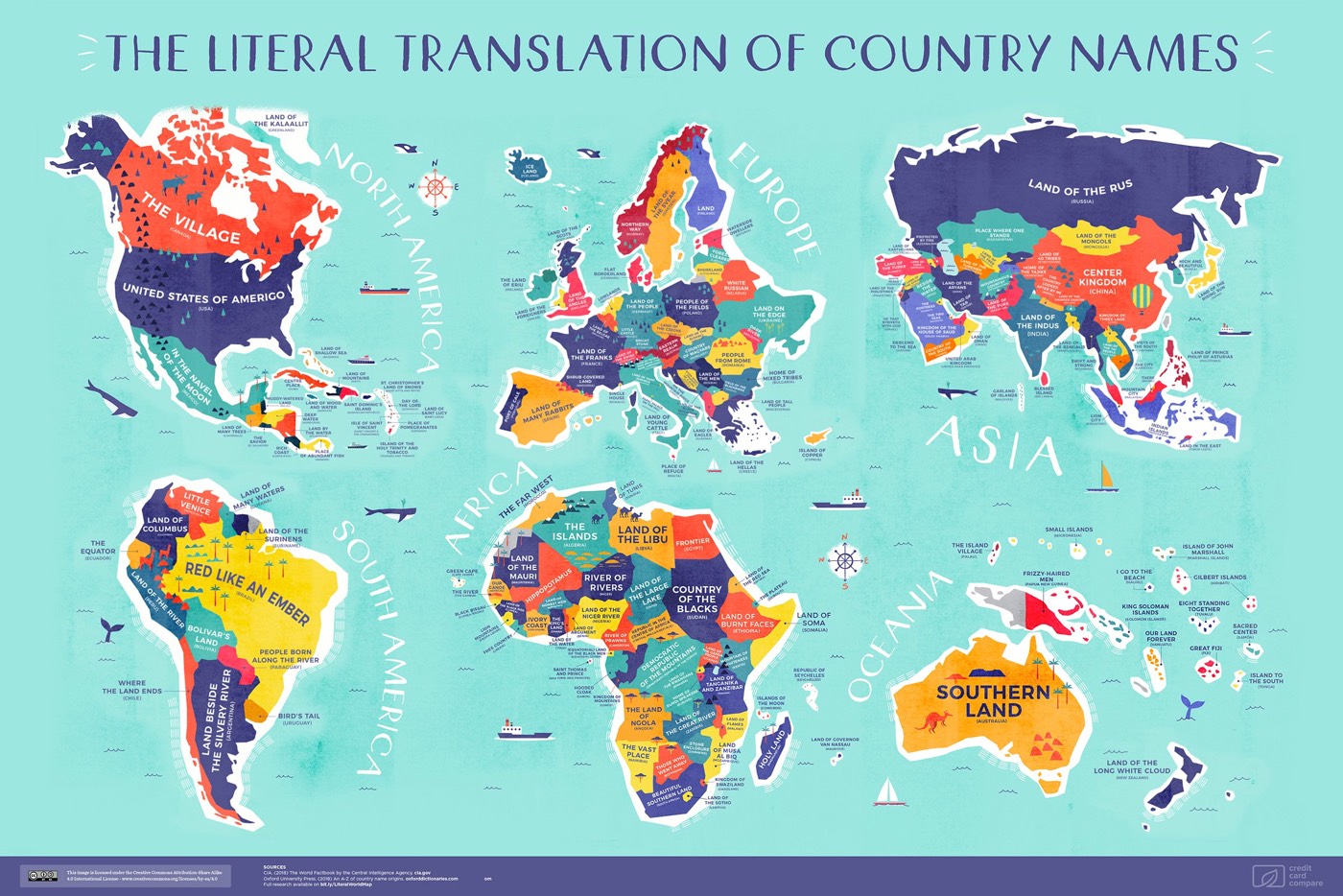
The literal translation of the names of various states is fascinating. Remember that many of these names are not authentic to the indigenous people who lived in the areas–the translation is from the European designation of the imposed colonies. If you want to see the maps in finer detail, click here.

I have posted several times on the apparent decline of the rules-based liberal world order established by the US after the end of World War II. That world order was never fully realized, as the US and other powers often lapsed back into the balance of power world order of the 19th century. But there was steady progress from 1945 on to create institutions that aspired to enforcing the rules of representative democracy, market capitalism, and human rights (even as many countries had serious reservations about those objectives). The breakdown of the liberal world order since the election of US President Trump has accelerated, leading to questions about what world order might replace liberal rules. Writing in the Asia Times, Pepe Escobar suggests that the populist/authoritarian movements in the world might be a template for an emerging world order:
“China, Russia, Iran and Turkey — all implicated in Eurasia integration — may all rank as authoritarian systems at different levels. And cases can be made that, with the exception of China they still underperform economically compared to their true potential.
“Yet one thing they value most of all is national sovereignty amid a multipolar system. That’s their conceptual counterpoint to the il(liberal) world (dis)order.”
There are some who have explicitly argued for such a world order although it is too early to believe that this alternative can be made systematically or in a manner that many would find appealing.
There are media reports that North Korean leader, Kim Jong-un, has traveled to Beijing which, if true, would mark the first time he has been outside of North Korea since taking power. The evidence consists of a special train that left North Korea and a very tightly controlled motorcade through the city. The US appears not to have known in advance of the visit and the visit suggests that the Chinese do not wish to be left out of the diplomatic process which was started by the South Koreans and includes a possible meeting between US President Trump and Kim sometime in May. We will have to see if the rumors are true and what effect the Chinese will have on a possible resolution of a situation in which they have an overwhelming interest.
At least 21 states, primarily from Europe, have expelled about 135 Russian diplomats as a show of protest over Britain’s allegations that Russia was involved in the poisoning of a former Russian spy and around 120 innocent civilians two weeks ago. For its part, the US expelled around 60 Russian diplomats from New York and Washington, DC and closed the Russian consulate in Seattle. The Russians will likely respond with similar expulsions, but the tit-for-tat will have few significant effects. The liberal states must consider cutting off the flow of Russian private money into the large financial centers of the world if they wish to penalize the Russians for their abhorrent behavior in a meaningful way.
As talk of a trade war with China escalates, one should think about what products will be affected by rises in tariffs. The Chinese import some very important products for various sectors of the US economy. For example, it bought 26% of the airplanes that the Boeing Corporation sells abroad. It is highly likely that the European based AirBus company would be delighted to replace those airplanes. Similarly, China imports a huge amount of US soybeans. Again, Brazil would easily be able to supply that amount of soybeans to the Chinese. Losses of those exports would definitely increase the US balance of trade deficit with China unless somehow US consumers find alternatives suppliers of Chinese products. But China is a key supplier of products largely produced in other countries–its main manufacturing function is to assemble the final shape of many electronic products. The complicated supply chain makes it very difficult to single out “China-only” exports.

The Netherlands is no stranger to far-right politics, having endured the presence of Geert Wilders, the leader of the nativist Party for Freedom (PVV). Wilders, however, has been eclipsed by a new far-right leader, Thierry Baudet of the Forum for Democracy (FvD), whose party just won two seats in the elections for Amsterdam’s local elections. Baudet is an admirer of Vladimir Putin and Donald Trump and only emerged in Dutch politics in 2017. The FvD does yet appear to be a threat to the current government of Conservative Prime Minister Mark Rutte and does not share the virulent anti-Muslim sentiment of the Party for Freedom. Instead, it appears to be ensconced in a more traditional European conservatism that embraces 19th century values. It is, nonetheless, a real departure from the more progressive perspectives that largely characterize Dutch society.
Thierry Baudet

Egyptians will head to the polls on Monday but there is little question that Egyptian President Abdel Fattah al-Sisi, who seized power five years ago, will be elected. There is only one declared candidate running against Sisi, Moussa Mustafa Moussa, but Moussa has barely campaigned. Voting is compulsory in Egypt, but we should look to the turn-out to determine the degree of dissatisfaction with the situation in Egypt. Sisi has pretty much extinguished normal democratic rights in the country which is also deeply in debt. Since the Arab Spring of 2011 which led to the overthrow of former strongman, Hosni Mubarak, Egyptian politics have been turbulent and highly authoritarian.
Abdel Fattah al-Sisi

On 16 March, US President Trump signed the Taiwan Travel Act which allows high-level US officials to meet with high-level Taiwanese officials. The act signals a major change is US-Taiwan relations after over 40 years of relative quiescence. In 1972 the US and China agreed (in what was known as the Shanghai Communique) that there was only one China, ending years of US official recognition of Taiwan as the representative of the Chinese people despite complete control of the Chinese mainland by the Chinese Communist Party. The 1972 agreement stipulated that China would not take control of Taiwan by force and the US would not support Taiwanese independence. The Taiwan Travel Act upsets that agreement and the Chinese were furious over the move–indeed, the Act was more upsetting to Beijing than the threat of US tariffs against Chinese exports. After all, the Act threatens sovereignty, not just economic activity. The degree of anger was expressed by the Global Times, a newspaper often regarded as an official mouthpiece for Beijing:
“The mainland must also prepare itself for a direct military clash in the Taiwan Straits. It needs to make clear that escalation of US-Taiwan official exchanges will bring serious consequences to Taiwan. This newspaper has suggested that the mainland can send military planes and warships across the Taiwan Straits middle line. This can be implemented gradually depending on the cross-Straits situation.
“Preventing the Taiwan independence movement and promoting unification through peaceful ways can be costly, perhaps costing more than the short-term loss brought about by forceful unification. It’s a misunderstanding to think that peaceful unification will be a harmonious and happy process. The Taiwan authority will only turn around when left with no choice. Sticks matter more than flowers on the path to peaceful reunification.”

The lefty British newspaper, The Guardian has published an article on the views of President Trump’s new National Security Advisor, John Bolton. It is predictably critical, but makes a point of quoting Mr. Bolton directly. There is little question that he is quite a hawk and that his views on the value of military action against Iran and North Korea are provocative and dangerous. Mr. Bolton’s op-ed piece in the New York Times in 2015 on the need to bomb Iran gives good insight into his views.
John Bolton

Israel has confirmed that it destroyed a Syrian nuclear reactor in 2007. The strike was not a secret and most knew that Israel conducted it, so the question is why did Israel break its long-standing tradition of staying silent? There was a fear that the admission was going to be released in an upcoming memoirs by former Prime Minster Barak and former Defense Minster Barak, due to be published this spring. But it also highly likely that Israel is sending a message to Iran if the nuclear agreement with the P-5+1 breaks down in May if the US decides to withdraw from the agreement. It is important to remember that the Israeli strike in 2007 was a “preventive” strike, not a “pre-emptive” strike.
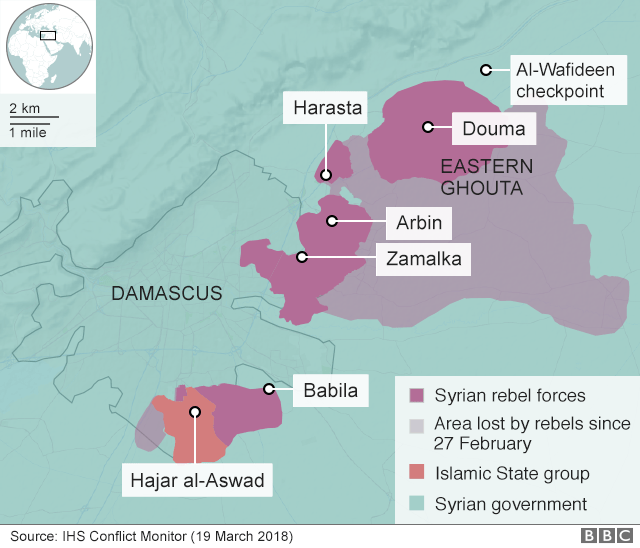
Many are evacuating the area of Eastern Ghouta in Syria which has been subjected to intense bombardment in recent months. The area has long been held by rebels opposed to President Assad, but the humanitarian crisis in the city is clearly overwhelming and untenable. The evacuation represents a victory for Assad. But it is a Pyrrhic one since his government is saddled with large debts, the loss of a large proportion of the population, and widespread destruction of many formerly productive areas. Assad may emerge as the leader of a country that will be on life support for many years to come.
China has blamed the US for its balance of payments deficit with China. As President Trump announced new tariffs and other restrictions on trade with China, the Chinese point out that the US has many export restrictions on goods sold to China, primarily of high technology products. China would willingly buy those products if it could. The US is angry about the loss of intellectual property, but tariffs are not nearly precise enough to alleviate that problem. They will, however, spark a response from China.
Saudi Arabia’s Crown Prince Mohammed Bin Salman is in Washington to meet with US President Trump. The main topic of discussion will be Iran since the US must make a decision by 12 May whether to recertify the Iran nuclear agreement. In an interview with CBS News, Salman stated that it Iran were to develop nuclear weapons, Saudi Arabia would no choice but to develop them as well. Logic would suggest that the US should not break the Iran nuclear agreement to prevent the spread of nuclear weapons to yet another state. But it appears as if the opposite path is going to be followed, particularly now with Mike Pompeo, a noted opponent of the agreement, as DirectorUS o of the CIA and the rumor that John Bolton, another fierce opponent of the agreement, will succeed McMaster as the National Security Advisor. But there are members of Congress who wish to condemn US cooperation with Saudi Arabia in the war against Yemen, and that opposition may complicate the US-Saudi discussions.
Mohammed bin Salman

There are reports that n the national security clauses of US law and could therefore be implemented unilaterally by the President, the Chinese tariffs need to undergo a period of public review before they can go into effect. It is highly likely that many US companies will lobby hard against the tariffs, relieving the Chinese of an immediate response to the tariffs. Nonetheless, China’s response was highly negative and the prospect of a trade war with China is not remote.

Israeli historian, Yuval Noah Harari, conducted a rather depressing interview with the New York Times about the future of humanity given current technological trends. One paragraph of the story goes as follows:
“Just as the Industrial Revolution created the working class, automation could create a “global useless class,” Mr. Harari said, and the political and social history of the coming decades will revolve around the hopes and fears of this new class. Disruptive technologies, which have helped bring enormous progress, could be disastrous if they get out of hand.”
There are good reasons to suspect that the future will not be so grim, but Harari’s prediction is not fanciful. But unless societies decide to prevent such a future, it may well be inevitable.
Katie LaRoque is a Mount Holyoke alumna who served in Ukraine for the Peace Corps. She has spent a great deal of time in Ukraine after her Peace Corps service and has become a distinguished analyst of the country. She has written an article for The Hill which argues that corruption in Ukraine hampers the struggle against Russian attacks on Ukrainian sovereignty. Her conclusion is straightforward:
“Until Ukraine wins its internal war on corruption, it will be more difficult to make the case to residents of occupied Crimea and the Donbass that their reintegration would bring about a full and equal partnership in Ukraine’s political development. A well-governed Ukraine reduces the vulnerability of these already vulnerable regions to Russian influence, and gives citizens a stake in Ukraine’s future as a united democratic country.”
She also stresses the need for the US and the European Union to offer support for the anti-corruption efforts. Such efforts must be coordinated carefully with local authorities to avoid the appearance of outside interference. An important article for a conflict that has largely been forgotten in the US.

In 2004 a movie entitled “The Day After Tomorrow” was released which posited a change in the Atlantic meridional overturning circulation (AMOC) because of climate change. The ocean currents carry warm, salty water to the north, and cold, freshwater then circulates back down to the tropics. It is a relatively stable and accounts for the stability of the Gulf Stream which keeps northwestern Europe fairly warm in the winter. The movie overdramatized the possibilities of such a change and the consequences from such a change. But there is no question that such a change is possible and we are beginning to see evidence that the AMOC is changing. The Washington Post summarizes the research and articulates the tentativeness of the findings:
“Again, it’s important to underscore that there are no predictions in this study about when these processes would reach such a threshold or cause a major switch to a new regime. Climate change simulations have generally found that while global warming should indeed weaken the Atlantic overturning circulation, that should play out gradually — but scientists acknowledge that these simulations are not necessarily complete.”
The evidence suggests that the process has been going on since 2008 but there is no way to determine at this time whether the process is unusually rapid nor is there any way to determine the threshold at which dramatic changes could be expected.

The Tax Justice Network has published its annual Financial Secrecy Index which”ranks jurisdictions according to their secrecy and the scale of their offshore financial activities. A politically neutral ranking, it is a tool for understanding global financial secrecy, tax havens or secrecy jurisdictions, and illicit financial flows or capital flight.” People use these jurisdictions in order to hide their money from tax authorities, creditors, or disgruntled relatives. According to the report:
“An estimated $21 to $32 trillion of private financial wealth is located, untaxed or lightly taxed, in secrecy jurisdictions around the world. Secrecy jurisdictions – a term we often use as an alternative to the more widely used term tax havens – use secrecy to attract illicit and illegitimate or abusive financial flows.
“Illicit cross-border financial flows have been estimated at $1-1.6 trillion per year: dwarfing the US$135 billion or so in global foreign aid. Since the 1970s African countries alone have lost over $1 trillion in capital flight, while combined external debts are less than $200 billion. So Africa is a major net creditor to the world – but its assets are in the hands of a wealthy élite, protected by offshore secrecy; while the debts are shouldered by broad African populations.”
Switzerland leads the list and the US is in second place (for a full list of the jurisdictions, click here). Political institutions create the laws that provide the secrecy and thus deprives the states from collecting taxes. Government revenues would be substantially greater if those political institutions took away the ability to hide such great wealth. The laws provide a grotesque way for the poor to subsidize the rich.
The Guardian is reporting on new research which suggests that current policies to reduce greenhouse gas emissions are unlikely to forestall serious changes to many parts of the world. According to The Guardian:
“The world’s greatest forests could lose more than half of their plant species by the end of the century unless nations ramp up efforts to tackle climate change, according to a new report on the impacts of global warming on biodiversity hotspots.
“Mammals, amphibians, reptiles and birds are also likely to disappear on a catastrophic scale in the Amazon and other naturally rich ecosystems in Africa, Asia, North America and Australia if temperatures rise by more than 1.5C, concludes the study by WWF, the University of East Anglia and the James Cook University.
The article contains several graphs which dramatically show how the current reductions designed to limit temperatures to 1.5°C are profoundly insufficient to protect these ecosystems since the actions taken fall far short of meeting that goal. In the worst cases, almost half of the plant and animal species in the Amazon forest will die off.
FDD Long War Journal is reporting that the US has been actively launching attacks against suspected terrorist groups in Yemen. There has been little reporting on US military actions in Yemen. The blog states:
“The United States’ air campaign in Yemen has shown no signs of slowing down. US forces conducted 12 airstrikes against terrorist groups in Yemen over the last month that were not publicly announced, FDD’s Long War Journal has learned.
“Maj. Josh T. Jacques at US Central Command Communication Integration said yesterday in an email that “U.S. forces have conducted twenty-two (22) strikes against AQAP and ISIS-Y terrorists in Yemen 2018.” The US had conducted 10 counterterrorism strikes in Yemen when CENTCOM last issued a press release updating figures in early in February.
“The latest data put this year’s number of strikes on-pace to fall just short of last year’s record surge. In 2017, the United States conducted a record 131 strikes in Yemen.”
The humanitarian crisis in Yemen is one of the worst in the world. It is also a proxy conflict between Saudi Arabia and Iran, and the US has weighed in heavily on the side of Saudi Arabia. Unfortunately, very few Americans are aware of how deeply involved the US is in this balance of power struggle.
There are reports that US President Trump is seeking to reduce the trade deficit with China by $100 billion (out of $375 billion deficit with China overall) and invoking penalties on alleged theft of intellectual property seems to be part of his strategy. The tariffs would be based on Section 301 of the Trade Act of 1974, a law that has been invoked very infrequently since the creation of the World Trade Organization which is supposed to adjudicate such matters. Needless to say, China has a dim view of Mr. Trump’s proposals. An editorial in China Times is quite blunt:
“China won’t allow itself to be trampled upon. Perhaps it is China’s destiny to struggle with the US only in order to teach Washington a lesson. In which case, so be it.”
Unfortunately, any trade war between the US and China would have serious consequences for the rest of the world.

 World Politics News