Turkish President Recep Tayyip Erdogan has called for snap elections a year and a half before they are required. He has led the country for 15 years, both as President and Prime Minister, and is riding a wave of popularity that seems to assure his re-election. If he is elected, he will become President with enhanced powers due to constitutional changes approved in an earlier referendum. The opposition parties seem to be disorganized at this time and the Parliament has approved the extension of a state of emergency which has increased Erdogan’s powers considerably. Even though the decision was a surprise, the initial reaction of the markets in Turkey was quite favorable.
President Trump’s nominee for Secretary of State, Mike Pompeo, made a secret trip to North Korea to make arrangements for negotiations between the US and North Korea. At this time it is not clear at what stage the negotiations are, but it seems as if the process is moving much faster than usual given the complexities of the issues. But North Korean leader Kim Jong-un has unquestionably achieved what he and his predecessors have longed desired: recognition by the Great Powers. Since his meeting with Chinese President Xi, there is no question that Kim has accomplished a great deal and has given up very little in return. At his meeting with Japanese Prime Minister Abe today, US President Trump declared that he was prepared to walk away from the negotiations with North Korea if he was dissatisfied with the progress of the negotiations. That very well may be the case, but it will be Mr. Trump who leaves and Mr. Kim will have the implicit recognition of the US.
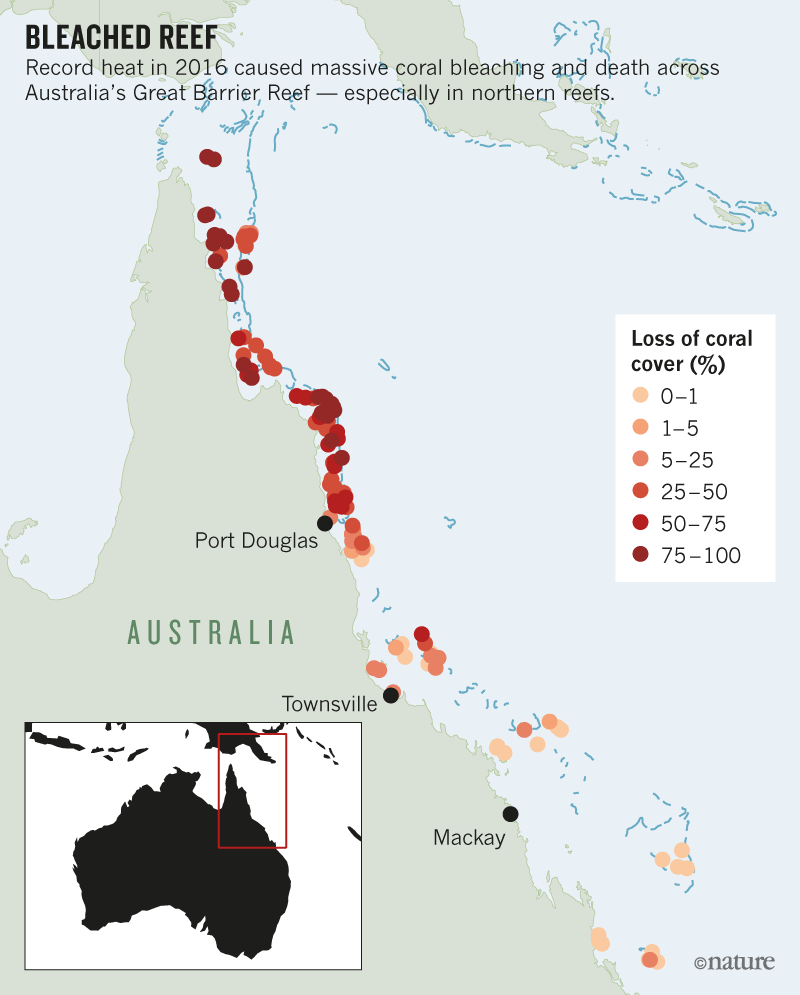
Recent research indicates that up to a third of the Great Barrier Reef off the coast of Australia has died because of global warming. The research was conducted after the record-breaking heat wave in 2016 and, according to Nature:
“‘The world’s largest coral reef is unlikely to recover soon. The damage is a harbinger of what a warming future might hold for a wealth of tropical reef ecosystems’, says lead study author Terry Hughes, director of the coral-reef centre at James Cook University in Townsville, Australia.”
The Washington Post has an op-ed piece which features a podcast by Robert Kagan entitled “The liberal world order is an ‘artificial construction.’ And now it’s in trouble.” I disagree with Kagan far more than I agree with him, but this podcast is quite good. If one can listen to the podcast and ignore Kagan’s assertions about US superiority and focus instead on his analysis of the liberal world order, then one can appreciate more fully the threat that the world faces with the decline of that world order without having a clear and acceptable replacement on the horizon. The liberal world order was far from perfect, but the absence of a world order, as occurred between 1918 and 1939, is a far more dismal world.
“There seems to be a certain European civil war: national selfishness and negativity seems to take precedence over what brings us together. There is a fascination with the illiberal, and that is growing all the time…
“In the future, we must struggle to defend our ideals … This is a democracy that respects individual minority fundamental rights, which used to be called liberal democracy, and I use that term by choice. The deadly tendency which might lead our continent to the abyss, nationalism, giving up of freedom: I reject the idea that European democracy is condemned to impotence.
“I don’t want to belong to a generation of sleepwalkers, I don’t want to belong to a generation that’s forgotten its own past”.
French President Emmanuel Macron
Israel has been carrying out military strikes in Israel for quite some time, but it has been careful to avoid striking Iranian militia forces in Syria directly. That changed two weeks ago when Israeli jets bombed a suspected Iranian military base after Iran sent a drone into Israeli airspace. That attack reportedly killed 7 members of the Iranian Quds force. Israel is now preparing for a counterattack by Iranian forces which, if it occurs, will signal a dramatic escalation of the wars in Syria. The Iranian forces have vowed retaliation for the deaths of their soldiers. The Israelis have called many of their fighter jets on a military exercise with US forces in Alaska in case they are needed to fend off an Iranian attack. Thomas Friedman of the New York Times has written an op-ed piece outlining the dynamics underlying this possible escalation.
Satellite Image of the Iranian Military Base in Syria Destroyed by Israeli Forces.
We continue to get information about the chemical weapons attacks in Syria that raises questions about the possible effectiveness of the coalition strike against the Syrian weapons facilities. The Organisation for the Prohibition of Chemical Weapons (OPCW) is the agency entrusted with investigating chemical weapons use in the world. The OPCW was created when the Chemical Weapons Convention (CWC) came into force in 1997. It is not an arm of the United Nations, but rather an independent international organization that works closely with the US. The OPCW is trying to investigate the incident in Douma, Syria but there are reports that Russia and Syria are blocking access to the site. On the news program, Face the Nation, US Ambassador to the UN, Nikki Haley, made this statement about further efforts to punish the regime for its use of chemical weapons, notably additional sanctions on Russia for not enforcing the agreement made with the OPCW to eliminate all chemical weapons in Syria in 2014:
“So, you will see that Russian sanctions will be coming down. Secretary Mnuchin will be announcing those on Monday, if he hasn’t already. And they will go directly to any sort of companies that were dealing with equipment related to Assad and chemical weapons used.”
“Sometime after Haley’s comments on CBS, the Trump administration notified the Russian Embassy in Washington that the sanctions were not in fact coming, a Russian Foreign Ministry official said Monday.
“The Trump team decided to publicly characterize Haley’s announcement as a misstatement.”
Again, we have little guidance to determine what the US policy toward Syria actually is.
There is another area of policy confusion in US foreign policy. One issue that Mr. Trump made central to his 2016 presidential campaign was China’s role as a currency manipulator. The charge is that China artificially manipulated the value of its currency in order to make its exports cheaper and its imports more expensive. The US Treasury is charged with making the decision as to whether a country is in fact a currency manipulator:
“Treasury has established thresholds for the three criteria specified in the Trade Facilitation and Trade Enforcement Act of 2015 (the “2015 Act”) that determine whether enhanced analysis is necessary: (1) a significant bilateral trade surplus with the United States is one that is at least $20 billion;2 (2) a material current account surplus is one that is at least 3 percent of gross domestic product (GDP); and (3) persistent, one-sided intervention occurs when net purchases of foreign currency are conducted repeatedly and total at least 2 percent of an economy’s GDP over a 12-month period.”
In its most recent semiannual report, the US Treasury found that China was not a currency manipulator (p.3), although it was, along with Japan, Korea, Germany, Switzerland, and India, being monitored for the issue (India is a new addition to the list). Nonetheless, today US President Trump tweeted: “Russia and China are playing the Currency Devaluation game as the U.S. keeps raising interest rates. Not acceptable!” I have no idea how all this translates into a coherent policy.
The microblogging site in China, Sina Weibo, which is similar to Twitter, announced recently that it would ban all content referring to homosexuality. The reaction to the announcement was dramatic. According to the Chinese media outlet, Caixin: “Over the weekend, millions showed their support for China’s gay community, using the five-character Chinese-language hashtag phrase “wo shi tongxinglian” (“I am gay”). It appears as if there is little question that many Chinese people regard gays and lesbians as deserving of the full panoply of human rights. We shall see whether there is follow-through on this movement on issues that confront the LGBT community and its full acceptance into Chinese society.
A bipartisan group of US Congresspeople sent a letter to President Trump asking for the legal justification for his two military strikes on Syria (one in 2017 and one a few days ago). Many of these legislators believe that only Congress has the right to declare war and that a military strike in response to a chemical attack is not covered by Authorization to Use Military Force (AUMF) which was passed right after the attacks on American soil on 11 September 2001. That AUMF and its update only authorize attacks against groups associated with those attacks and the is no evidence that the Syrian government was involved at all in those attacks. President Trump, like previous US Presidents argues that the authority stems from Article II, Section 2 of the US Constitution which simply reads: “The President shall be commander in chief of the Army and Navy of the United States, and of the militia of the several states, when called into the actual service of the United States”. Thanks to a tip from my younger son, Zachary, I learned of an interesting article in The Intercept. In The Intercept, Jon Schwarz argues that the Office of Legal Counsel (OLC) in the Department of Justice defends the President’s use of force in a memo which has been classified as secret and has been seen by no one outside of a special group of people which does not include the Congress. According to Schwarz:
“What makes Trump’s actions new, according to several legal experts I spoke with, is that previous presidents appear to have always made public their legal justification for any overt military action on a significant scale. No matter how shoddy their explanations were, this at least made debate possible.
“The only reason the existence of the 2017 OLC memo on Syria is public knowledge is because the organization Protect Democracy filed a lawsuit to compel the Justice Department to comply with a Freedom of Information Act request that the OLC provide “the President’s legal authority to launch such a strike.”
“The OLC refused — but did produce an index of relevant documents. The first on the list is key: As described by the OLC, it is a ‘Legal Memo’ that ‘is currently classified TOP SECRET.’”
“Soon after the 2017 strikes, two prominent Democrats, Sen. Tim Kaine of Virginia and Rep. Adam Schiff from California, wrote to Trump and requested ‘a detailed analysis of the legal precedents and authorities supporting the action in Syria.’ They have not received any response.”
It seems as if that memo will never see the light of day.
One point should be kept in mind as the world debates the utility or legality of the recent military strikes against Syria: more people have been killed in chemical weapons attacks in Syria this year than have been granted refugee status in the US. According to The Guardian: “America resettled 15,479 Syrian refugees in 2016. Under Trump, only 3,024 Syrians were allowed in during 2017 and only 11 so far in 2018.” About 40 Syrians were killed in the chemical attack against Douma last week, but there have been many hundreds of Syrians killed so far in the civil war and over 500,000 since 2011. And there are 12 million Syrian refugees.
Robert Kuttner has published a new book entitled Can Democracy Survive Global Capitalism?He is interviewed on National Public Radio by Terry Gross and he links the process of globalization to changes in the conduct of capitalists and how that change affected the politics of liberal societies:
“I think you have to go back to what happened after World War II, which was a quite remarkable moment in history when laissezfaire capitalism, which brought us the Great Depression, had obviously failed. And the capitalism that was prevalent in the 1920s did not just produce the Great Depression, it produced Hitler because unemployment rates were so high and austerity policies were so perverse that people turned to fascists because they were desperate. It’s very hard for democracies to survive 20 and 30 percent unemployment.
“So the people after World War II who founded the post-war system said, we are never going to let this happen again. And so they built a global system that was compatible with a system of managed capitalism domestically so that prosperity would be broadly distributed. Now, globalization, beginning in the ’70s and the ’80s, overturned that system to the point where economic insecurity increased to the point where ordinary people lost confidence in elites to the point where, in country after country after country, the far-right fill that vacuum very much the way it did in the 1920s.”
I suspect that it is not just high rates of unemployment that lead ordinary citizens to lose faith. It also occurs when they believe that the system as a whole is rigged against their interests, no matter what the unemployment rate may be.
The military strike against Syrian chemical weapons facilities by the US, Great Britain, and France appears to have been a very specific and focused one-time military action that did not include among its objectives the overthrow of the Assad regime or an end to the violence being inflicted upon the civilian population. As such, the strikes represent a victory for the Secretary of Defense, James Mattis, and a repudiation of the more hawkish views of Mike Pompeo, the likely CIA Director, and John Bolton, the National Security Adviser. We will not know how to assess the strikes for some time, but here are the issues I think are worth thinking about.
First, the strikes represent a victory for those who believe that the rules against the use of chemical and biological weapons must be supported. But it is a victory tainted by remaining ambiguities. We still do not know what the chemical agents used last week were, and there are important differences among possible agents. If a nerve gas like Sarin was used, then it was very important for the world to take a stand. Sarin is difficult to manufacture and weaponize and a strong message needs constant reinforcement to dissuade people from developing it. But if the agent was chlorine, then we have a serious problem. Chlorine is easy to produce and has some very important civilian uses. It is unlikely that a military strike has any practical effect on anyone who intends to weaponize chlorine–the costs of producing it are significantly lower than the perceived expectations for punishment if used. The inability of the US, Great Britain, and France to specify the chemical agent weakens the deterrent effect of the strike.
Second, it is difficult to interpret a single military strike as an effective deterrent against chemical weapons. The world has refused to classify a number of agents as chemical weapons, notably white phosphorous and napalm. The first wide-scale use of gas as a weapon occurred on 22 April 1915 when Germany used gas in the trenches of World War I. Russia introduced a resolution to the UN Security Council to condemn the attacks on Syria. Three countries–Russia, China, and Bolivia–voted in favor of the resolution. Eight voted against: the U.S., U.K., France, Netherlands, Sweden, Kuwait, Poland and Ivory Coast. But four countries–Ethiopia, Kazakhstan, Equatorial Guinea and Peru–abstained, a rather large number given the seriousness of the issue. There does not seem to be an international consensus on the matter.
Third, it is difficult to interpret the future in Syria. This military strike seems completely divorced from anything that might even remotely seem to be a policy toward the civil war in Syria. In truth, the strike was carefully calibrated to completely ignore the many complexities of the civil and international war in Syria. The strike has not moved the world closer to a solution and it seems as if the strike may have reinforced Assad’s hold on power in Syria. The strikes actually reminded many of how the region has been massively destabilized since the collapse of the Ottoman Empire. People in the region could not help but be reminded that it was the British and the French that carved out the artificial nation-states of Syria, Lebanon, and Iraq in their last gasps as colonial powers at the end of World War I. Their return as partners in a coalition bombing their former colonies was more than ironic.
The Targets in Syria
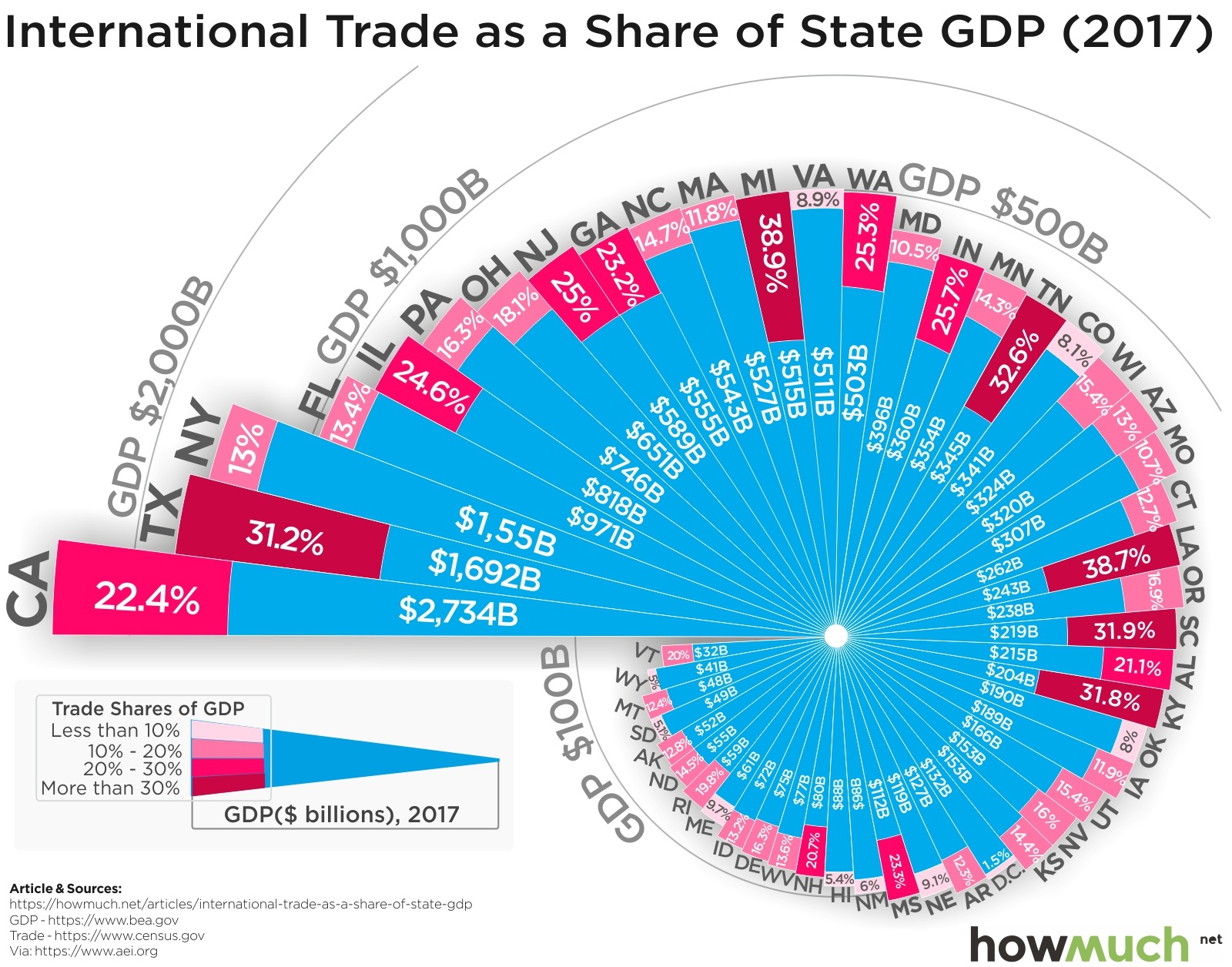
International trade is not simply a foreign policy concern; it is also a key determinant of domestic politics. How Much, a website site devoted to things economic, has produced an unusual graph showing how much each state in the US is dependent on international trade as a percentage of its total GDP. Here are the five US states most dependent on international trade:
Here are the top five states where international trade makes up the greatest percentage of the local economy (we included the GDP ($B) of each state for reference):
1. Michigan: $200B – 38.9%
2. Louisiana: $94B – 38.7%
3. Kentucky: $78B – 38.1%
4. Tennessee: $112B – 32.6%
5. South Carolina: $70B – 31.9%
All five states voted for Donald Trump in the 2016 presidential election. We will see how their economies are affected if his proposed tariffs go into effect.
Surprisingly, US President Trump indicated today that he is thinking about rejoining the Trans-Pacific Partnership (TPP), a trade agreement with 11 other Pacific countries negotiated by President Obama. The 12 countries negotiated the agreement without China’s participation on the assumption that if all twelve were to agree on all matters, then, when was invited to join, it would have no choice but to accept the terms of the TPP. The main sticking point was agreement on the protection of intellectual property, an issue on which the Chinese have been notoriously obstreperous. US President Trump savaged the agreement during the presidential campaign (see the video below). Apparently, President Trump now believes that the TPP offers the best negotiating position vis-a-vis the Chinese. But the 11 Pacific countries proceeded with the agreement after Mr. Trump pulled the US out, and it is not a clear bet that they will now welcome the re-entry of the US. Mr. Trump also wants to join the TPP in order to placate US farmers who stand to lose significant markets if the Chinese make good their threats of retaliatory tariffs on US products.
Textiles are one of the major products that essentially tracked the process of globalization. Textile mills started in Great Britain, then moved to the northeast of the US, then to the southern US, then to China, then to Vietnam, and finally to Bangladesh. The manufacturers of textiles basically followed the path to the cheapest labor market. Textiles may no longer follow this track since robotics are being developed to the point where virtually no labor at all will be required. According to the IEEE Spectrum:
“Sometime later this year, dozens of robots will spring into action at a new factory in Little Rock, Ark. The plant will not make cars or electronics, nor anything else that robots are already producing these days. Instead it will make T-shirts—lots of T-shirts. When fully operational, these sewing robots will churn them out at a dizzying rate of one every 22 seconds.”
Robotization of textiles was considered highly unlikely since the raw material of most clothes is impossible to standardize: fabrics are highly pliable and each cut differs from every other. The solution for robots? Don’t measure the fabrics; just count the threads. High-speed cameras, operating at 1,000 frames per second, make it possible to cut and sew based on the number of threads in each piece of fabric. Who knows how many jobs will be lost to this miracle of modern science?
The Russian publication, Kommersant, has run an article on the Russian preparations for a US attack on Syrian and the Russian interpretation of US intentions in the region. At the end of the article, there is a fascinating paragraph which provides some insight into the way the US and Russia are addressing the issue of the use of chemical weapons:
“At the same time, according to Kommersant’s information, the Russian side expects to receive from the Pentagon the coordinates of the targets, on which the United States is going to strike (as it was on April 7, 2017 before the shelling of the Syrian air base Shayrat). This is necessary to exclude even the theoretical possibility of losses from the Russian side, since MO officers are present on dozens of Syrian infrastructure facilities.”
In other words, Russia and the US are coordinating the possible strikes in Syria so as to avoid Russian military casualties and thereby prevent a great power confrontation in Syria. Syrian President Assad could hardly be reassured by the duplicity of its major supporter. And it is not clear whether the other players in the possible attack–Israel and Iran–are involved in this ploy. It also may be the case that the US does not intend to inflict great damage, if any, on Syria. US President Trump tweeted this morning: “Never said when an attack on Syria would take place. Could be very soon or not so soon at all! In any event, the United States, under my Administration, has done a great job of ridding the region of ISIS. Where is our ‘Thank you America?’”
Turkish Flag: US Flag: Syrian Flag: Russian Flag: French Flag:
The Turkish think tank, the Omran Institute for Strategic Studies, has also published a very good map of the military bases in Syria.
If military action occurs in Syria, one can use these maps to determine the objectives of the attacks. In particular, one should look to see if US and allied forces are deliberately avoiding Russian targets in an attack to prevent an escalation of the conflict. If it is clear that such restraint is being exercised, then the Russians will likely not seek to raise the stakes. But there will be a point where the Russians may have to worry about attacks that threaten to topple the Assad regime. These lines are very fine and the possibility of inadvertent attacks may upset these specific intentions.
The Russian news source, Interfax, is reporting that 11 Russian naval vessels have left their port at Tartus in Syria. The British newspaper, The Telegraph, is reporting that Britain is moving some of its submarines toward the Syrian coast, even as Prime Minister May indicated that she did not need the consent of Parliament to use force against Syria. The US already has the USS Donald Cook and the USS Porter–both Arleigh Burke-class destroyers–off the coast of Syria. But the USS Harry Truman carrier group has only just left its port in the US and will not arrive off the coast of Syria until mid-May. Meanwhile, Iran and Israel are trading diplomatic barbs after the Israeli strike on a Syrian military base that killed 4 Iranian soldiers. Israel said that “If the Iranians act against Israel from Syrian territory, Syrian President Bashar Assad and his regime will be those that pay the price.” In response, the “top adviser to Iran’s Supreme Leader Ali Khamenei called a strike on the Syrian T-4 air base ‘Israel’s crime’ and said the alleged act would ‘not remain without response.'” In addition, US President Trump and Russian President Putin continue to exchange harsh words over the situation in Syria. Russia vetoed a Security Council resolution condemning the Syrian government for the chemical attack. Despite all this activity, I still cannot figure out what US policy toward Syria is right now.
Scientific American is reporting on new research that suggests that a significant change in the dynamics of the North Atlantic may be occurring: “The grand northward progression of water along North America that moves heat from the tropics toward the Arctic has been sluggish. If that languidness continues and deepens, it could usher in drastic changes in sea level and weather around the ocean basin.” The research suggests that “Sea levels could ratchet upward along the U.S. east coast, key fisheries could be devastated by spiking water temperatures and weather patterns over Europe could be altered.” The movement of the water currents is called the Atlantic Meridional Overturning Circulation (AMOC) and it is determined by the differences between the warm, salty water that comes up from the tropics and the cold, fresh water that comes from melting ice in the polar seas. According to the Washington Post, the AMOC is slowing down and is weaker than at any point in the last millennium. What is not clear is whether this is a natural process of slowing down or part of the process of global warming. Unfortunately, highly precise ocean measurements are a very recent development in climate science, so the record of the past cycles is not well understood.
As the world waits for the response of the US and Europe to the reports of chemical weapons attacks by the Syrian government against civilians in the city of Douma, it is useful to know the background to the use of these weapons in Syria since the outbreak of the civil war in 2011 (although it is clear that Assad’s father, Hafez al-Assad, slaughtered thousands in the city of Hama in 1982). ABC News has published a timeline of the known events. Chemical weapons were supposed to have been removed from Syria in 2014 and Russia agreed to monitor their removal. But there were significant problems in the monitoring, cataloged by the international lawyer, Ahmet Üzümcü, most notably the omission of chlorine from the list of banned weapons (there are similar problems in listing white phosphorous and napalm as banned weapons). Unfortunately, there are a large number of incidents concerning chemical weapons in the 20th century, and, shockingly, there have been no prosecutions on the use of chemical weapons despite their widespread use.
The Russian military forces in Syria have been put on high alert in anticipation of an attack by the US and its allies. There are reports that the Syrian military has placed sophisticated anti-missile systems around the presidential house in Damascus, Syria, that Russian Beriev A-50 early-warning aircraft had been deployed along the coast, and the the Russian Black Sea fleet has been placed on high alert. Additionally, the Russians have figured out to jam the communications of US drones in Syria. For its part, the US has deployed the Arleigh-class naval destroyer, the USS Donald Cook, to the eastern Mediterranean and that it will be joined by the Harry S. Truman Carrier Strike Group. And Israel has indicated that it favors more military action, despite strong protests from Russia and Iran after its attack on Syrian military base that killed four Iranian soldiers. Israel faces three military threats in the region: Iranian troops in Syria, Hezbollah, which has thousands of missiles in Lebanon, and the Hamas-inspired protests in the Gaza.
Viktor Orbán has won a decisive and historic third term as Hungary’s Prime Minister. His party, Fidesz, won 133 of 199 seats in the Parliament, enough to guarantee a two-thirds majority and the ability to alter the country’s constitution. Orban ran on a platform excoriating migrants, the European Union, and George Soros. Here is a part of Orbán’s final campaign speech on 6 April as translated by the Budapest Beacon:
“They want to take our country away. Opposition parties in the service of foreign interests want to come to power. They want to give power to opposition politicians in the pay of foreigners so that they can demolish the fence and accept from the hand of Brussels the compulsory settlement quota, and in this way turn Hungary into a country of immigrants in order to serve the financial and power interests of their clients.”
“Tell everyone that they want to settle the first ten thousand migrants in Hungary yet this year. Tell everyone that they have made a pact with everyone from (DK chairman Ferenc) Gyurcsány to (Jobbik chairman Gábor) Vona. Tell everyone that immigration is the blight that slowly but surely devours our homeland. Tell everyone that we have to support migrants. If the settlement (of migrants) takes place, in vain will there be economic growth, there will be nothing with which to support families or to pay pensions. Tell everyone that mass migration threatens the everyday security to which we are accustomed. With mass migration comes a greater threat of terror. It is as clear as day that where there is mass migration, women are threatened with violent attacks.”
“The reason we came together here is to demonstrate the seriousness of our intentions, the strength of our determination, and the firmness of our resolve. We wanted to stand here where one thousand years ago the Hungarian temple of heroes stood. We wanted to stand here where the Christian kingdom of Hungary was born. Where the founders of the country understood the gravity of their mission and their work and fulfilled their mission. We wanted to assemble here where the chapter of the Christian statehood began that continues to this day. This is where we really feel what is at stake in the struggle before us on Sunday. When we stand in this place we must withstand its gaze and we must subject ourselves to its status. Their country stands before us. Three dates: 1001 – The coronation of Szent István. 1688, the liberation of the (Buda) castle from the Turkish occupation. 1938, the 900th anniversary of the death of Saint István. What they founded, and for which they fought, what they defended and retain, we also need to retain and defend and, when the time comes, give over to our children and grandchildren. Hungary is our home. We have no other. We need to protect it. We need to defend it. Because without it we are homeless orphans and beggars in the big world.”
“His was a nasty campaign. It was fought on a venomous blend of anti-Muslim, anti-migrant rhetoric, wrapped up in a barely concealed anti-Semitic conspiracy theory. The latter targeted Mr Orban’s pet hate, the Hungarian born financier George Soros, whose foundation promotes openness and tolerance. In more veiled fashion, the campaign also targeted the EU and its founding values.”
Viktor Orbán
We are beginning to get more information about the chemical weapons attack in Douma, Syria. Nothing is yet conclusive but the physical evidence indicates a chlorine-like agent. The US and its allies are pushing for an investigation of the incident by the UN, and Russia has invited investigators from the Organisation for the Prohibition of Chemical Weapons (OPCW) to visit the site. But there is a great deal of hostility in the UN Security Council meeting that is going on as I write this post. The US Ambassador to the UN, Nikki Haley, made this statement in the Security Council: “The Russian regime, whose hands are all covered in the blood of Syrian children, cannot be ashamed by pictures of its victims.” US President Trump said that the US, in consultation with its allies, will decide upon a response within 24 to 48 hours. Since the US response to a similar chemical attack last year–which consisted of 59 cruise missiles–apparently did not deter Syria from further use of those weapons, it is difficult to imagine what kind of military attack could succeed in preventing another such attack. But US credibility is on the line right now with negotiations with North Korea and Iran coming up in less than a month, and it would be very difficult for the US to back down from its inflammatory rhetoric. Tom complicate matters further, Israel struck a military base in Syria at which Iranian militias were reportedly based. Things seem to be spinning out of control.


 US Flag:
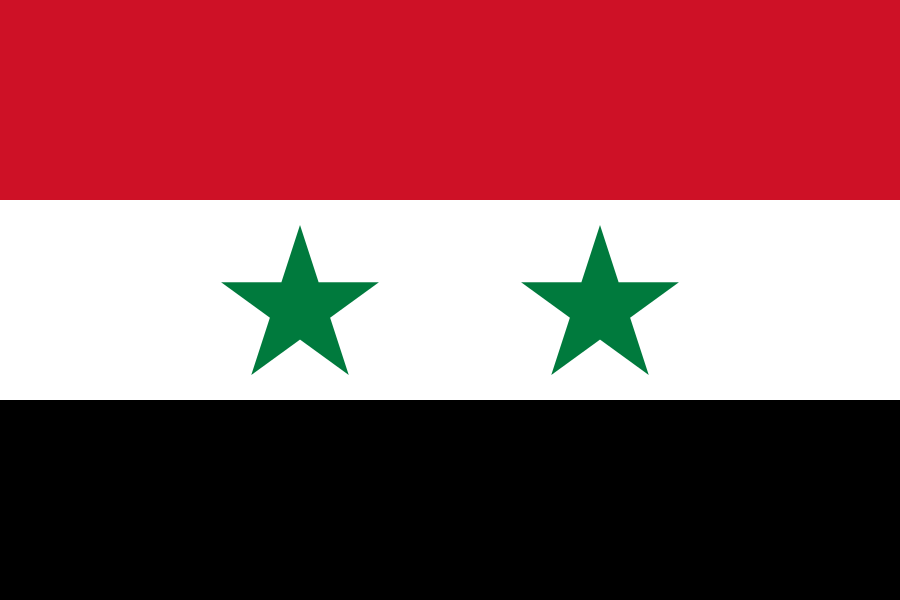
  Syrian Flag:
  Russian Flag:
  French Flag:


 World Politics News