Stock markets around the world fell today as evidence mounts that global economic growth seems to be slowing. In China, industrial production fell 4.8 percent in July, the lowest level since 2002, and Germany experienced negative growth for the second time in the last three quarters. In the US, the bond market became “inverted” with short term rates higher than long term rates–a sign that bond investors believe that economic growth in the future will decline. An inverted bond market often signals the onset of an economic recession.
The stock market in the US was higher yesterday as US President Trump decided not to impose new tariffs on Chinese products on 1 September as he had threatened. Instead, a decision will be made at the end of the year. The tactical change revealed a number of important issues. First, the delay was justified by President Trump because he did not want prices of such goods as toys and electronics to rise before the Christmas buying season:
Q. Would you consider moving the tariffs, even? Delaying them even further, past December 15?
THE PRESIDENT: No, we’re doing this for Christmas season, just in case some of the tariffs would have an impact on U.S. customers, which, so far, they’ve had virtually none.
Note that the statement contradicts President Trump’s earlier position that the Chinese are paying for the higher tariffs, as noted by Tory Newmyer in The Washington Post: ” The president’s claim that the impact of existing tariffs on American shoppers has been ‘virtually none’ is provably false. Yet the acknowledgment that consumers would be on the hook for tariffs broke new ground for Trump, who has insisted for months, against a consensus among economists and a raft of data, that the Chinese are footing the bill for his trade war.”
Second, the US received nothing in return from China from the delay. Last week, China announced that it would stop buying US agricultural products because of the threat of the new tariffs. But after Trump announced that he was delaying the tariffs, the Chinese did not say that they would return to buying US agricultural products. Backing down without any reciprocation is capitulation, which is not necessarily a bad tactic unless one is engaged in extended negotiations. Capitulation in an early stage of a negotiation weakens a bargaining position since it indicates a reluctance to endure the economic or political position to force concessions.
Third, there are two keys to winning a negotiation. First, one needs to figure out a way for both sides to benefit from the outcome of the negotiation. There is precious little evidence that either Trump or Xi are pursuing a win-win strategy at this point. Second, each side needs to persuade the other that it is willing to endure the pain of loss in order to achieve a victory. President Trump has always said that China will suffer more than the US from a trade war. But his statement today suggests that he is worried about the effects of a trade war on his re-election chances. If that is true, and China is certainly aware of that concern, then there is a real time limit on how much pain Trump is willing to suffer. The Chinese may simply decide that they should wait until election pressures force Trump to capitulate again.
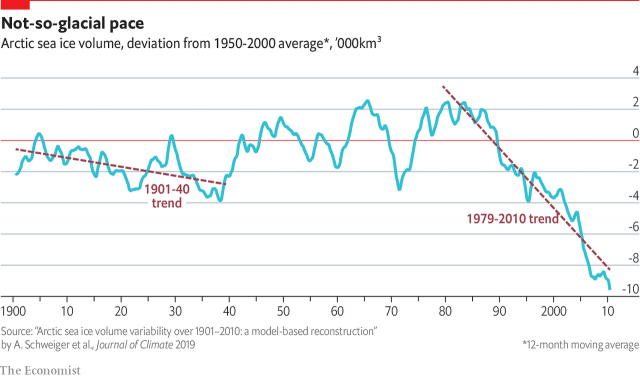
The Paris Agreements on climate change were a set of policies designed to keep the increase of global temperatures below 2 degrees Celsius. That increase was determined to be critical to efforts to prevent catastrophic changes which would be either difficult or impossible to accommodate. The Washington Post, however, has published an article that indicates that many places in the US have already passed temperature increases equal to or higher than 2 degrees C.:
“NOAA data shows that in every Northeast state except Pennsylvania, the temperatures of the winter months of December through February have risen by 2 degrees Celsius since 1895-1896. And U.S. Geological Survey data shows that ice breaks up in New England lakes nine to 16 days earlier than in the 19th century.
“This doesn’t mean the states can’t have extreme winters anymore. Polar vortex events, in which frigid Arctic air descends into the heart of the country, can still bring biting cold. But the overall trend remains the same and is set to continue. One recent study found that by the time the entire globe crosses 2 degrees Celsius, the Northeast can expect to have risen by about 3 degrees Celsius, with winter temperatures higher still.”
There are several other areas of the US that have passed the 2 degree increase, and all areas of the US except for the deep South have experienced higher average temperatures. Globally, last July was the warmest month ever recorded.
“The messages from Beijing to protesters in Hong Kong are increasingly ominous. First there was propaganda footage of Chinese soldiers garrisoned in Hong Kong drilling for intense urban fighting that looked more like a civil war than search and rescue or crowd control.
“Now footage has emerged of armoured paramilitary vehicles massing across the border. Two months into demonstrations sparked by a controversial extradition law, official rhetoric from Beijing has escalated too. Authorities recently denounced protests as “terrorist acts”, promised an “iron fist” response and, perhaps most alarmingly, described the movement as a ‘colour revolution’.
“China considered the pro-democracy protests which swept across the former Soviet Union during the early years of this century, most prominently Ukraine’s 2004 Orange Revolution, to be existential threats to be tackled at almost any cost. Putting the same label on protesters implies Beijing will stop at little to crush the movement.”
US President Trump tweeted some rather extraordinary information today: “Our Intelligence has informed us that the Chinese Government is moving troops to the Border with Hong Kong. Everyone should be calm and safe!” It is highly unusual for a power to relate classified intelligence about the internal problems of another power (just imagine what a tit-for-tat exchange of intelligence suggesting vulnerability would look like). But Mr. Trump did not support the protesters, although a number of US politicians, both Republican and Democratic, voiced support for the protesters.
” The movement now has five key demands for Hong Kong’s government:
to withdraw the extradition bill
to officially retract descriptions of the protests as a “riot”
to drop charges against protesters
to launch an investigation into police force during the protests
“universal suffrage,” which would allow Hong Kong voters to directly pick their leaders rather than the current process that includes Beijing’s involvement.
The US should be strongly supportive of these demands. There is no question that China will regard US expressions of support as meddling in their internal affairs. So be it.
As the US continues to exert pressure on Iran, one can assume that Iran is trying to find allies, or, at the least, sympathetic friends to maintain its economy. It is also pretty safe to assume that it has been successful, given that the price of oil has not risen dramatically, even as the US tries to cut off exports of oil from Iran and Venezuela. The suspicion is that both China and Russia are moving closer to Iran (and perhaps India as well), and are conducting economic and strategic relations surreptitiously. US policy seems to be isolating the US quite effectively, and the long-term consequences of the shift will likely be significant.
We know that Russia has been developing new weapons to counteract the US effort to build an effective anti-missile system. The US systems are far from operational, but Russia is taking no chances that its nuclear arsenal could be made obsolete by new technologies. The two ways to defeat an anti-missile system is to make nuclear missiles so fast that an anti-missile system could not respond in time and/or to develop missiles that can travel close to the ground for extended periods of time, allowing missile trajectories that cannot be effectively tracked. The Russians (and the Chinese) are developing hypersonic missiles to accomplish the first tactic and there have been some successes in this area. The second tactic requires missiles that use an energy source other than chemical fuels. The most obvious fuel source is an very small nuclear reactor fitted onto a cruise missile, but the technological hurdles for building such reactors are formidable.
The Russians are reporting that a nuclear accident occurred near their testing site in the Arctic, in a closed town named Sarov. At least five people, all scientists, were killed in the accident and higher levels of radioactivity were reported. It appears as if a new cruise missile was being tested. In talking about the Russian test, US President Trump also revealed that the US is working on a similar missile, apparently breaching a highly classified secret. Both states are working on a weapon that neither side needs for any strategic purpose.
Protests in Hong Kong are continuing and the protesters are adopting cat-and-mouse tactics to evade the riot police. The protests seem to have gone far beyond expressing displeasure at the extradition bill proposed by Beijing that places Hong Kongers within the jurisdiction of the central government in Beijing. Now, protesters are using slogans that refer to the “liberation” of Hong Kong. Global Times, a media outlet that often reflects the opinion of the Beijing government, claims that the protesters do not have the support of ordinary people in Hong Kong:
“More and more Hongkongers urged police to strictly enforce the law and bring all violent rioters to justice after the city suffered another weekend of chaos and public transport disruption.
“Illegal protesters began to use guerrilla-style assemblies and flash mob protests to hit different districts during the weekend, seriously affecting the normal life of Hong Kong residents.”
“Large groups of Hong Kong people visited several police stations in Hong Kong Saturday to express their firm support for and utmost respect to the police force.
“The scene stood in stark contrast to the chaotic and violent besieges of police stations by black-clad protesters on many nights over the past weeks.
“‘The police have been working really hard to safeguard social order. We came here to show our support,’ said a resident surnamed Chan, who visited Kwai Chung Police Station with his wife and son. The boy gave the police a hand-written card as a gift.’
The evidence, however, suggests that the protests have wide support. The protesters are also becoming quite sophisticated, playing games of rock-scissors-paper to determine the location of their protests so that the police cannot anticipate their moves. It seems clear, however, that the Beijing government’s willingness to tolerate the protests is getting short, and there is great danger that violence will be used to suppress the protests, as was done in the protests in Tiananmen Square in 1989.
“The numbers are mind-boggling: $70,000 per minute, $4 million per hour, $100 million per day.
“That’s how quickly the fortune of the Waltons, the clan behind Walmart Inc., has been growing since last year’s Bloomberg ranking of the world’s richest families.
“At that rate, their wealth would’ve expanded about $23,000 since you began reading this. A new Walmart associate in the U.S. would’ve made about 6 cents in that time, on the way to an $11 hourly minimum….
“So it goes around the globe. America’s richest 0.1% today control more wealth than at any time since 1929, but their counterparts in Asia and Europe are gaining too. Worldwide, the 25 richest families now control almost $1.4 trillion in wealth, up 24% from last year.”
The rate at which wealth is being concentrated cannot be sustained, economically or politically. Common Dreams extrapolated the rate and found that there is an end point which is morally inconeivable:
“If wealth inequality in the United States continues to soar at its current rate, the top 10 percent of Americans could own 100 percent of the nation’s net worth by 2052.
That’s according to an analysis by Dallas Morning News finance columnist Scott Burns, who wrote Sunday that the wealthiest Americans ‘will truly ‘have it all’ just 33 years from now.’
“‘However you slice it, the rich have been getting richer. Lots richer,’ wrote Burns, citing Federal Reserve data. ‘Here are the basics. From 2013 to 2016, the top 10 percent of households increased their share of total wealth from an amazing 75.3 percent to a stunning 77.2 percent. That’s a share gain of 1.87 percent in just three years.’
“‘If they continue to gain share at that rate,’ Burns added, ‘they’ll have the remaining 22.8 percent of net worth held by the other 90 percent in just 12 more surveys, give or take an upheaval or two.'”
We should all keep this data in mind as we are flooded with charges of “socialism” as efforts are made to protect the interests of those who are not benefiting from the economic system in place.
We need to keep a close eye on what’s happening in North Korea. In the last few weeks it has conducted five short-range missile tests, but the more recent tests seem to be of a different kind of missile. We do know that the Trump Administration believes that as long as North Korea does not test a nuclear bomb or launch a long-range ballistic missile, it does not violate the understanding reached between leader Kim and President Trump in Singapore last year. But it appears as if leader Kim is threading a very small needle of understanding. North Korea believes that the US is preparing to violate the Singapore Agreement by conducting military exercises with South Korea tomorrow, and these tests are expressions of discontent with the US actions. If the war games occur, then it may be the case that North Korea considers the Singapore Agreement null and void. If that is the case, then we should expect North Korea to reciprocate by either testing a bomb or a long-range missile. How President Trump responds to that move is a matter of conjecture: President Trump will likely downplay its significance, but National Security Adviser Bolton and Secretary of State Pompeo, both of whom have argued for regime change in North Korea. will likely push for a more robust response. While the US and North Korea continue to dance, South Korea seems to be increasingly worried about the reliability of the US as an ally. It recently announced that Lee Soo-hyuck, who has described Mr. Trump as “treacherous”, will be the next South Korean Ambassador to the US.
We have virtually no hard information about what is happening in Kashmir. The Indian government has cut off all internet connections with the territory, controls all flows of information, and has reportedly sent a large number of troops into the region. The Straits Times reports that India has arrested 300 Kashmiri politicians. The New York Times reports:
“On the streets of Srinagar, Kashmir’s biggest city, security officers tied black bandannas over their faces, grabbed their guns and took positions behind checkpoints. People glanced out the windows of their homes, afraid to step outside. Many were cutting back on meals and getting hungry.
“A sense of coiled menace hung over the locked-down city and the wider region on Saturday, a day after a huge protest erupted into clashes between Kashmiris and Indian security forces.
“Shops were shut. A.T.M.s had run dry. Just about all lines to the outside world — internet, mobile phones, even landlines — remained severed, rendering millions of people incommunicado.”
“A swing of about 2.5 million residents would shift Jammu and Kashmir from majority-Muslim to majority-Hindu. In a nation of 1.3 billion, that’s not such a stretch. The BJP forcefully advocates for in-migration of Hindus to the state. Officially, this applies only to those who fled Kashmir in the violence of the 1990s, but there is now no legal barrier to a full-bore program of government-sponsored in-migration. Such a move would solidify the BJP’s Hindu-nationalist agenda of redefining India not as a multireligious secular state, but as a Hindu rastra in which 200 million Muslims are tolerated only so long as they remain on good behavior.”
It is difficult to see how Pakistan can effectively respond to this move. It has recalled its ambassador, but the Indian government of Narendra Modi has unquestionably committed to this course of action. I suspect, however, that there is no stable outcome without a dramatic reversal by India.
The US has imposed additional sanctions on the Maduro regime in Venezuela. The sanctions are designed to pressure Maduro to resign and will undoubtedly aggravate the desperate situation for most Venezuelan citizens. It is not clear why the Trump Administration believes that additional sanctions will work since they have not only been ineffective against Venezuela, but also Russia, Cuba, North Korea, and Iran. Like the Iranian sanctions, the US is applying secondary sanctions against companies that trade with Venezuela–in effect, making US law extra-territorial. The US National Security Adviser, John Bolton, made this comment:
“Critically, it also exposes foreign entities doing business with the Maduro government to so-called secondary sanctions in the U.S. — a fact not lost on Maduro’s government as it tries to rally support at home and abroad.
“’The U.S. has to understand once and for all that they aren’t the owners of the world,’ Vice President Delcy Rodriguez said in a statement from Caracas. ‘Every country that has investments in the U.S. should be very worried because this sets a dangerous precedent against private property.'”
I doubt that these sanctions will induce Maduro to leave office, particularly since he seems to have the backing of both Russia and China.
The United Nations Intergovernmental Panel on Climate Change has released another report, this one on climate change and food production. It is a very lengthy report and at this point I have only read the first chapters. It is so depressing, however, that I may not finish it. Rolling Stone summarized some of the findings:
“The report confirmed that the world’s land areas are warming about twice as fast as the oceans, a phenomenon that was long predicted (soil heats up faster than water, which is why we cool off in swimming pools). Warming over land is happening so fast that even since the end of the 10-year average used in report (2006 to 2015), global land temperatures have increased by a further 20 percent. New data show that last month, July 2019, was the hottest month ever measured on the planet…..
“That ongoing transition to a world never-before experienced by humans is greatly worrying, because we’re not sure how modern agriculture will respond. Among other things, the report finds food will become less nutritious at higher levels of carbon dioxide in the atmosphere as plant’s chemistry fundamentally changes. Masson-Delmotte said that the search is already on for crops that are resilient to extreme heat and drought, as well as urgent efforts to conserve and protect forests that help buffer the natural world from the expansion of agriculture.
“The risks to the world’s farms increases rapidly beyond warming of 1.5 to 2 degrees Celsius, to the point where some of the possible solutions to climate change might quickly become impossible.”
The situation in Kashmir continues to be unsettled. The moves by the Indian government has opened the door to what Kashmiris believe could be a demographic catastrophe. Writing in The Intercept, Murtaza Hussain explains:
“Modi has repeatedly promised to take such a step despite the likely backlash from Kashmiris, most of whom either nurse separatist sentiments or wish to maintain autonomy from the rest of India. A particular clause of that law, known as article 35A, gives the Kashmiri government the ability to determine who is a permanent resident of the state. The revocation of both 370 and 35A opens the door to India’s population of 1.2 billion to begin moving into Kashmir en masse, a development likely to dangerously escalate a conflict that is at its core over territorial control.
“’For Kashmiris, it was the last thing they were holding onto before a complete and utter ethnic cleansing could take place,’ wrote Hafsa Kanjwal, an assistant professor of South Asian history at Lafayette College, in a Facebook post about the revocation of article 35A. ‘But this has changed now. The worst nightmare that Kashmiris could have imagined in their already existing nightmare can take place now. Indians can buy property and land in Kashmir, and drive out the local population.’”
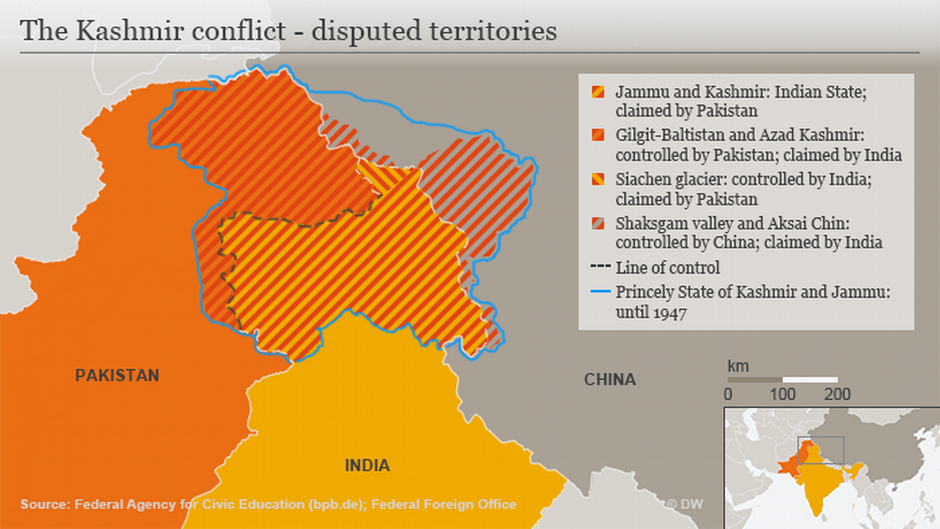
“While India was part of the British Empire, Jammu and Kashmir was one of the many princely states that made up the colonial territory, this one presided over by Maharajah Hari Singh. As India’s independence from Britain—and the ensuing partition—was being planned in 1947, Singh, a Hindu ruler of a Muslim-majority state, initially desired that the Jammu and Kashmir become an independent neutral region between India and the new nation of Pakistan. However, an uprising in the state’s western region, aided by Pakistani raiders and primarily targeting Singh, forced him to cede sovereignty to India in exchange for military aid. This led to India and Pakistan’s first major war—although the two countries had already been locked in bitter conflict since gaining their freedom. While Pakistani forces were successful in taking the western and northern areas of Kashmir, India was able to hold the majority of the princely state, including the areas of the Kashmir Valley, Jammu, and Ladakh. The Pakistani region of Kashmir was then recognized as ‘Pakistan-administered Kashmir,’ while India’s territory retained the name Jammu and Kashmir.”
The Indian decision brings the world back to 1947, except that now both India and Pakistan are nuclear-armed states, which are inching closer to war.
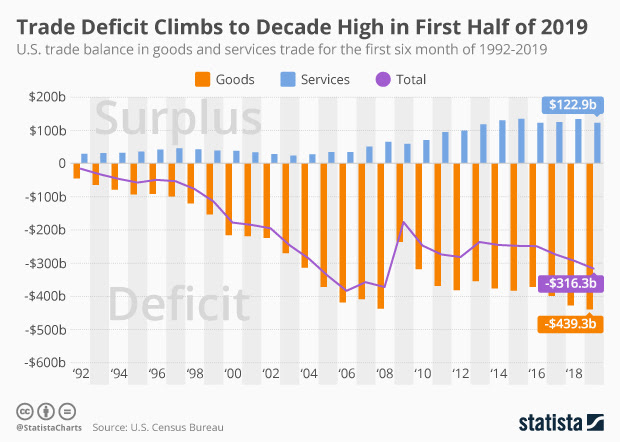
China has allowed its currency, the Yuan, to depreciate below the critical level of 7 Yuan per dollar: “onshore trade of the Chinese yuan changed hands at 7.0304 against the dollar, while the offshore yuan traded at 7.0807 against the greenback. The effect of the depreciation is to make Chinese exports less expensive and Chinese imports more expensive. There was no explicit announcement about the move, but most suspect that it is retaliation by China against US President Trump’s decision to impose an additional 10% tariff on Chinese exports to the US. The US stock market fell sharply because of the news as it suggests that the trade war is far from being resolved. The US does not seem to have a plan for resolving these tensions and the Chinese are simply reacting to US moves. The actual data indicates that Chinese exports to the US are falling, but the US trade deficit with other countries is increasing.
US trade policy seems to be identifying the wrong source of the balance of trade deficits.
India has revoked the special status of Jammu and Kashmir, making the territories legally equal to all other parts of India. Jammu and Kashmir have been contested territories ever since the partition of India into India and Pakistan in 1947. The territory has a primarily Muslim population, but was divided by a “Line of Control” between India and Pakistan, and the two states have fought several times–in 1947, 1965, and 1971–over the right to control the territory. Since the Simla Agreement of 1972, there has been sporadic violence between the two states but the government of Narendra Modi in India has encouraged the growth of Hindu nationalism which has aggravated the tension. The revocation decision has led many in Pakistan to fear that the Indian government wishes to foster Hindu nationalism in these volatile territories. Pakistan has angrily responded to the decision:
” Pakistan’s Foreign Ministry responded to the revocation with a statement saying it ‘strongly condemns’ India’s decision and ‘will exercise all possible options to counter the illegal steps.’
“‘The Indian Occupied Jammu and Kashmir is an internationally recognized disputed territory. No unilateral step by the government of India can change this. Nor will this ever be acceptable to the people of Jammu and Kashmir and Pakistan,’ the ministry said, citing that its status had been upheld by UN Security Council resolutions.
“‘Pakistan reaffirms its abiding commitment to the Kashmir cause and its political, diplomatic and moral support to the people of occupied Jammu and Kashmir for realization of their inalienable right to self-determination.'”
“More broadly, though, India unilaterally pushed to change Kashmir’s status without Pakistan’s buy-in. The worry now is that widespread unrest will spike in the region. Indian forces already heavily patrol Kashmir, but it has sent thousands of extra troops there in anticipation of violence, as well as closed schools, evacuated tourists, cut off internet connectivity, and put some of the area’s political leaders under house arrest. In effect, the area is on lockdown.”
We should all keep an eye on how this situation unfolds.
Protests are continuing in Hong Kong and the central government in Beijing appears to be at a loss to address the situation effectively. The immediate cuase of the protests is a extradition bill proposed by the Legislative Council in Hong Kong which would make Hong Kongers subject to the laws of the central government. That possibility violates the spirit of the agreement worked out with great Britain in 1997: “One Country, Two Systems”. The protesters seem to be taking a harder line:
“Authorities in Hong Kong and Beijing this week signalled a hardening stance, including with the arrests of dozens of protesters, and the Chinese military saying it was ready to quell the “intolerable” unrest if requested.
“But protesters have remained unyielding, vowing to hold multiple occupations and rallies into next week, sending tensions soaring once more.
“On Saturday they embraced their mantra ‘be water’ – a philosophy of unpredictability espoused by local martial arts legend Bruce Lee – in a bid to keep police guessing.
“Throughout the evening they put up makeshift barricades across multiple roads in Tsim Sha Tsui, a popular shopping and tourist district on the harbourfront, where many luxury malls and hotels shut their doors.
“They also blocked one of the three cross-harbour tunnels connecting to the main island, causing widespread traffic chaos, before disappearing after half an hour.
“’We will fight as guerrillas today and be water,’ a masked and helmeted 19-year-old, who gave her surname Lee, told AFP.”
China blames the US for stoking the protests, but the US has yet to issue strong warnings to the government in Beijing to respect the right of protests, even as it seems as if China may be contemplating a military crackdown on the protests.
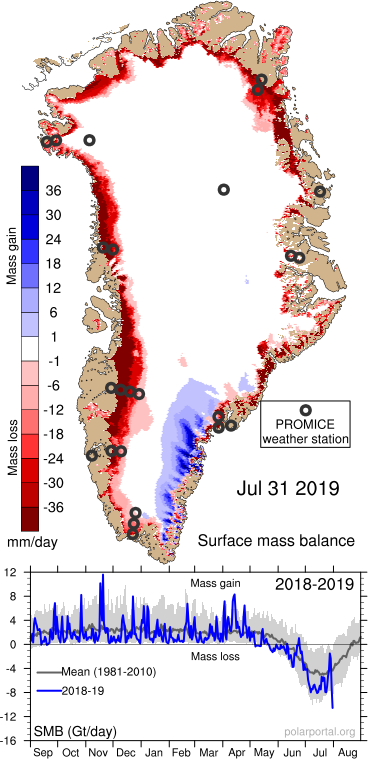
The European heat wave has moved north and now temperatures in Greenland are leading to significant glacial ice melt. In the month of July, Greenland lost 197 billion tons of ice, including 11 billion tons in one day. At the same time, wildfires are burning out of control in Siberia. Climate change is clearly not a future event.


 World Politics News