The announcement by President-elect Biden that he will appoint retired Army Gen. Lloyd J. Austin III to be the next Secretary of Defense has raised concerns about whether the military will have a inordinate voice in American foreign policy. The tradition in the US is to have the military run by a civilian as explained by Amber Philips in The Washington Post:
“Does being cozy with the military, because you recently served in it, make someone unfit to lead the military?
“There’s a law that says the leader of the Defense Department needs to have at least seven years’ distance between themselves and military service. The law, originally passed in 1947 and originally with a requirement that a candidate be retired from military service for a minimum of 10 years, is derived from the concept that the military should serve civilians, not the other way around. (Congress changed the law in 2007 to a seven-year minimum.)
“The roots of this desire to have a civilian head the military run deep. At the outset of the nation, Congress was really worried about how its military could be seized by malign actors who could overthrow their democratic experiment. Founders took pains to put lots of checks and balances on the military, such as congressional reconsideration of defense funding every two years. The big protection was having a civilian control the military.
“’This has been a recurring theme in U.S. history, separation of military and civilian authority,’ said Mark Cancian, a retired colonel and military expert at the Center for Strategic and International Studies. ‘It’s written into the Constitution. It’s in the Declaration of Independence. That was one of the complaints we had about the British.’”
Austin will require a waiver from Congress because he has been retired less than the required number of minimum years. He is reputed to be close to President-elect Biden, but has a less than distinguished record of interactions with the Congress over his leadership in the Middle East during the fight against ISIS in Syria. And many question whether he is the right person for the job by those who believe that the major challenges to American foreign policy will be in the Indo-Pacific, specifically with respect to growing Chinese military power.
“In his more than 40 years in the United States Army, Austin met every challenge with extraordinary skill and profound personal decency. He is a true and tested soldier and leader. I’ve spent countless hours with him, in the field and in the White House Situation Room. I’ve sought his advice, seen his command, and admired his calm and his character. He is the definition of a patriot. He rose through the Army’s ranks during his distinguished and trailblazing career. He was the 200th person ever to attain the rank of an Army four-star general, but only the sixth African American. He built a career grounded in service to this country and challenged the institution that he loves to grow more inclusive and more diverse at every step.
“He was the first African American general officer to lead an Army corps in combat and the first African American to command an entire theater of war; if confirmed, he will be the first African American to helm the Defense Department—another milestone in a barrier-breaking career dedicated to keeping the American people secure.”
Austin appears to be a second choice for Biden. The initial reports suggested that Michèle Flournoy, a former undersecretary of defense for policy in the Obama administration, was Biden’s first choice. I had reservations about Flournoy who seemed to be more hawkish than Biden himself. For example, in July 2020 Flournoy co-authored an essay entitled “Sharpening the U.S. Military’s Edge: Critical Steps for the Next Administration” which gave me pause:
“As a result, the United States can no longer assume that it will have air, space, or maritime superiority early in a conflict, or the freedom of action that this domain superiority allows. The U.S. military will need to fight to gain advantage—and then to keep it—in the face of continuous PLA efforts to disrupt and degrade U.S. battle management networks, while accelerating its own decision making cycle by leveraging artificial intelligence. China’s theory of victory increasingly relies on the notion of “system destruction warfare”: crippling an adversary’s networks at the outset of conflict by deploying sophisticated electronic warfare, counter-space, and cyber capabilities to disrupt critical C4ISR (command, control, communications, computers, intelligence, surveillance, and reconnaissance) networks, thwart U.S. power projection, and undermine American resolve.”
Flournoy’s emphasis on Great Power competition with China worries me because it reflects the mantra of many who wish to see military spending rise even more than it has during the Trump Administration. There are many more policies toward China that do not emphasize the need to compete militarily.
But it is difficult for me to pin down Biden’s foreign policy preferences. In earlier years Biden was quite hawkish–his support for the Iraq war in 2003 was deeply troubling to me. Biden seems to now be more reticent about the use of the US military, and Austin is more consistent with that perspective. Many seem to believe that a civilian would fill that role, but I no longer believe that to be true. Robert McNamara in the Kennedy/Johnson Administrations and Donald Rumsfeld in the George W. Bush Administration were very hawkish and were enthusiastic supporters of horribly ill-advised American adventures in Vietnam and Iraq.
Austin strikes me as someone who would be more like Colin Powell who was reluctant to put troops in danger unless they were supported to the fullest extent before the war against Iraq in 1991 started. I personally think that someone who has served in the Army (as opposed to the Navy or the Air Force) considers the risk to ground troops very seriously. President Truman took the matter of combat deaths seriously because of his experience in World War I: “Truman was a war hero. The US suffered 53,402 combat deaths in World War I, many of them from the 129th Field Artillery. Under Truman’s command, Battery D had no combat deaths.”
Additionally, the preference for civilian control ignores what I consider to be a more serious threat to American democracy: the inordinate influence of corporations on military spending, perhaps best exemplified by the misbegotten F-35 fighter plane. It is unlikely that Congress would approve of an academic or a peace activist for the post and support for military spending is often used as a surrogate for the “toughness” necessary for credibility in military circles.
In sum, there are some disadvantages to having Austin as Secretary of Defense but the likely alternatives to Austin worry me. It is far better to go with someone who has the confidence of the new President and does not need to prove their spurs to an audience that sees nothing but profit in military spending.
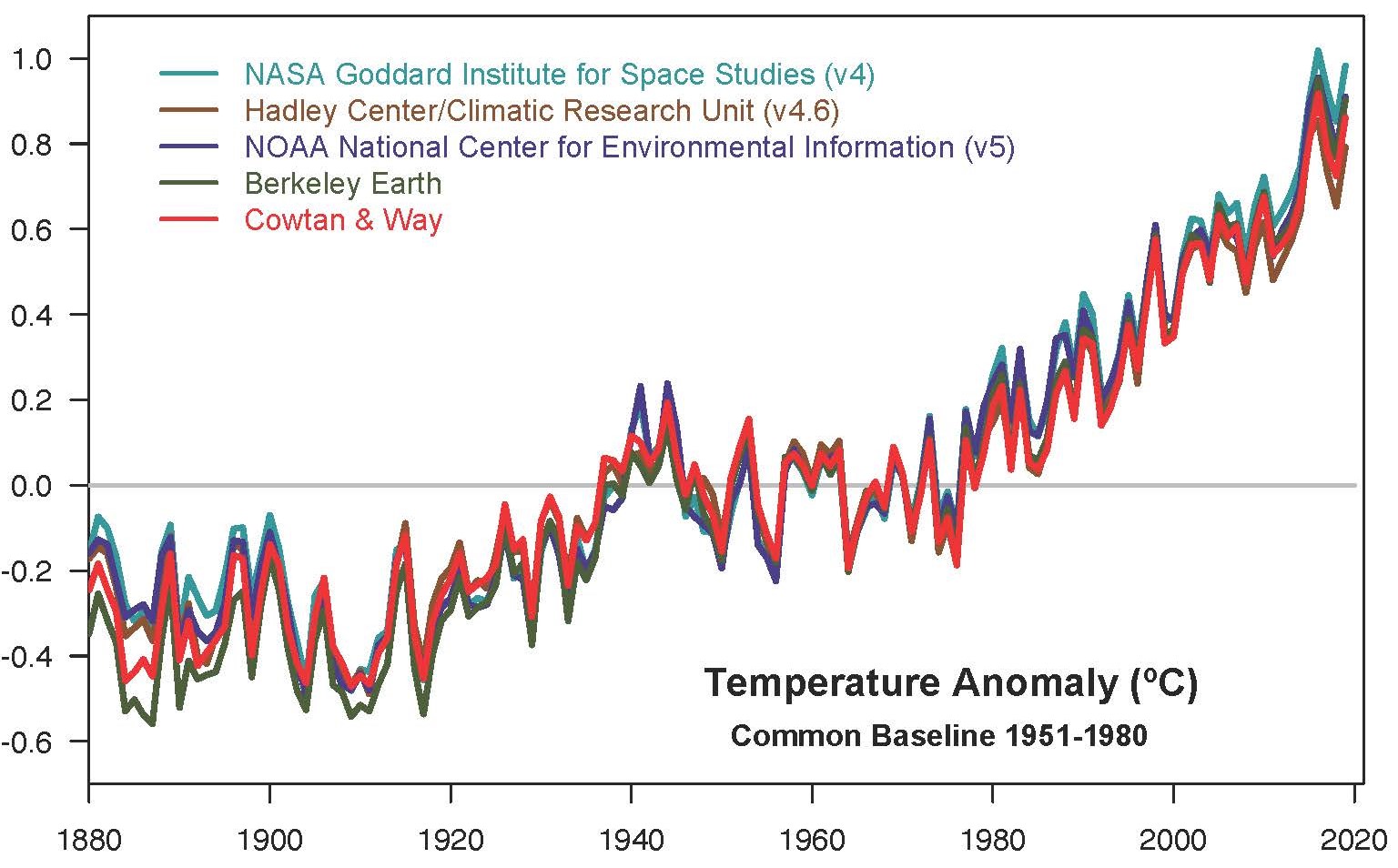
NASA has announced that 2019 was the second warmest year on record, second only to 2016. But it was only second by a hair. According to CNN: “The only year in recorded history the planet has experienced that was hotter was 2016, and only by a hair — just 0.04 degrees Celsius.” The World Meteorological Organization (WMO) provides the background to this warming:
“Concentrations of the major greenhouse gases, CO2, CH4, and N2O, continued to increase in 2019 and 2020.
“Despite developing La Niña conditions, global mean temperature in 2020 is on course to be one of the three warmest on record. The past six years, including 2020, are likely to be the six warmest years on record.
“Sea level has increased throughout the altimeter record, but recently sea level has risen at a higher rate due partly to increased melting of ice sheets in Greenland and Antarctica. Global mean sea level in 2020 was similar to that in 2019 and both are consistent with the long-term trend. A small drop in global sea level in the latter part of 2020 is likely associated with developing La Niña conditions, similar to the temporary drops associated with previous La Niña events.
“Over 80% of the ocean area experienced at least one marine heatwave in 2020 to date. More of the ocean experienced marine heat waves classified as ‘strong’ (43%) than ‘moderate’ (28%).”
The warming process was most acute in Siberia (more that 5 degrees C than normal), southwestern US, northern and western parts of South America, and parts of China. The emission of greenhouse gases contributing to the warming was notable:
“In 2019, greenhouse gas concentrations reached new highs (Figure 3), with globally averaged mole fractions of carbon dioxide (CO2) at 410.5±0.2 parts per million (ppm), methane (CH4) at 1877±2 parts per billion (ppb) and nitrous oxide (N2O) at 332.0±0.1 ppb. These values constitute, respectively, 148%, 260% and 123% of pre-industrial (before 1750) levels. The increase in CO2 from 2018 to 2019 (2.6 ppm) was larger than both the increase from 2017 to 2018 (2.3 ppm) and the average over the last decade (2.37 ppm per year). For CH4, the increase from 2018 to 2019 was slightly lower than from 2017 to 2018 but still higher than the average over the last decade. For N2O, the increase from 2018 to 2019 was also lower than that observed from 2017 to 2018 and practically equal to the average growth rate over the past 10 years.”
The data led a large number of climate scientists to issue a stark warning which was published in The Guardian:
“As scientists and scholars from around the world, we call on policymakers to engage with the risk of disruption and even collapse of societies. After five years failing to reduce emissions in line with the Paris climate accord, we must now face the consequences. While bold and fair efforts to cut emissions and naturally drawdown carbon are essential, researchers in many areas consider societal collapse a credible scenario this century. Different views exist on the location, extent, timing, permanence and cause of disruptions, but the way modern societies exploit people and nature is a common concern.
“Only if policymakers begin to discuss this threat of societal collapse might we begin to reduce its likelihood, speed, severity, harm to the most vulnerable – and to nature….
“We have experienced how emotionally challenging it is to recognise the damage being done, along with the growing threat to our own way of life. We also know the great sense of fellowship that can arise. It is time to have these difficult conversations, so we can reduce our complicity in the harm, and make the best of a turbulent future.”
Such warnings run the risk of inducing a sense of fatalism about climate change. But the world has not moved very far in addressing this crisis over the last five years, despite the promise of the Paris Accords. US President-elect Biden has spoken often about the need to address climate change, and the appointment of former Senator John Kerry as the special presidential envoy for climate suggests that there may be support for what has been termed the “Great Reset”. The Great Reset initiative tries to integrate the economic, political, and health-related aspects of climate change and it is a profoundly ambitious perspective on the crisis. The obstacles to effective change, largely stemming from the financially powerful oil and gas industries, still remain, however. Nothing less than extreme public pressure will overcome the powerful resistance to change.
US President Trump has tweeted that his personal lawyer, Rudy Guiliani, has tested positive for the COVID-19 virus. While I despise everything that Guiliani has done to corrupt the US political system, I genuinely wish him a full recovery from the disease. But I also hope that his experience with the virus will remind him that we are all vulnerable and that the only human reaction is to be compassionate and caring.
He does, however, still need to be reminded that he has become a total jerk in disseminating foolish and evil lies about the 2020 national election. I cannot resist.
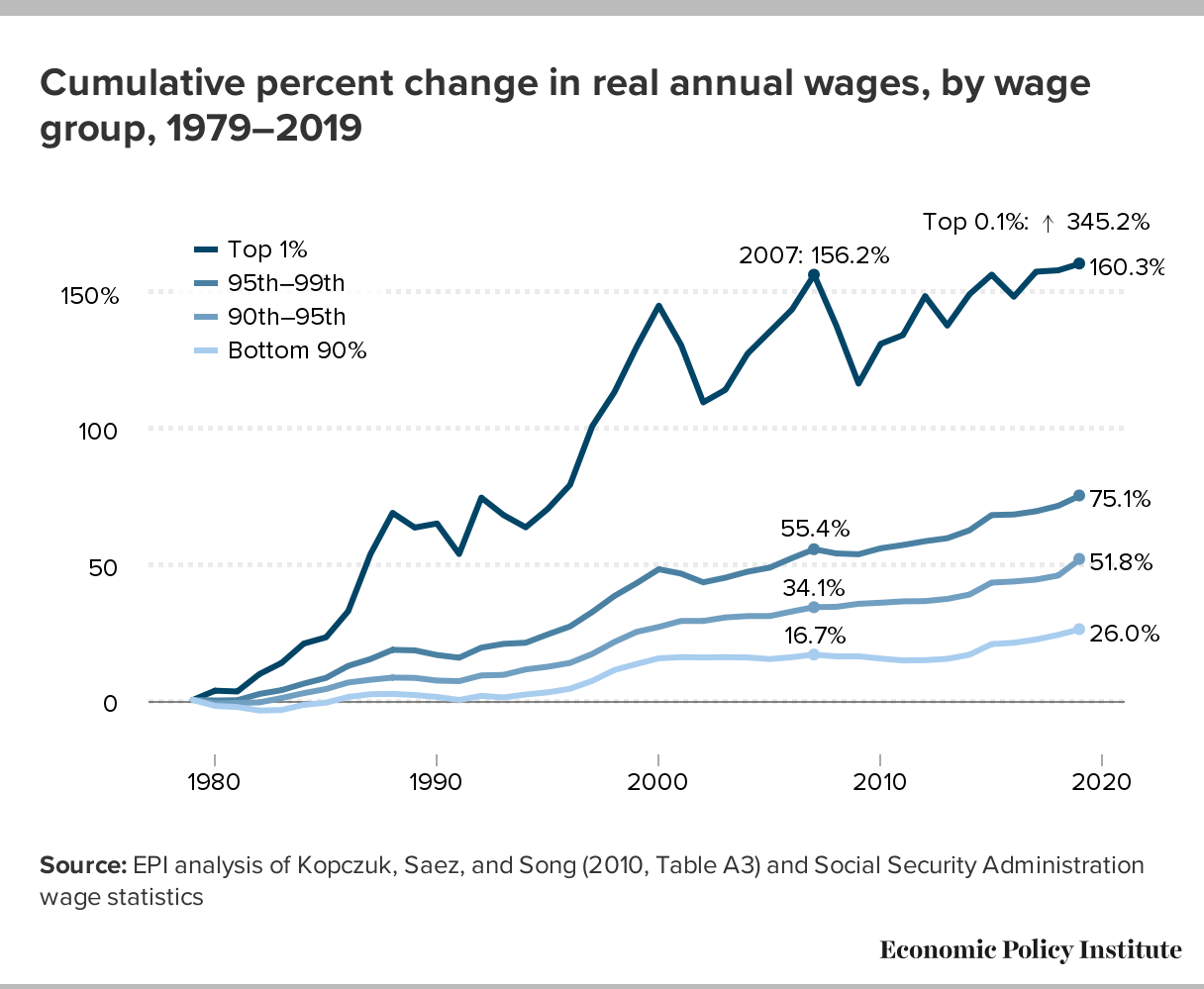
The COVID-19 pandemic has accelerated one of the more unfortunate aspects of the US economy–the continued redistribution of wealth from the poor to the rich. The Economic Policy Institute (EPI) has just analyzed the most recent data on income inequality in the US and the results are genuinely disturbing. According to the report:
“….the top 1% and the very tippy top, those in the top 0.1%, were the clear winners over the longer-term 1979–2019 period:
the top 1.0% saw their wages grow by 160.3%; and
wages for the top 0.1% grew more than twice as fast, up a spectacular 345.2%.
In contrast, those in the bottom 90% had annual wages grow by 26.0% from 1979 to 2019.
“This disparity in wage growth reflects a sharp long-term rise in the share of total wages earned by those in the top 1.0% and 0.1%.
Perversely, the pandemic has made the tendency much more pronounced, as the owners of capital have benefited from many aspects of the various lockdowns while what we call “essential” workers have seen their employment opportunities vanish. Common Dreams provides important background to this trend:
“While U.S. income inequality is the worst among most-developed nations, its wealth inequality is even more egregious. According to a 2017 report (pdf) from the Institute for Policy Studies, the three wealthiest Americans at the time, Jeff Bezos—who has since become the world’s first multicentibillionaire—Bill Gates, and Warren Buffett, collectively held more wealth than the bottom 50% of the population, or some 160 million people.
“Experts say it is no accident that the period in which the yawning, ever-growing chasm between rich and poor began coincides with the rise of corporatist and neoliberal economic policies—colloquially dubbed ‘trickle-down economics’—implemented by conservative leaders including British Prime Minister Margaret Thatcher and President Ronald Reagan in the U.S.
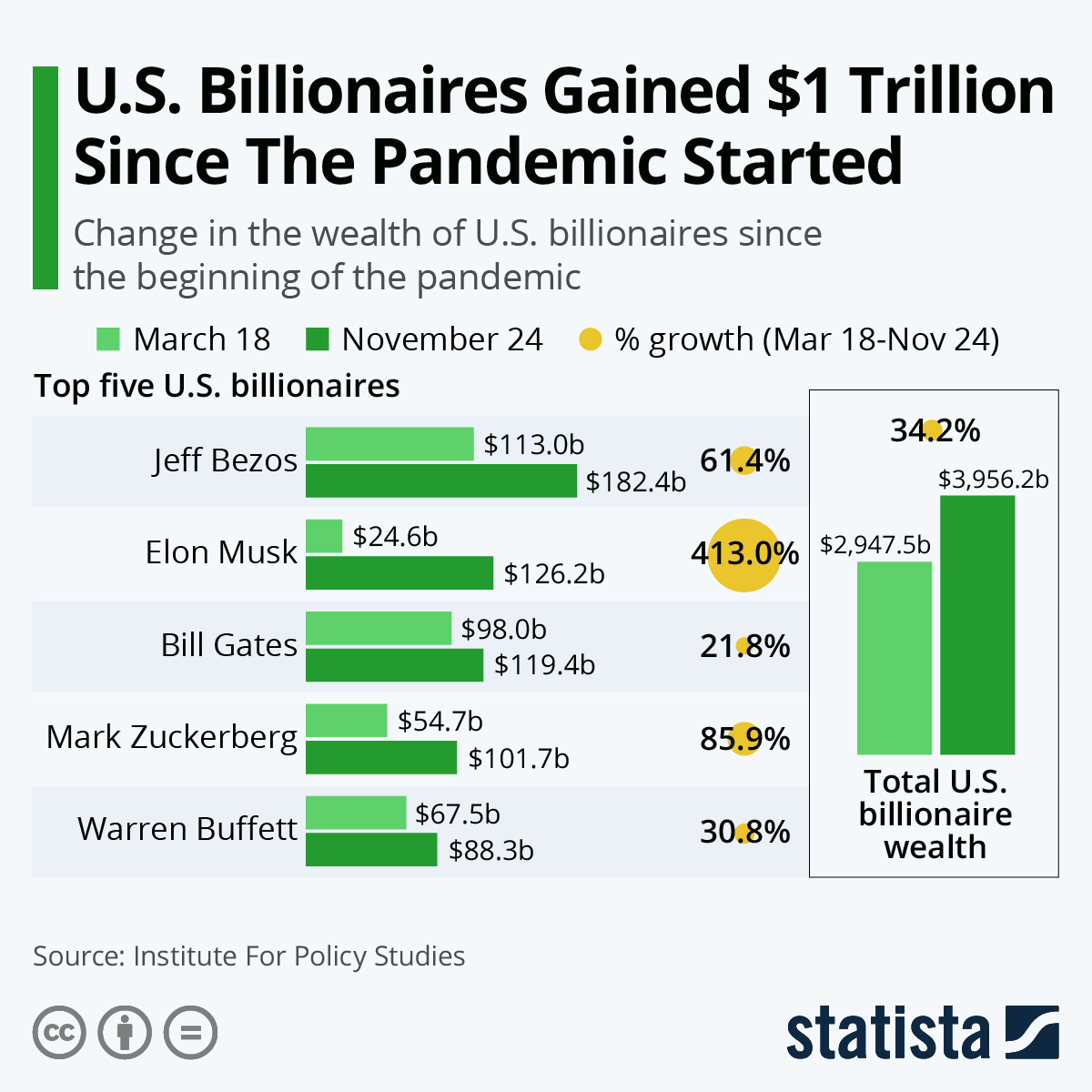
Statista quantifies how much money we are talking about: “Illustrating the gulf in financial inequality in the U.S. today, the analysis states that U.S. billionaires own $4 trillion, 3.5 percent of all privately held wealth in the country. Billionaire wealth is now twice the amount of wealth held by the bottom 50 percent of all American households combined, approximately 160 million people.”
This situation is politically dangerous. We have already seen the discontent from the Great Recession of 2008-09 lead to an increase in a political dynamic that boosted Trump into the Presidency. That dynamic led to a willingness to believe that certain groups–immigrants, African-Americans, and Muslims–were the causes of economic deprivation. If the job losses of the pandemic, which totaled 22 million at the outset, are not recovered quickly, the political consequences could be severe.
I made the mistake of watching the evening news tonight. I heard two people in South Dakota, which has one of the highest rates of COVID-19 in the US, make the following comments: “I’m not sick. Why should I be forced to wear a mask?”; and “What gives the government the right to tell me what to wear?” (I noticed that the gentleman making the second comment was actually clothed to the dismay of many nudists in America). The comments reflect the all-out assault on logic and evidence that the current Administration has conducted for the last four years.
We now find ourselves in a situation where a large proportion of the American people believe that the national election was fraudulent even though no evidence has surfaced that could possibly call the election into question. Under such conditions, it is hard to imagine that President-elect Biden will be able to lead effectively even as the twin threats of COVID-19 and the economic pressures on the American middle and lower classes promise to become even more intolerable and intractable. The larger issue is the extent to which many American citizens no longer believe that the principles and values of the Enlightenment are viable. It is hard for me to imagine what a post-Enlightenment America would be, but I fear that it would be more feudal than fascist. And it certainly would not be an America governed by the Constitution.
I will confess that I cannot think about what has happened to the country over the last four years from a clinical or dispassionate perspective. I have not been able to follow the advice I have given to many students over my teaching career when they are confronted with intense disagreements: Do not take the disagreement personally. I can, however, give an idea of how strongly I feel about this in a Baccalaureate Speech I gave to the seniors of the class of 2014. It was a defense of the Liberal Arts which, in my mind, embody the highest aspirations of the Enlightenment. Most importantly, it is an expression of my views in the absence of the anger, disillusionment, and pathos I feel tonight.
Farmers in India have been protesting for a number of weeks against new regulations proposed by the Indian central government. The Guardian reports:
“The farmers are protesting against a series of agricultural laws that see the deregulation of crop pricing, including the removal of guaranteed minimum crop price, which farmers say will leave them at the mercy of big corporations. The government has argued that the laws are necessary reforms that give farmers more autonomy over the selling of their crops and will break big unfair monopolies.
“Though farmers’ unions have been protesting in Punjab for the past two months, holding marches and blocking roads and train lines, they said they were organising the march to Delhi to force the government’s hand. Unions want to repeal the laws, which they say are anti-farmer and pro-corporate interests.
“Farming is one of the biggest employers in India, with more than 40% of the population working in agriculture.
“The Modi administration has indicated that it will not talk to the protesting farmers unless they move to a fairground on New Delhi’s outskirts and stop blocking the highways.
“But the farmers have said that they will not move their tractors or trailers until negotiations start. They are digging in, resupplying themselves with food, fuel, firewood and medical supplies to stay put for weeks.
“’Now we have leverage,’” said Ramandeep Singh Mann, a farmers’ rights activist, who gazed across the protest zone on Monday afternoon with a look of pride. ‘If we go to those fairgrounds, we will lose it.’”
Prathamesh Mulye, writing in Quartz, points out that the Indian economy is suffering greatly from the effects of the COVID-19 pandemic: “In the September quarter, India’s economy contracted by 7.5% year-on-year, pushing the country into a recession. Among the major economies of the world, only the UK and Spain shrunk sharper than India.” The recession makes it very difficult for the government to respond effectively and there is little likelihood that the welfare of farmers will improve any time soon. India is actually doing far better than the US in dealing with the pandemic, but it still has had a major effect on the Indian economy.
In an earlier post, I expressed alarm over the growing indications that there were plans to attack Iranian nuclear facilities before US President Trump leaves office. Yesterday, a prominent Iranian nuclear scientist, Mohsen Fakhrizadeh, was assassinated as he was driving near a suburb close to Tehran. It is not known who was responsible for the assassination, but it was the third killing of a prominent Iranian this year. But the use of assassination against Iranian nuclear scientists and efforts to derail the Iranian nuclear program are long-standing tactics by Israel and the US: “The killing comes just days before the 10-year anniversary of the killing of Iranian nuclear scientist Majid Shahriari, which Tehran also blamed on Israel. Those targeted killings came alongside the so-called Stuxnet virus, believed to be an Israeli and American creation, that destroyed Iranian centrifuges.” Further,
“In 2011, Darioush Rezaeinejad, an electrical engineer doctorate student whose work involved nuclear applications, was gunned down outside his Tehran apartment. In November 2010, a bombing in Tehran killed Majid Shahriari, was a member of the nuclear engineering faculty at Shahid Beheshti University in Tehran and a member of Atomic Energy Organization of Iran. Another blast that month injured a nuclear scientist, Fereidoun Abbasi, who was later appointed head of Iran’s atomic agency.
“In 2012, motorcycle riders attached a magnetic bomb that tore apart a car carrying Mostafa Ahmadi Roshan, a nuclear scientist working at Iran’s main uranium-enrichment facility in Natanz. Roshan, 32, had planned to attend a memorial for another nuclear researcher, Tehran University professor Masoud Ali Mohammadi, who was killed in a similar pinpoint blast in 2010.”
The Iranian foreign Minister, Mohammad Javad Zarif, blamed Israel for the attack and it is well known that Israel had its eye on Fakhrizadeh for some time. The Times of Israel reports:
“Fakhrizadeh was named by Israeli Prime Minister Benjamin Netanyahu in 2018 as the director of Iran’s nuclear weapons project.
“When Netanyahu revealed then that Israel had removed from a warehouse in Tehran a vast archive of Iran’s own material detailing with its nuclear weapons program, he said: ‘Remember that name, Fakhrizadeh.’
“The Israel Defense Forces have in recent weeks been instructed to prepare for the possibility that the U.S. will conduct a military strike against Iran before President Trump leaves office, senior Israeli officials tell me….
“Israeli minister of defense Benny Gantz spoke twice in the last two weeks with Christopher Miller, Trump’s acting defense secretary. They discussed Iran as well as Syria and defense cooperation.
“Last Sunday, Israeli Prime Minister Benjamin Netanyahu met in Saudi Arabia with Crown Prince Mohammed Bin Salman. One of the main issues discussed was Iran, Israeli officials say.
“Pompeo visited Israel and several Gulf countries last week to discuss Iran. State Department officials traveling with Pompeo told reporters ‘all options are on the table.’
“While Pompeo was in the Gulf, U.S. Central Command announced that B-52 strategic bombers conducted a ‘short-notice, long-range mission into the Middle East to deter aggression and reassure U.S. partners and allies.’ That was seen as another signal to Iran.
“Hossein Dehghan, an adviser to Iran’s leader and a possible candidate in Iran’s upcoming presidential elections, told AP last week that a U.S. military strike against Iran could set off a ‘full-fledged war’ in the Middle East.”
“While Fakhrizadeh had been a key figure in Iran’s bomb program, ‘that work is all in the past, and there is no reason to expect that if Fakhrizadeh is gone it would have any effect on Iran’s current nuclear program,’ said Paul Pillar, a 28-year veteran of the CIA and a senior fellow at Georgetown University’s Center for Security Studies.”
The critical question is whether this act will provoke Iran into taking some act of retaliation which could then be used as a justification for launching an all-out attack on Iranian nuclear facilities. The issue is a difficult one to resolve. If Iran does not respond to the attack, then some in Iran will take inaction as a capitulation. That image would undoubtedly play into the hands of hardliners in Iran who might demand a very forceful retaliation. But a harsh retaliation, such as an attack on Israel or actions against US vessels in the Persian Gulf, would then be used by Israel, Saudi Arabia, and the US to justify a robust attack on Iran. Calibrating an effective response to the assassination is a very difficult act. The most likely beginning of a crisis would begin in Iraq where Iran has a number of militias active and where the US still has a number of troops stationed. The Washington Post assesses the sensitivities of both the US and Iran in Iraq:
“In calls to Kadhimi and Iraqi President Barham Salih in late September, Secretary of State Mike Pompeo threatened to shutter the U.S. Embassy in Baghdad unless militia rocket attacks were reined in. U.S. officials say that a plan for closing the embassy remains a live possibility, and administration officials have been instructed to prepare for various scenarios.
“While U.S. officials have advised Trump against a preemptive strike on Iran, according to a senior official, they say that Trump has described the killing of an American as a red line that would prompt immediate and ‘crushing’ retaliation.”
Conflict in Iraq would exempt the homeland of both the US and Iran and thus could be more easily controlled politically.
The other crucial question is how this might affect domestic politics in both Israel and the US. Israeli Prime Minister Netanyahu has not been able to secure a strong position in the Israeli Knesset and is currently under investigation for corruption. He has long regarded the Iranian nuclear program as the single most dangerous threat to Israeli security and firm and effective action against Iran might bolster his domestic political position. But Netanyahu (as well as Saudi Crown Prince Salman in Saudi Arabia) know that there is no likelihood of American action against Iran by the Biden Administration, so he may be thinking that he only has a month left to take action and to count on American support.
US President Trump likely considers the disarming of Iran as a way to ensure his legacy as President who followed a strong “America First” policy. He also might think that a war against Iran would enhance his chances of securing the Republican Party nomination for President in 2024, reinforcing his status among Christian Zionists who are some of his strongest supporters. An attack would also ensure that Iran would never agree to the re-establishment of the nuclear agreement which President-elect Biden says he supports. Finally, but less predictably, Trump may regard the use of war against Iran as a way of muddling the process of the Presidential transition scheduled for 20 January.
If there is an attack against Iran, President-elect Biden would find deep opposition to the attack by loyal European allies who support a return to the Iran nuclear agreement (the Joint Comprehensive Plan of Action–JCPOA). And both Russia and China have been forging closer ties with Iran and they would object strenuously, although not to the point of supporting Iran militarily.
I wish everyone a Happy Thanksgiving. It has been a wretched year in many respects, but we still have much to be thankful for. And, if we think about it with an open and honest mind, we all have many things for which we should express thanks and gratitude.
Readers should take this post with a huge grain of salt. I will readily confess that my analysis is driven by my fear of an armed attack on Iranian nuclear facilities before President Trump leaves office. It is not a likely possibility but there are disturbing patterns in the conduct of American foreign policy right now.
First, there is considerable evidence that the Trump Administration has been focused on “unfinished business” as he prepares to leave office. Two elements of Mr. Trump’s foreign policy are crystal clear after his four years in office. First, he has been especially solicitous of Israeli interests: moving the US Embassy from Tel Aviv to Jerusalem; the Abraham Accords, normalizing relations between Israel and the United Arab Emirates (UAE) and Bahrain; the decision to assert that Israeli settlements do not pose an obstacle to peace with the Palestinians; the decision to recognize Israeli sovereignty over the Golan Heights which were once part of Syria; cutting all funding to the Palestinians through the UN Relief and Works Agency, the Agency for International Development, and financial aid for Palestinian hospitals in East Jerusalem; the closing of the Palestinian Liberation Organization consulate in Washington, DC; the decision to label the Boycott, Divestment and Sanctions (BDS) movement as anti-Semitic; and switching the US terminology for the Occupied Territories to the Israeli-preferred terms of Judea and Samaria.
Second, the Trump Administration has also been solicitous of Saudi Arabian interests. Saudi Arabia was the first country Mr. Trump visited as a new President. The Trump Administration has also pushed for very large weapons sales to Saudi Arabia (and is pressing for similar aid to Kuwait and the UAE). And the Trump Administration did not impose any sanctions on Saudi Arabia for the murder of Jamal Kashogghi nor has it pushed hard to stop the Saudi slaughter of Yemeni citizens.
Third, both Israel and Saudi Arabia regard Iran as an existential threat. Israel fears an Iranian nuclear capability since it would cancel out the military superiority that Israel currently holds over every other state in the Middle East. Israel also fears Iranian proxies, such as Hamas and Hezbollah, as well as Iranian influence in Iraq. Saudi Arabia fears Iranian subversion of the many Shia Muslims who live in Saudi Arabia and regards them as a highly destabilizing 5th column. The Washington Post explains:
“That has changed for the oldest of diplomatic reasons: self-interest. The Iranian regime views both Israel and the Sunni gulf kingdoms as illegitimate and has worked tirelessly to bring them down. Tehran also funds terrorist groups such as Hezbollah, and rebel groups such as those in Yemen, to put military pressure on Saudi Arabia and Israel. This alone brings these two together.
“Iran’s attempt to bring Iraq fully under its sway particularly presents threats to the Saudis and the gulf kingdoms. Iraq shares extensive borders with Kuwait and Saudi Arabia. If Iranian-backed troops were ever stationed in the Shiite regions in southern Iraq, they could easily launch an invasion at a moment’s notice. Saudi Arabia’s Eastern Province, which is directly south of Kuwait, holds much of the kingdom’s oil wealth and Shiite population, and the oil-rich gulf kingdoms also all border the Eastern Province. It is crucial to Saudi and the gulf kingdoms’ security that Iranian forces be kept as far away as possible.
“It is against this backdrop that Iran’s pursuit of a nuclear weapon must be understood. Were Iran ever to obtain such a weapon, its ballistic missile technology would put Israel and the Arabs alike at risk of nuclear blackmail. That in turn amplifies the conventional military power of Iran and its proxies. The Islamic republic could launch invasions or incursions as it pleases, secure in the knowledge that its nuclear weapons would deter serious retaliation.”
Fourth, US Secretary of State Mike Pompeo recently facilitated the first known official contact between Israel and Saudi Arabia. We have known for some time that Israel and Saudi Arabia have been consulting each other for some time, but the Saudis, led by King Salman, have always conditioned its contact with Israel with a firm link to the creation of a Palestinian homeland. But there is evidence that Crown Prince Salman does not hold the same view and is considered more amenable to normalized relations with Israel without attention to the Palestinian Issue.
Fifth, The New York Times recently reported that Mr. Trump has requested military options against Iranian nuclear facilities from his advisers. This personnel shuffle is decidedly curious. Why would such changes be implemented after the evidence suggested that President Trump would not be re-elected? Perhaps Mr. Trump simply had personnel axes to grind. But the changes were sweeping and quite dramatic. The report indicated that the advisers dissuaded Mr. Trump from taking any action, but we have plenty of examples where Mr. Trump has not followed the advice of his advisers. More importantly, Mr. Trump has conducted a purge of high-ranking officials at the Defense Department, and replaced them with people he deemed personally loyal. CNN reports:
“Among those who assumed new roles at the Department of Defense was controversial retired Brig. Gen. Anthony Tata, who moved into the Pentagon’s top policy role, taking over the duties of James Anderson, who resigned Tuesday, according to another US defense official.Tata had been nominated to be under secretary of defense for policy this summer but his nomination was withdrawn because of bipartisan opposition.
“CNN’s KFile reported that he has made numerous Islamophobic and offensive comments and promoted various conspiracy theories. In several 2018 tweets, he claimed Obama was a “terrorist leader” who did more to harm the US “and help Islamic countries than any president in history.”
“After the withdrawal of his nomination, Tata was designated ‘the official performing the duties of the deputy under secretary of defense for policy,’ reporting to Anderson.
“Tata is widely viewed as a Trump loyalist who maintained support from the White House even as Republicans on the Senate Armed Services Committee signaled they were unwilling to support his confirmation earlier this year.”
The changes assure that the new leadership of the Defense Department could be receptive to orders from Mr. Trump regarding Iran.
These points are merely pieces on a chessboard and it seems to me that they make the possibility that an attack on Iran is, at the very least, plausible. What is unclear is what the opening gambit might be. A “bolt out of blue” is probably not likely–I seriously doubt that the US would initiate an attack without significant cause. And I also suspect that Iran is well aware of this possibility and I believe that it will try hard to avoid any confrontation which might create a casus belli.
But there are myriad ways to create tension. Iran will continue to support its militias in Iraq, the most obvious place for a confrontation. The anniversary of the assassination of Iranian General Soleimani will heighten Iranian politics on 3 January and Iran will likely try to highlight that attack as a way of creating solidarity among the various factions in Iraq.
But the US could simply rely upon Israeli and Saudi capabilities to take out the Iranian nuclear facilities and could simply provide intelligence and logistical support in the initial phases of the conflict. The Iranians would probably not attack Israel, but the oil production and refining infrastructure of Saudi Arabia is within easy range of Iranian missile capabilities. Additionally, Iran would likely try to demonstrate some control over the Strait of Hormuz through which a large percentage of the world’s oil flows. If it were to take one or both of those options, then the US would likely join in an attack to assure the total destruction of Iran’s nuclear facilities.
Such an attack would only buy the world a little time before Iran could regain the ability to build a bomb which it would most certainly do if it were attacked. But the destruction of those facilities is probably not the prime motivation for Mr. Trump. I suspect that he simply wants to be able to say that he kept his promises to Israel perhaps to enhance his attractiveness as a presidential candidate in 2024. I do not have any doubts that Mike Pompeo wants to attack Iran and he certainly has his eye on the 2024 national election. More importantly, such an action would complicate President-elect Biden’s desire to rejoin the Iranian nuclear agreement (the JCPOA). An attack on Iran would guarantee that the agreement could never be revived.
I hope that these speculations are all off-base. But Mr. Trump’s scorched-earth tactics on both domestic and foreign policy give me serious pause. Lame duck Presidents do not usually want to leave office in a blaze of glory. Mr. Trump may be different.
On Thursday the US State Department designated the “Boycott, Divestment, and Sanctions” (BDS) movement as anti-Semitic. US Secretary of State Mike Pompeo made the announcement in a meeting with Israeli Prime Minister Benjamin Netanyahu:
SECRETARY POMPEO: Today I want to make one announcement with respect to a decision by the State Department that we will regard the global anti-Israel BDS campaign as anti-Semitic. I know this sounds simple to you, Mr. Prime Minister, it seems – it seems like a statement of fact, but I want you to know that we will immediately take steps to identify organizations that engage in hateful BDS conduct, and withdraw US government support for such groups. The time is right.
PRIME MINISTER NETANYAHU: It doesn’t sound simple – it sounds simply wonderful to me. (Laughter.)
SECRETARY POMPEO: Look, we want to stand with all other nations that recognize the BDS movement for the cancer that it is, and we’re committed to combating it. Our record speaks for itself. During the Trump administration, America stands with Israel like never before. Indeed, the commitment we’ve made, the ironclad commitment we’ve made to the Jewish state, will continue. It was – I’m confident that after our conversation this morning – we talked about how we can protect Americans and Israelis in the region from the regime in Tehran. You talked about this. They remain – we should not take for granted they remain the foremost state sponsor of terrorism in all the world.
The BDS movement was launched in 2005 in order to change Israeli policy toward Palestinians who lived in Israel and in the Occupied Territories. The effect of the US decision is to penalize individuals, organizations, and companies who support the BDS movement by denying government contracts to those entities. A number of states in the US have passed similar laws, although some of them have not passed a judicial test.
Denying the right of people to protest against Israeli policies toward the Palestinians is an affront to the right of peaceful expression. But to go further and label that protest as anti-Semitic is outrageous. Asserting that Palestinians have a right to cultivate land that their families have cultivated for many years is not a measure of hatred toward Jews. Amnesty International issued the following statement after the US announcement was made:
“This is simply the latest attack from a US government determined to undermine the universality of human rights and the global fight against racism and discrimination, including antisemitism.
“Advocating for boycotts, divestment and sanctions is a form of non-violent advocacy and of free expression that must be protected.
“The Department of State’s targeting of groups advocating for using peaceful means – such as boycotts – to end human rights violations against Palestinians as antisemitic violates freedom of expression and is a gift to those who seek to silence, harass, intimidate and oppress those standing up for human rights around the world.
“The US administration is following the Israeli government’s approach in using false and politically-motivated accusations of antisemitism to harm peaceful activists – including human rights defenders – and shield from accountability those responsible for illegal actions that harm people in Israel, in the Occupied Palestinian Territories and here at home.”
The Trump Administration has been especially solicitous of Israeli policy. There is no reason in the world why US policy cannot simultaneously defend Israeli security issues while at the same time recognizing the right of the Palestinian people to self-determination. It remains to be seen whether President-elect Biden can forge a more even-handed policy toward the two peoples.






 World Politics News