There has been a sharp escalation of violence between Israel and the Palestinians. The conflict is rooted in passionately held views over the control of territory in the West Bank and the Gaza Strip. The immediate cause of the current violence stems from an attempt by Israel to evict Palestinians from the homes in East Jerusalem in a neighborhood known as Sheikh Jarrah. There are 7 Palestinian families who have lived in those homes since the 1960s but the Israelis claim that the home was previously owned by Israeli Jews. Those Jewish families lost their homes when the state of Israel was created in 1948 and the United Nations declared that the city of Jerusalem would be under international control:
“With the increase in violence in 1947 and the all-out war between the two communities in 1948, which was joined by the neighbouring Arab States, Jerusalem was placed at the heart of the conflict and its control became an essential goal of the fighting parties. In an attempt to find a permanent solution, the United Nations adopted in 1947 the Partition Plan for Palestine which, while dividing the country into Arab and Jewish States, retained the unity of Jerusalem by providing for an international regime under United Nations control.”
That plan was never fully implemented and Jerusalem was divided into West Jerusalem under Israeli control and East Jerusalem under the control of Jordan. The division collapsed after Israel took control of all of Jerusalem in the 1967 war. The world, however, did not recognize Israeli sovereignty over all of Jerusalem until US President Trump moved the US Embassy into Jerusalem in 2017. Even now, however, most of the world recognizes East Jerusalem as Occupied Territory subject to the rules of the 1907 Hague Convention and the Geneva Conventions of 1949. The International Committee of the Red Cross outlines the responsibilities of the Occupying Power:
“The duties of the occupying power are spelled out primarily in the 1907 Hague Regulations (arts 42-56) and the Fourth Geneva Convention (GC IV, art. 27-34 and 47-78), as well as in certain provisions of Additional Protocol I and customary international humanitarian law.
“Agreements concluded between the occupying power and the local authorities cannot deprive the population of occupied territory of the protection afforded by international humanitarian law (GC IV, art. 47) and protected persons themselves can in no circumstances renounce their rights (GC IV, art. 8).
“The main rules of the law applicable in case of occupation state that:
The occupant does not acquire sovereignty over the territory.
Occupation is only a temporary situation, and the rights of the occupant are limited to the extent of that period.
The occupying power must respect the laws in force in the occupied territory, unless they constitute a threat to its security or an obstacle to the application of the international law of occupation.
The occupying power must take measures to restore and ensure, as far as possible, public order and safety.
To the fullest extent of the means available to it, the occupying power must ensure sufficient hygiene and public health standards, as well as the provision of food and medical care to the population under occupation.
The population in occupied territory cannot be forced to enlist in the occupier’s armed forces.
Collective or individual forcible transfers of population from and within the occupied territory are prohibited.
Transfers of the civilian population of the occupying power into the occupied territory, regardless whether forcible or voluntary, are prohibited.
Collective punishment is prohibited.
The taking of hostages is prohibited.
Reprisals against protected persons or their property are prohibited.
The confiscation of private property by the occupant is prohibited.
The destruction or seizure of enemy property is prohibited, unless absolutely required by military necessity during the conduct of hostilities.
Cultural property must be respected.
People accused of criminal offences shall be provided with proceedings respecting internationally recognized judicial guarantees (for example, they must be informed of the reason for their arrest, charg ed with a specific offence and given a fair trial as quickly as possible).
Personnel of the International Red Cross/Red Crescent Movement must be allowed to carry out their humanitarian activities. The ICRC, in particular, must be given access to all protected persons, wherever they are, whether or not they are deprived of their liberty.
Most importantly, the Hague and Geneva Conventions prohibit the confiscation of private property. The controversy over the evictions is complicated by the inequities in Israeli law, as explained by The Economist:
“The land on which their homes sit was owned by Jews before Jordan occupied the eastern part of Jerusalem in 1948. Jordan used it to resettle Palestinian refugees from the western part of the city, which had been taken by Israel. Under Israeli law the heirs of the original owners, as Israelis, can reclaim the property. The Palestinian families have no such rights over their former homes in West Jerusalem. In fact, all property once owned by ‘absentee’ Palestinians was expropriated by Israel and can no longer be claimed by its original owners.
“A month ago, the Muslim holy month of Ramadan began, and Palestinians have complained of what they say are unnecessarily severe restrictions by Israeli police, who prevented them from gathering on steps outside the Old City – an unofficial tradition after evening prayers.
“Amid rising tensions, there was an increase in communal violence, with videos shared online of street harassment and several attacks between Jews and Palestinians. Events came to a head in late April when hundreds of far-right Israelis marched down city streets chanting ‘death to Arabs’ and confronted Palestinians.
“Anger built ahead of an Israeli court ruling, which was due on Monday, on whether authorities would evict dozens of Palestinians from the majority-Arab East Jerusalem neighbourhood of Sheikh Jarrah and give their homes to Jewish settlers.
“On the same day, thousands of flag-waving Israeli nationalists were due to march through Muslim neighbourhoods in the Old City in a provocative parade that celebrated Israel’s capture of the city in 1967.
“By Monday, the court date had been delayed and the march was rerouted, but by that point, the situation has already spiralled.”
The violence now involves rocket attacks launched by Hamas from the Gaza Strip and Israeli counterattacks by air against targets in the Gaza. The rocket attacks have been against civilian population centers such as the city of Tel Aviv, attacks which clearly contravene the laws of war. Similarly, Israeli aerial attacks have been targeting military targets, but the close proximity of civilian centers to those targets have rendered the distinction moot, and many civilians have been killed in the strikes.
It would be foolish to try to predict how the violence will unfold in the immediate future. The last overt violence was in 2014 and it lasted 7 weeks. But the Israeli government is still not settled despite 4 elections in the last two years and the settler movement is a powerful constituency in determining the coalition that will ultimately govern Israel. And the Palestinian Authority, divided among Hamas in the Gaza Strip and the Palestinian Authority in the West Bank, has not held a legitimate election since 2006.
Finally, the US government does not seem to want to be involved in the dispute. It is not clear how the US can avoid involvement, but it is safe to say that President Biden does not seem to have a plan of action. It is doubtful, however, that wither the Israelis or the Palestinians would pay much attention to anything that President Biden might say.
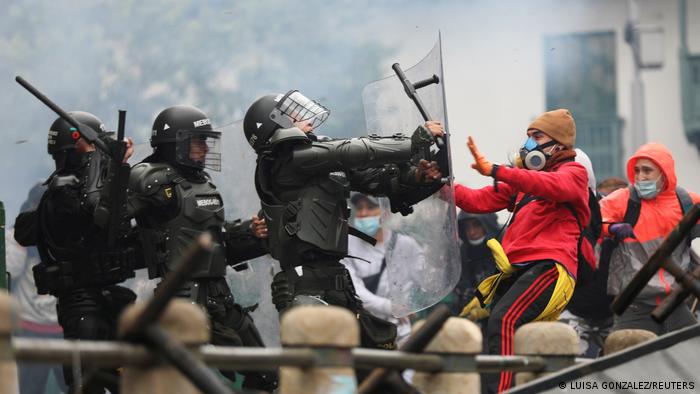
Colombia has entered its second week of protests and the government’s response to the protests has become increasingly repressive. There are actually a number of issues that have led to the protests, as explained by The Guardian: “Demonstrations began over an unpopular tax reform but have since grown into outburst of rage over poverty, human rights abuses and the authorities’ heavy-handed response to protests.” Colombian President Iván Duque has called for a national dialogue, but the government’s handling of the protests has become increasingly militarized:
“Duque has been powerless to quell the unrest despite ordering the militarization of major cities and withdrawing his tax plan. His government has attempted to frame the protests as the work of “terrorists” from dissident rebel groups.
“Amid growing popular anger, observers have advised caution over the possible spread of disinformation. But videos analysed by Amnesty International confirm that police have used lethal weapons, including rifles and semi-automatic guns, against protesters around the country.
“’It is deeply alarming to see the heavy-handed crowd control response across the country,’ said Erika Guevara-Rosas, Americas director of Amnesty International. ‘The people’s discontent over the economic crisis is clear – it is unjust and puts their human rights at risk.’”
The protests have occurred in over 240 villages and towns in the country, suggesting that the discontent is widespread. The protests have intensified because of the heavy-handed response and the death count is over 25 so far. The effect of the COVID pandemic on Colombia has mirrored the experience of many other countries in the world. Unemployment in the country increased from 9% to 16% because of the economic slowdown caused by the disease. COVID has heightened the disparity between rich and poor in the world to an alarming degree:
“Globally, 41 percent of workers in the poorest 20 percent of their country’s income distribution said they lost their job or business as a result of the pandemic, compared with 23 percent of workers in the richest 20 percent. That gap in job loss is similar between those with a college degree (16 percent who have lost a job or business) and those without (35 percent).
“The gulf in economic vulnerability is strongly linked to the prevailing level of income inequality going into the pandemic. In the most economically egalitarian nations (as measured by the Gini coefficient for household income), workers with lower incomes and less education were protected from mass unemployment, in part through national policies that sought to prevent job loss.”
The relatively good news about COVID in the US is not reflected in many poor countries. India is the most destabilizing example so far, but Colombia suggests that we can anticipate further protests globally.
The National Oceanic and Atmospheric Administration (NOAA) has released a report on new “normals” for temperature and precipitation in the US. NOAA determines these normals for thirty-year periods and assesses current conditions with those periods. NOAA explains:
“U.S. Climate Normals are designed—and best-suited for—better understanding what is happening today. Rather than assess long-term climate trends, Normals reflect the impacts of the changing climate on our day-to-day weather experience. Normals are not merely averages of raw data. Thirty years of U.S. weather station observations are compiled, checked for quality, compared to surrounding stations, filled in for missing periods, and used to calculate not only averages, but many other measures. These then provide a basis for comparisons of temperature, precipitation, and other variables to today’s observations.”
The procedure is designed to help us make the distinction between weather and climate. We experience weather on a daily basis but climate is far less observable except over a long period of time. I have little difficulty in asserting that the climate today is different from when I was 12 years old (in 1961): spring comes earlier for me and winter starts a little later. I am pleased that NOAA agrees with my clearly unscientific assessment:
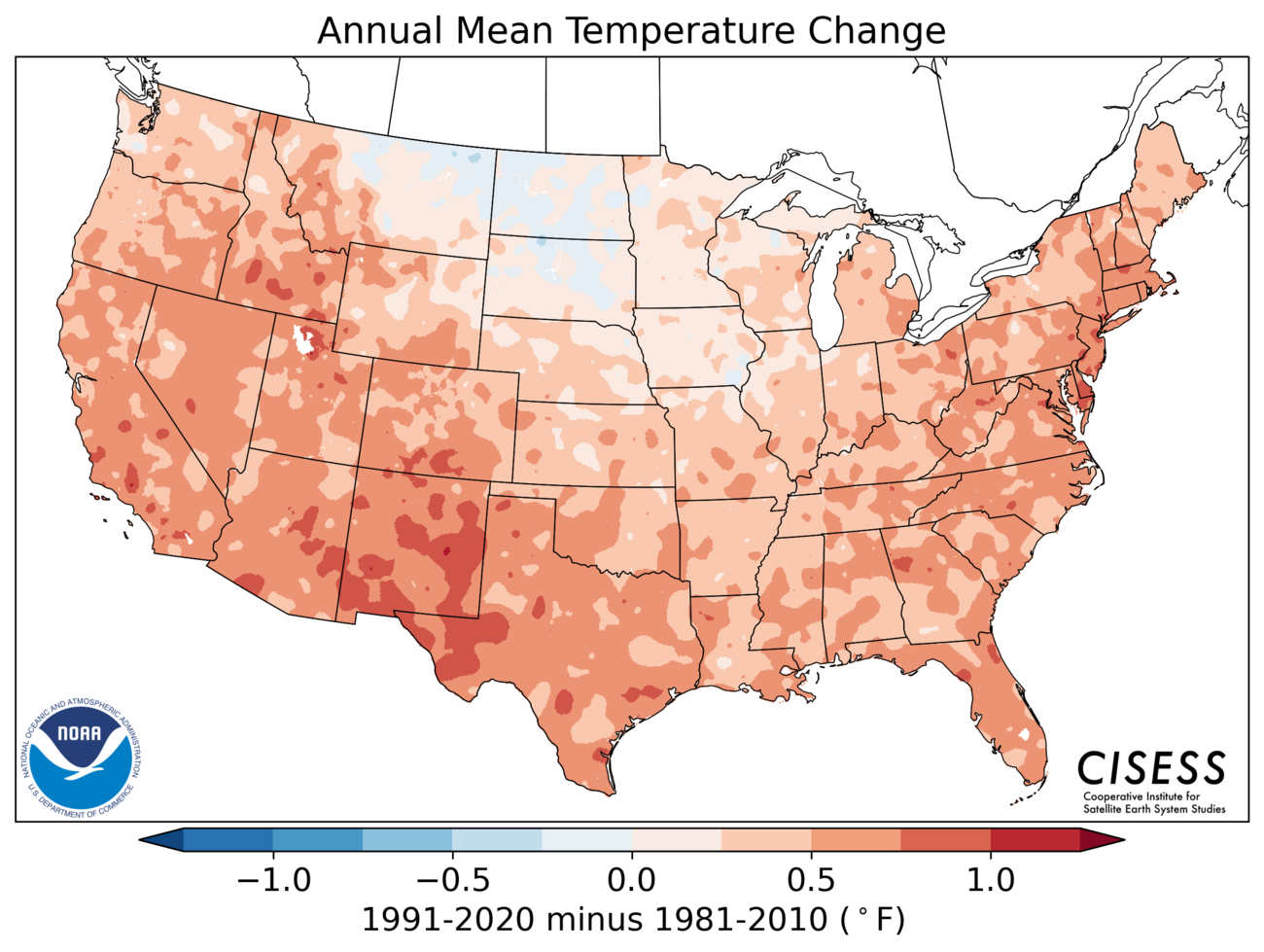
“The 1981–2010 average temperature for the contiguous U.S. was 52.8°F while the new average temperature for the contiguous U.S. for 1991-2020 is 53.3°F. The new normals period, 1991-2020, is the warmest on record for the country. But warming is not ubiquitous across the contiguous U.S. in either geographic space or time of year. Changes vary from season-to-season and month-to-month.
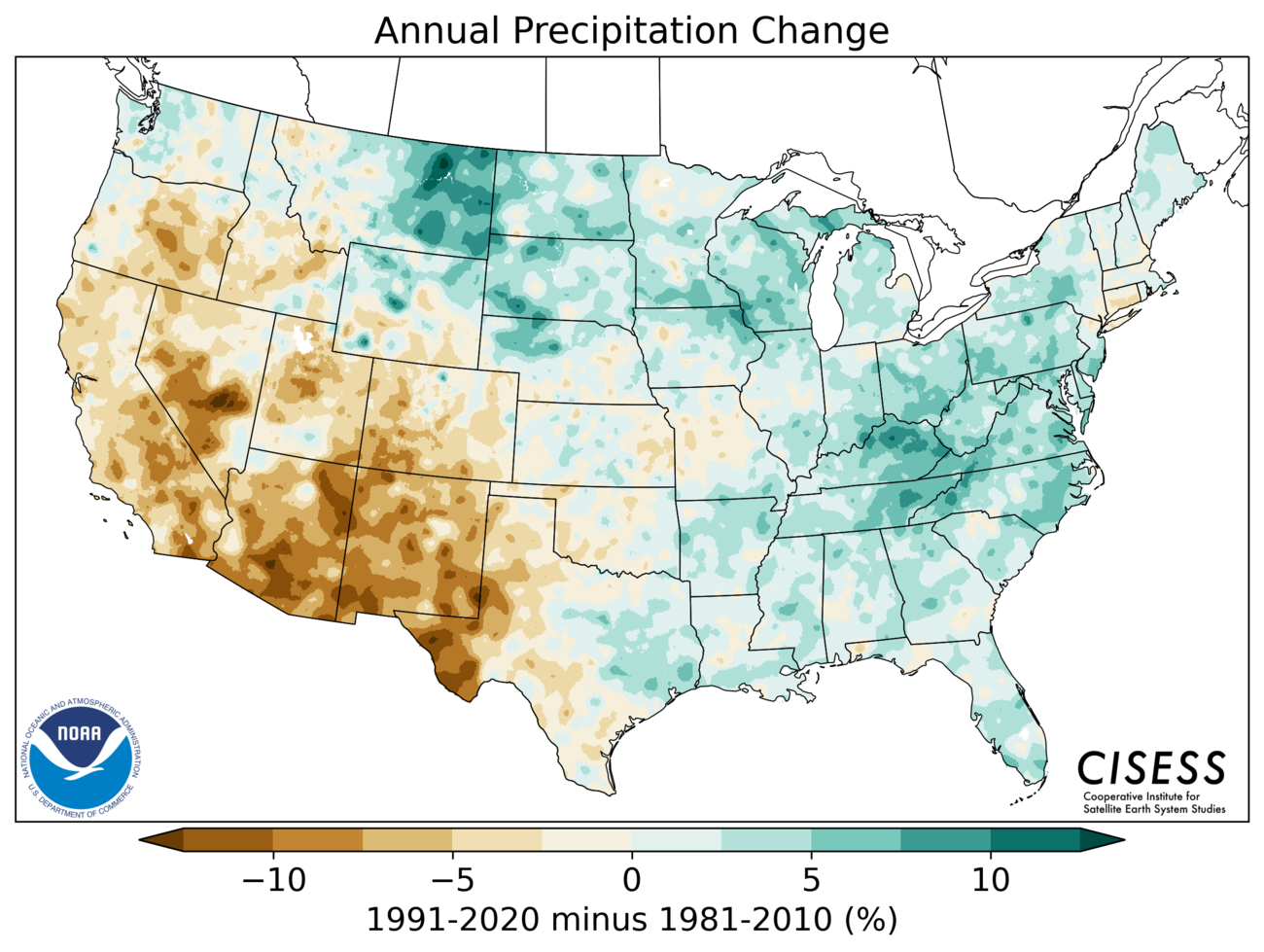
“For instance, the north-central U.S. Temperature Normals—for those in the Northern Plains and Upper Midwest—have cooled from 1981–2010 to 1991–2020, especially in the spring. The South and Southwest are considerably warmer. Normals were also generally warmer across the West and along the East Coast. Precipitation-wise, the Southwest was drier; wetter averages emerged in the U.S. east of the Rocky Mountains, especially the Southeast in the spring.
NOAA presents its data graphically
The distinction between weather and climate is important. Europe experienced the coldest April in decades this year. Nonetheless, the trend toward warmer climate continues. European temperatures were the highest ever recorded in 2020:
“2020 was Europe’s warmest year to date, as temperatures rose by almost half a degree above previous records. Across the entire continent, mean temperatures exceeded the 1981-2010 average, with parts of northern and eastern Europe being more than 2°C warmer. The same regions had higher than average daily minimum temperatures, while France and Benelux countries saw higher daily maximum temperatures.
“’We’ve had some periods of exceptionally high temperatures, heatwaves in summer and a warm spell in autumn, though they were not as intense, widespread and long-lived as in recent years,’ says Dr. Francesca Guglielmo, senior scientist at the Copernicus Climate Change Service (C3S) and one of ESOTC report’s co-authors.
“The most striking temperature anomaly was last winter. Cold season temperatures rose on average about 1.9°C above the previous record and 3.4°C above the average for 1981-2010, in what C3S scientists deem ‘an exceptionally warm’ winter. ‘The number of days in which the temperature stayed below zero throughout the day illustrates this warming,’ says Dr. Freja Vamborg, senior scientist at C3S and lead author of the report. ‘Whether you have a freezing or non-freezing situation in a certain location, it makes a big difference.’”
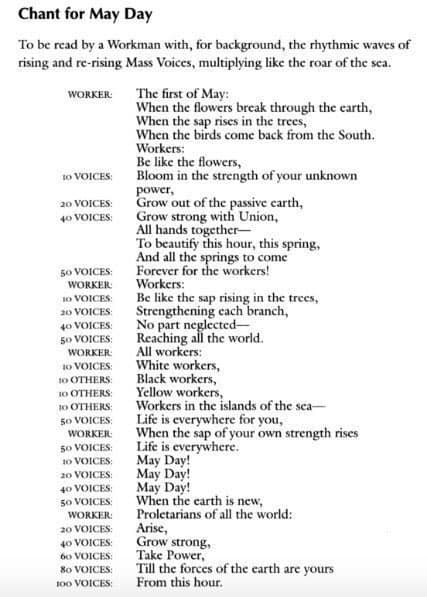
It’s May Day. Unlike the US, the rest of the world celebrates the power and value of workers. It is unfortunate that Americans do not join in and instead celebrate the Pablum we call Labor Day in September.
Violent Scenes in France As Police and Protests Clash Over May Day Rallies, May Day 2021
Arundhati Roy has written a powerful essay on the COVID crisis in India for The Guardian. It is a very long essay but pulls together a number of important threads which serve to explain why the country is in such terrible straits. The situation in India is grim: there are shortages of oxygen, vaccines, hospital beds, and wood for cremation. Reuters reports:
“India’s total COVID-19 cases passed 18 million on Thursday after another world record number of daily infections, as gravediggers worked around the clock to bury victims and hundreds more were cremated in makeshift pyres in parks and parking lots.
“India reported 379,257 new infections and 3,645 new deaths on Thursday, health ministry data showed, the highest number of fatalities in a single day since the start of the pandemic.
“The world’s second most populous nation is in deep crisis, with hospitals and morgues overwhelmed.”
Initially, India took a very hardline against the virus, ordering a nation-wide lockdown with only four hours notice. That step, while economically disastrous, was effective in bringing down the number of COVID infections. The Washington Post describes the move:
“Modi’s approach to India’s current surge stands in contrast to his actions last spring. Last March, he ordered a strict nationwide lockdown, the world’s largest, with four hours’ notice at a time when the country had recorded about 500 coronavirus cases. The lockdown caused extreme economic hardship: More than 100 million people lost their jobs. Among them were millions of migrant workers who began leaving cities on foot to return to their home villages.
“The lockdown slowed transmission of the virus and gave India time to scale up testing and other capacities to fight the pandemic. Infections surged in the fall as restrictions were loosened across the country but receded early this year for reasons that remain unclear.”
“Modi’s national government as well as state authorities ‘went into the comfort zone of believing the pandemic has passed,’ said Srinath Reddy, the president of the Public Health Foundation of India. ‘That illusion came to settle in the minds of most people and clouded their judgment.’”
Roy reproduced parts of Prime Minister Modi’s speech last year in which he celebrated India’s success in containing the virus:
“Modi spoke at a time when people in Europe and the US were suffering through the peak of the second wave of the pandemic. He had not one word of sympathy to offer, only a long, gloating boast about India’s infrastructure and Covid-preparedness. I downloaded the speech because I fear that when history is rewritten by the Modi regime, as it soon will be, it might disappear, or become hard to find. Here are some priceless snippets:
“’Friends, I have brought the message of confidence, positivity and hope from 1.3 billion Indians amid these times of apprehension … It was predicted that India would be the most affected country from corona all over the world. It was said that there would be a tsunami of corona infections in India, somebody said 700-800 million Indians would get infected while others said 2 million Indians would die.’
“’Friends, it would not be advisable to judge India’s success with that of another country. In a country which is home to 18% of the world population, that country has saved humanity from a big disaster by containing corona effectively.’”
Her analysis of the crisis is damning but it also reflects the inadequacies of governments in Trump-era America and in Bolsonaro’s Brazil:
“The system has not collapsed. The ‘system’ barely existed. The government – this one, as well as the Congress government that preceded it – deliberately dismantled what little medical infrastructure there was. This is what happens when a pandemic hits a country with an almost nonexistent public healthcare system. India spends about 1.25% of its gross domestic product on health, far lower than most countries in the world, even the poorest ones. Even that figure is thought to be inflated, because things that are important but do not strictly qualify as healthcare have been slipped into it. So the real figure is estimated to be more like 0.34%. The tragedy is that in this devastatingly poor country, as a 2016 Lancet study shows, 78% of the healthcare in urban areas and 71% in rural areas is now handled by the private sector. The resources that remain in the public sector are systematically siphoned into the private sector by a nexus of corrupt administrators and medical practitioners, corrupt referrals and insurance rackets.
“Healthcare is a fundamental right. The private sector will not cater to starving, sick, dying people who don’t have money. This massive privatisation of India’s healthcare is a crime.
“The system hasn’t collapsed. The government has failed. Perhaps ‘failed’ is an inaccurate word, because what we are witnessing is not criminal negligence, but an outright crime against humanity. Virologists predict that the number of cases in India will grow exponentially to more than 500,000 a day. They predict the death of many hundreds of thousands in the coming months, perhaps more. My friends and I have agreed to call each other every day just to mark ourselves present, like roll call in our school classrooms. We speak to those we love in tears, and with trepidation, not knowing if we will ever see each other again. We write, we work, not knowing if we will live to finish what we started. Not knowing what horror and humiliation awaits us. The indignity of it all. That is what breaks us.
The crisis in India affects everyone in the world. Given the high number of cases and how quickly it has spread, the are legitimate fears that there will be a large number of mutations in the virus, some of which may be more resistant to the vaccines that have already been developed. But the world also relies heavily on the robust pharmaceutical sector of India. CNN reports:
“The country is a major player in COVAX, the global vaccine-sharing initiative that provides discounted or free doses for lower-income countries. India promised to supply 200 million COVAX doses that are being distributed to 92 poor countries. But its own rapidly worsening situation has prompted Delhi to shift focus from COVAX to prioritizing India’s own citizens….
“‘I don’t think the global leadership has woken up to the scenario of how bad this delay can be for the world,’ said Shruti Rajagopalan, a Senior Research Fellow at the Mercatus Center at George Mason University. The moment India is short on vaccines and keeps its supplies for domestic purposes, it means other countries like South Africa and Brazil have to wait, she said. ‘You’re delaying the world getting vaccinated by many months,’ Shruti added.
“John Nkengasong, the director of Africa’s disease control body, warned earlier this month that India’s hold on exports could be ‘catastrophic’ for the continent’svaccine rollout.”
The US and other states are stepping up relief actions, including vaccines and medical supplies like oxygen. But those supplies will take some time. In the meantime, Roy’s characterization of the failure of the Indian government looks accurate: “an outright crime against humanity“.
“Each year on this day, we remember the lives of all those who died in the Ottoman-era Armenian genocide and recommit ourselves to preventing such an atrocity from ever again occurring. Beginning on April 24, 1915, with the arrest of Armenian intellectuals and community leaders in Constantinople by Ottoman authorities, one and a half million Armenians were deported, massacred, or marched to their deaths in a campaign of extermination. We honor the victims of the Meds Yeghern so that the horrors of what happened are never lost to history. And we remember so that we remain ever-vigilant against the corrosive influence of hate in all its forms.
“Of those who survived, most were forced to find new homes and new lives around the world, including in the United States. With strength and resilience, the Armenian people survived and rebuilt their community. Over the decades Armenian immigrants have enriched the United States in countless ways, but they have never forgotten the tragic history that brought so many of their ancestors to our shores. We honor their story. We see that pain. We affirm the history. We do this not to cast blame but to ensure that what happened is never repeated.”
The term Meds Yeghern roughly translates as “Great Evil Crime” and it is a phrase that has been used by previous US Presidents to avoid the use of the word “genocide” in order to assuage Turkish sensibilities which flatly denies that a genocide occurred (US President Reagan actually did use the word genocide, but subsequent Presidents avoided the term).. Biden’s use of the word genocide, a word coined in 1944 to describe the Holocaust tragedy, is a first for the US.
Turkey insists that the deaths of the Armenians was not intentional and therefore does not qualify as genocide. Turkey’s position was that Armenians in the then Ottoman Empire were Christians and therefore identified more closely with other powers, notably the Russians who were fighting against Germany with which the Ottomans were aligned. The Ottomans regarded the Armenians as a Fifth Column who could not be trusted. The Washington Post provides some of the historical context:
“When World War I broke out, Armenians found themselves physically on both sides of the battlefront between the Ottomans and the Russians. The Ottoman government drafted Armenian men to fight, but when the military suffered heavy losses, it blamed them on Armenians, accusing them of collaborating with the enemy. The Armenian soldiers were disarmed and murdered by Ottoman troops.
“On April 24, 1915, the government arrested about 250 Armenian leaders and intellectuals. This is seen by many as the beginning of the massacre, and April 24 now marks Armenian Genocide Remembrance Day.
“In the following months, most of those Armenian leaders were killed. The military forced Armenian villagers from their homes and on long, cruel marches to concentrations camps in what is now northern Syria and Iraq. Many of them died along the way; others died in the camps of starvation and thirst. Meanwhile, irregular forces and locals rounded up Armenians in their villages and slaughtered them. Historians estimate that between 600,000 and 1.5 million Armenians died.
“The few survivors were often forced to convert to Islam, and Armenian orphans were adopted by Muslim families. The empty homes and businesses were also given to Muslims, some of whom had recently been forced out of the Balkans.
“At this point in the war, the United States was still neutral. Henry Morgenthau Sr. was the U.S. ambassador to the Ottoman Empire and witnessed many of the atrocities. In a July 16, 1915, cable, he told the State Department: ‘It appears that a campaign of race extermination is in progress.’”
President Biden is scheduled to meet with Turkish President Erdogan in June and the US declaration will unquestionably sour US-Turkish relations. But those relations were already in bad shape and it is not at all clear that Erdogan wishes to repair the damage. Turkish activities in Syria and Libya, as well as its relations with Russia and its treatment of the Kurds in the region, are all inconsistent with US interests. Turkey may be a member of NATO but one would be hard-pressed to label Turkey as a loyal US ally.
India recorded 315,000 COVID deaths on Thursday, [I apologize–the number only refers to the number of cases, not deaths. I apologize for the error in the initial post] the highest number of cases for any country since the pandemic began last year. For a while, it appeared as if India was weathering the storm quite well. but in recent weeks the number of cases and deaths have exploded. The Guardian reports:
“The blindspots in India’s response to its second, devastating wave of coronavirus infections serve as a stark warning to other countries.
“In retrospect it was clear that the figures for new infections that India was reporting in January and February were probably too good to be true, with a country of more than 1.3 billion people seeing its caseload drop from its first peak last year of over 100,000 cases a day to under 10,000.
“Then, it was reported in terms of being almost miraculous.
“As Jishnu Das, a health economist at Georgetown University in the US, told NPR in early February: ‘It’s not that India is testing less or things are going underreported. It’s been rising, rising – and now suddenly, it’s vanished! I mean, hospital ICU utilisation has gone down. Every indicator says the numbers are down.’
“Except it had not vanished. The reasons for that illusion are likely to take years to unpick, but it is clear that India’s surveillance of the virus missed its real prevalence earlier this year, even at a point when people were celebrating its decline, until it was too late.”
This second surge is stunning in both numbers and in the character of the victims which seem to be much younger than in other states. The ramifications of this trend in one of the most populous countries in the world as well as one of the most sophisticated biotechnology economies are deeply troubling. The Economist explains:
“This horrifying second wave is a catastrophe not only for India but for the world. Allowing the virus to circulate unchecked increases the risk that dangerous new strains will emerge. One worrying variant first detected in India, called the ‘double mutant’, has already been found in several other countries, including America and Britain. Even as scientists labour to understand how big a threat it poses, more variants are appearing.
“A more immediate consequence of India’s second wave for the rest of the world is a disruption to vaccine supplies. India had hoped to be the world’s pharmacy. But with case numbers exploding the government has restricted exports of vaccines. In the first half of April India shipped just 1.2m doses abroad, compared with 64m in the three prior months. The Serum Institute of India, a private company that manufactures the AstraZeneca vaccine, has defaulted on commitments to Britain, the European Union and covax, a scheme to supply more shots worldwide. African countries that had been counting on India to provide them with vaccines are looking on in dismay.”
Hospitals are overwhelmed and oxygen supplies are running low. Many are blaming the government for not following strict pandemic guidelines. In particular, there are elections scheduled in the next few weeks, and many packed rallies have been held without adequate safety precautions:
“And with repeated claims of underreporting of deaths, the real toll may already be a lot higher. India’s medical infrastructure, from tests to hospital beds to medicine and the supply of oxygen, is creaking under the weight of cases. Srivastava’s desperate appeals were only one among thousands of users flooding social media, begging for desperately needed help. In the worst-hit state of Maharashtra, one man drove his ailing father around for 24 hours, crisscrossing states over hundreds of miles, in search of a bed.
“Amid this catastrophe, Modi has been concentrating not on the pandemic but on politics—and has been mostly absent. Modi has been campaigning for his Bharatiya Janata Party (BJP) in the regional elections in West Bengal. In the last two weeks, the prime minister has held nine major campaign rallies with tens of thousands of supporters. Well-masked and distanced outdoor events are low risk for COVID-19 spread, but these are anything but that; supporters are pressed together and largely maskless. As a Stanford University study showed of Donald Trump’s rallies last summer, Modi’s gatherings are likely to have been major spreading events. Modi’s closest aide, Home Minister Amit Shah, has been even more brazen: Apart from crowded rallies, Shah has been crisscrossing West Bengal in massive roadshows, with supporters jampacking the streets and an unmasked Shah smiling and waving at them from an open truck. Not surprisingly, infections have shot up in the state, from 1,274 daily new cases on April 1 to 8,419 on Sunday. While all other main political rivals have either canceled or curtailed their campaigns, Modi and Shah have continued.
“Apart from its own rallies, the Modi government decided to allow millions of Hindus to gather for the Kumbh Mela, a major Hindu pilgrimage, in the city of Haridwar. The Uttarakhand state government even published front-page advertisements in newspapers with Modi’s face at the top “welcoming” devotees. Without any social distancing and few COVID-19 protocols being observed, devotees gathered, and within five days, more than 2,000 infections were recorded in the city, forcing Modi to ‘request‘ devotees to curtail the festivities.
India thus joins the list of countries that have failed to respond adequately to the pandemic–the US and Brazil also botched their responses. But India has 1.4 billion people and many in the world rely on its scientific expertise to address the pandemic. India’s tragedy is also the world’s tragedy.
Google has produced a time-lapse video of changes in the earth from 1984-2020. It is an eye-opening video: the changes are dramatic over a very short period of time. It is both frightening and mesmerizing.
US President Biden announced that the US will be withdrawing all of its combat troops from Afghanistan by September of this year. When asked, he noted that it was not a difficult decision but it was one that eluded both Presidents Obama and Trump even though both ran on a platform of ending the war. The war is a paradox: it has continued for the entire lifetime of many Americans, yet citizen awareness of the war is negligible. The Washington Post has a stunning graphic in one of its articles today which I cannot reproduce here, but the essence of the graphic is clear:
“What’s staggering about the U.S. involvement in Afghanistan is how many of those currently serving there were children when 9/11 occurred. Data on those killed in the country since 2001, compiled by the Iraq Coalition Casualty Count, show that about half of the Americans killed in Afghanistan since the conflict began were under the age of 18 when the terrorist attacks happened. On average, those killed in Afghanistan in the past five years were about 12 years old on the morning of Sept. 11, 2001.”
Looked at another way, I am 71 years old but the US has been at war (Korea, Vietnam, the Persian Gulf War and the conflicts in Iraq and Afghanistan) for 47.9 years of my life.
The US departure will leave many in Afghanistan vulnerable to the policies of the Taliban, and conservatives in the US will accuse the Biden Administration of abandoning those in Afghanistan who subscribe to liberal values. After 20 years of war there will be many personal vendettas to pursued and those who refuse to submit to the theocracy of the Taliban will undoubtedly be persecuted. Senator Lindsey Graham (R-SC), who is one of the least believable politicians in the US, made this comment to Fox News:
“Sen. Lindsey Graham warned that President Biden is ‘paving the way’ for another 9/11 with his commitment to fully withdraw all American troops from Afghanistan by September.
“‘With all due respect to President Biden, you have not ended the war, you’ve extended it,’ the South Carolina Republican said during a Capitol Hill press conference. ‘You have made it bigger, not smaller.'”
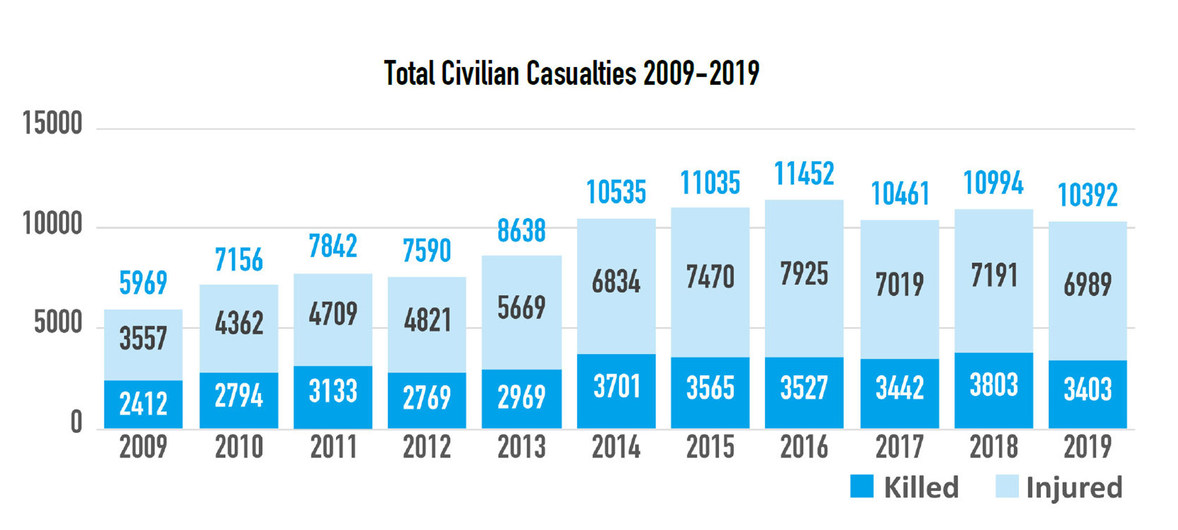
With all due respect to Senator Graham, his comment is ridiculous. The US has lost more than 2,500 soldiers and tens of thousands physically and mentally traumatized by the war. It has spent more than $2 trillion on the 20-year war. More than 100,000 civilians have been killed in the war and there is no one in the country that has not been dramatically affected by the war. But there is absolutely no evidence that the US has realized any of its goals in the war (remember–Osama bin Laden, the mastermind of the 11 September 2001 attack on the US. was killed in Pakistan by a Special Operations Team, not by any military action in Afghanistan). President Biden is absolutely justified in ending the futile war. I just hope that he allows those Afghans who sided with the US to leave Afghanistan if they wish to, and welcome them to the US
 World Politics News