Farmers in India have been protesting against changes in agricultural laws for over a year. The changes were passed by the government of Narendra Modi and the Bharatiya Janata Party (BJP) in in September 2021. The changes are described by Lawfare:
“Modi’s government passed the three farming laws in September to dramatically change the decades-old system of selling agricultural goods in India in an effort to resolve India’s long-standing agricultural crisis: Nearly half of India’s workforce is employed in agriculture, but farming makes up only around 15 percent of the country’s gross domestic product—a portion that is declining steadily. More than half of farming households are in debt, which has contributed to a crisis of suicide among farmers….
“The current agriculture system dates back to the decades after India’s independence. In the 1960s, with food shortages plaguing the country, the Indian government intervened in what is known as the ‘Green Revolution’ by introducing new technologies to increase the production of rice and wheat. At that time, the government also created a new food marketing system. The system is complicated and varies across states, but, essentially, it involves farmers bringing crops to wholesale markets known as mandis and selling the crops to traders in an open auction. The mandis are run by a marketing board established by the state to prevent farmers from being exploited by large retailers. Prices can be informed by minimum support prices (MSPs)—prices set by the government and at which it buys crops in certain states.
“The three new laws each deregulate a different aspect of the agricultural system: the sale, pricing and storage of goods. They allow farmers to sell their goods to private buyers outside the state-run markets and create a system for contract farming. Taken together, the laws reduce the government’s role in agriculture and open up spaces for private investors.
“The government argues that the deregulations increase efficiency, allow farmers greater freedom and let farmers negotiate better prices for their crops. But farmers say these reforms will devastate their earnings. Many worry that by allowing farmers to bypass the state-sanctioned marketplaces and sell directly to private buyers without paying the taxes or fees required by state-run markets, the laws will gradually make the mandi system obsolete. Protesting farmers’ biggest fear is that this dismantling of the mandis will end the MSPs—a safety net that assures farmers that they will be paid a certain price without regard to market conditions. Without MSPs, farmers would be at the mercy of private companies that have no obligation to pay them the guaranteed minimum price. The bills say nothing about the MSPs, and Modi has promised that they will remain. Still, protesters are skeptical and have demanded that the government make its promise in writing.
The protests have continued and have been violent at times. Yesterday, nine people were killed in the protests. The Guardian reports:
“Nine people have been killed in violent clashes during a protest by hundreds of farmers in the north Indian state of Uttar Pradesh, in a deadly escalation of year-long demonstrations against contentious agriculture laws.
“The farmers had gathered for a demonstration on Sunday in Lakhimpur Kheri district, where the junior home affairs minister Ajay Mishra and the state’s deputy chief minister, Keshav Prasad Maurya, were due to visit.
“There are conflicting reports of how four farmers, three BJP party workers, a driver and a journalist died as chaotic scenes broke out around vehicles that were part of Mishra’s convoy.
“Farmers at the scene alleged that a car thought to be owned by Mishra’s son ran over four protesters, killing them.”
The farmers will likely step up their protests and there is evidence that there is significant support for the farmers. The popularity of the Modi government has declined in recent months, largely because of the COVID pandemic. Whether these protests signal significant trouble for Modi remains to be seen.
The International Consortium of Investigative Journalists (ICIJ) has released a large number of confidential documents on how many public figures have used the offshore banking system to disguise how much money they possess and how that money was spent. The documents, which the ICIJ calls the “Pandora Papers“, build upon a previously released collection of similar papers dubbed the “Panama Papers” and document conclusively how many of the public figures shield their wealth from tax authorities. According to the ICIJ:
“Millions of leaked documents and the biggest journalism partnership in history have uncovered financial secrets of 35 current and former world leaders, more than 330 politicians and public officials in 91 countries and territories, and a global lineup of fugitives, con artists and murderers.
“The secret documents expose offshore dealings of the King of Jordan, the presidents of Ukraine, Kenya and Ecuador, the prime minister of the Czech Republic and former British Prime Minister Tony Blair. The files also detail financial activities of Russian President Vladimir Putin’s ‘unofficial minister of propaganda’ and more than 130 billionaires from Russia, the United States, Turkey and other nations.
“The leaked records reveal that many of the power players who could help bring an end to the offshore system instead benefit from it – stashing assets in covert companies and trusts while their governments do little to slow a global stream of illicit money that enriches criminals and impoverishes nations.”
What is especially disturbing about this system is that the very people who use the offshore banking system to hide money from tax authorities are the same people who write the laws that make such duplicity possible. The Washington Post points out the harms done by the system:
““The offshore financial system is a problem that should concern every law-abiding person around the world,” said Sherine Ebadi, a former FBI officer who served as lead agent on dozens of financial-crimes cases.
“Ebadi pointed to the role that offshore accounts and asset-shielding trusts play in drug trafficking, ransomware attacks, arms trading and other crimes. ‘These systems don’t just allow tax cheats to avoid paying their fair share. They undermine the fabric of a good society,’ said Ebadi, now an associate managing director at Kroll, a corporate investigations and consulting firm.
National Public Radio lists some of the people exploiting the offshore banking system for their personal benefit and it includes Ukrainian President Zelenskiy, Kenyan President Kenyatta, Pakistani Prime Minister Khan, former British Prime Minister Blair, Azerbaijani President Aliyev, the Russian confidante to President Putin, Svetlana Krivonogikh, and Jordan’s King Abdullah II. The report also notes that many of these banks are not, for Americans, “offshore” since states such as Nevada and South Dakota have changed their laws providing banking secrecy. The BBC also provides additional details on some of the people identified in the documents.
The fact that these offshore banking sites are legal exposes the corruption sometimes involved in writing tax laws. Few ordinary individuals have assess to these legal loopholes and are thus consigned to pay for the freedom of powerful individuals to avoid paying their fair share. The Guardian explains why it has published some of the papers: “Tax havens are estimated to cost governments anywhere between $400bn and $800bn (£293bn to £586bn) every year in lost tax revenues from corporations and individuals. That may be an unfathomable sum, but it is real money that is not being spent on schools, hospitals or the transition to a low-carbon economy.”
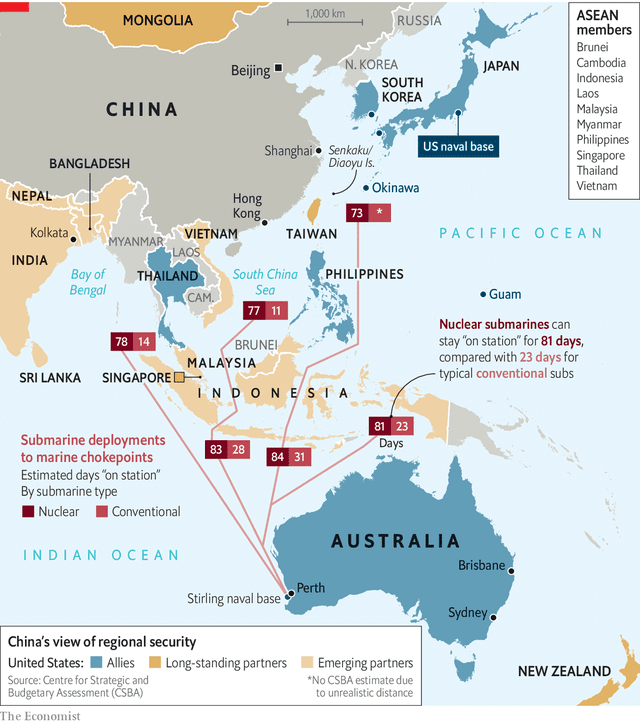
The recent agreement reached by the US, Great Britain, and Australia (labelled the AUKUS agreement) to provide nuclear powered submarines to Australia signals a continuation of the “pivot” toward Asia begun under the Obama Administration. It was a slap to another European power, France, which had signed an agreement in 2016 with Australia with diesel-powered submarines. The agreement–for $90 billion–with Naval Power, a French company in which the French government holds a majority interest, was for the provision of 12 diesel-powered submarines (named “Shortfin Barracuda) but had been on the rocks for some time. The Guardian reportsthat “Government figures were becoming increasingly concerned about delays, cost blowouts, and a difficulty in securing firmer pledges for more substantial domestic industry involvement.” The French, however, were completely blindsided by the AUKUS agreement and French President Macron labelled the deal–justifiably–“a stab in the back”.
The damage done to a strong NATO ally was deep, but the AUKUS decision represents a significant strategic decision by the US and Great Britain about the dangers of growing Chinese power in East and Southeast Asia. The French submarines would have been adequate for coastal defense of Australia. Running on electric power, the French submarines would have been quieter than nuclear powered submarines. But the diesel submarines had a shorter range because of fuel requirements and would not have been able to project power in the South China Sea, the Taiwan Straits, or the waters between China and Japan and South Korea. Nuclear submarines can stay on station for 81 days while diesel powered submarines can only stay on station for 23 days. Thus, the AUKUS deal clearly indicates a decision by the US, Great Britain, and Australia that they are prepared to “contain” China.
The decision is reminiscent of the US decision in 1950 to “contain” the Soviet Union, a decision that required the US to construct a wide array of military alliances, such as NATO and CENTO, that were buttressed by the US nuclear weapons arsenal. The AUKUS agreement does not envision any new emphasis on nuclear weapons–the nuclear submarines will not be outfitted with nuclear weapons although providing Australia with nuclear fuel for the submarines will stretch the limits of the Non-Proliferation Treaty to which all three powers are signatories. There are already several defense and economic treaties to which the US is a partner:
The ANZUS Treaty, signed by the US, Australia, and New Zealand in 1951
The Five Eyes (the UK, the United States, Canada, Australia and New Zealand) an intelligence sharing agreement created in 1956 but not publicly revealed until 2010
The Comprehensive and Progressive Agreement for Trans-Pacific Partnership (CPTPP) created after US President Trump pulled the US out of the Trans-Pacific Partnership. It now includes Canada, Australia, Brunei, Chile, Japan, Malaysia, Mexico, New Zealand, Peru, Singapore and Vietnam. China has requested membership in this free trade agreement.
The US has a lot of allies in the region and all these agreements suggest that there are deep institutional and political connections drawing them together. It is not clear, however, that China represents an adversary in the way that the Soviet Union contested American power and the liberal international order. China has made it clear that it does not intend to become a liberal state, but there is little evidence so far to suggest that it wishes to create alliances in opposition to a liberal world order. Indeed, China has benefited tremendously from its participation in the liberal economic order.
Nonetheless, the Chinese are deeply upset by the AUKUS Agreement. The BBC describes the Chinese reaction:
“China has criticised a historic security pact between the US, UK and Australia, describing it as ‘extremely irresponsible’ and ‘narrow-minded’.
“The deal will see the US and UK give Australia the technology to build nuclear-powered submarines for the first time.
“It is being widely viewed as an effort to counter China’s influence in the contested South China Sea.
“The region has been a flashpoint for years and tensions there remain high.
“Chinese foreign ministry spokesman Zhao Lijian said the alliance risked ‘severely damaging regional peace… and intensifying the arms race’.
He criticised what he called ‘the obsolete Cold War… mentality’ and warned the three countries were ‘hurting their own interests’.
One cannot help, however, to note that in comparison to the US network of alliances in the region, the Chinese are pretty much isolated. Many of the countries in the region depend upon the Chinese economy, but most of the countries in the region are suspicious of Chinese intentions. They are quietly pleased that the US might act as a counterweight to Chinese power. All those states would prefer that the US presence be as low-key as possible and submarines certainly fill that bill.
The Washington Post has published an article published in Science magazine which raises a deeply troubling issue of what is terms the “intergenerational inequality” of climate change. Unfortunately, the article resides behind a paywall so I can only comment on the interpretation offered by the Post. But the underlying logic of the argument is persuasive. According to the article:
“If the planet continues to warm on its current trajectory, the average 6-year-old will live through roughly three times as many climate disasters as their grandparents, the study finds. They will see twice as many wildfires, 1.7 times as many tropical cyclones, 3.4 times more river floods, 2.5 times more crop failures and 2.3 times as many droughts as someone born in 1960….
“Unless world leaders agree on more ambitious policies when they meet for the United Nations climate summit in Glasgow, Scotland, this fall, the study says, today’s children will be exposed to an average of five times more disasters than if they lived 150 years ago.”
Further, the children who live in tropical and subtropical climates will suffer more and have fewer resources with which to protect themselves. Phys Org notes:
“Behind these global numbers hide important regional variations. Young generations in low-income countries will face by far the strongest increases with a more than fivefold increase in overall lifetime extreme event exposure. While 53 million children born in Europe and Central Asia since 2016 will experience about four times more extreme events under current pledges, 172 million children of the same age in sub-Saharan Africa face an almost sixfold increase in lifetime extreme event exposure, and even 50 times more heatwaves.”
There is an upcoming UN conference on climate change that is scheduled to occur in Scotland in November. The purpose of the conference is to hold states to stricter reductions in the emissions of greenhouse gases in line with the 1.5 degree (C) goal of the Paris Agreement. But most analysts believe that efforts to take stronger measures will likely fail:
“Vital United Nations climate talks, billed as one of the last chances to stave off climate breakdown, will not produce the breakthrough needed to fulfil the aspiration of the Paris agreement, key players in the talks have conceded.
“The UN, the UK hosts and other major figures involved in the talks have privately admitted that the original aim of the Cop26 summit will be missed, as the pledges on greenhouse gas emissions cuts from major economies will fall short of the halving of global emissions this decade needed to limit global heating to 1.5C.
“Senior observers of the two-week summit due to take place in Glasgow this November with 30,000 attenders, said campaigners and some countries would be disappointed that the hoped-for outcome will fall short.”
I personally find the issue of intergenerational justice compelling. In a letter to the editor of The Economist, James Dingley of the Francis Hutcheson Institute in Ireland, articulated the premise of liberal thinkers on the balancing of rights and responsibilities:
“The problem lies in our failure to understand properly the original premises of our Enlightenment heritage. The ideals you refer to (“The threat from the illiberal left”, September 4th) are those mostly developed fully by Adam Smith as a moral philosopher (not as an economist). Smith’s mentor and teacher was Francis Hutcheson, whose influence is most clearly seen in Smith’s first book “The Theory of Moral Sentiments”. Here, Smith builds on Hutcheson’s arguments against greed and self-interest. The original reasoning in favour of individual freedom and liberty was to enable people to develop their talents both for their own self-worth and for the good of the community.
“Hutcheson was equally scathing on rights, which could quickly become a cover for greed and selfishness. Hence Hutcheson posited that rights must always be balanced against the virtue of an act, or its effect on others. This is an important moral corrective that is continually ignored in our pursuit of narrow individual or identity-group rights.”
Rights are important to create a good society, not to satisfy personal appetites. A society that does not value the lives of its grandchildren can hardly be described as good or even viable.
The Chinese media outlet, Global Times, which often reflects the official position of the Chinese Communist Party, has published an editorial entitled “PLA jets will eventually patrol over Taiwan: Global Times editorial“. The editorial comes as part of an escalating war of words and actions between the US and China over the status of Taiwan. Taiwan has historically been considered part of China but after the Chinese Communist Party took control of the mainland in 1949 (on October 1, 1949 which means that an important anniversary is coming up), the Nationalist government of China fled to the island and declared its independence as the Republic of China to differentiate itself from the communist controlled People’s Republic of China. From that time until 1972, the US recognized Taiwan as the legitimate government of the people of China and Taiwan held the UN Security Council seat reserved for China.
In 1972, the US and China signed what is known as the Shanghai Communique. The agreement was to put off the question of the status of Taiwan until at some point in the future. The Public Broadcasting System characterized the essential parts of the agreement:
“The U.S. declared its ‘interest in a peaceful settlement of the Taiwan question by the Chinese themselves,’ and affirmed a total U.S. military withdrawal from the island as an ‘ultimate objective.’ The U.S. also agreed to ‘progressively reduce its forces and military installations on Taiwan as the tension in the area diminishes,’ thereby giving China a stake in the abatement of the Vietnam War.
“For its part, the PRC firmly rejected any ‘two Chinas’ formulation, declaring unequivocally that ‘the Government of the People’s Republic of China is the sole legal government of China’ and ‘Taiwan is a province of China.’ The U.S., in deft phrasing, acknowledged ‘that all Chinese on either side of the Taiwan Strait maintain there is but one China and that Taiwan is a part of China,’ but neatly avoided the question of who should govern this ‘one China”.
In 1978, US President Carter, “severed US relations with the government on Taiwan and established formal diplomatic relations with the People’s Republic of China.” That should have been the end of the matter.
But many in the US believed that Taiwan deserved support in order to show that the US condemned Communist rule in China and also because Taiwan became an important economic partner to the US and the world. Indeed, Taiwan is home to one of the most important semiconducting corporations in the world, Taiwan Semiconductor Manufacturing Company (TSMC). In addition, Taiwan is one of the most important purchaser of US weaponry, buying $5 billion of arms from the US in 2020.
China’s rhetoric on Taiwan has become increasingly more strident as China has become more powerful. For example, the precipitating event for the Global Times editorial was a seemingly innocuous decision by the US to rename Taiwan’s mission office to the US from the Taipei Economic and Cultural Representative Office (TECRO) to the Taiwan Representative Office. The Council on Foreign Relations published a short essay highlighting the significance of the change:
“If the Biden administration allows Taiwan to rebrand TECRO as the Taiwan Representative Office, it would undermine the logic of the unofficial nature of the U.S.-Taiwan relationship. Removing the reference to economic and cultural ties and adding the word ‘Taiwan’ would implicitly upgrade the status of the office to something more akin to an embassy. Such a decision would also strengthen the hand of those in Taipei who advocate additional moves to make the relationship more official, such as allowing Taiwan’s president to visit Washington, DC.
“Some will argue that renaming the office will not start a war with China, so the United States should go ahead with the move. But that is not a sufficient way to measure whether the United States should undertake a given policy. Instead, the United States should keep in mind whether a policy sends mixed messages to Taiwan regarding the U.S. position on Taiwan independence and emboldens those on Taiwan who advocate for independence. It also should consider whether a proposed policy is intellectually consistent with the U.S. One-China policy and sends the proper signals to its own bureaucracy. The fact that TECRO is such a unique name forces those in the U.S. government who do not routinely work on U.S.-Taiwan relations to ask why it is different and what is unique about U.S.-Taiwan ties. This has a useful disciplining effect on the government.”
Similarly, China condemned the recent decision of Lithuania to open diplomatic ties with Taiwan, leading to an impasse which threatens to embroil the entire European Union.
The willingness of China to break its agreement with Great Britain over the status of human rights in Hong Kong (the “two Systems Agreement” of 1997 which was supposed to be in force until 2047) suggests that China is feeling less constrained by other powers. Its continued military build-up in the South China Sea, which is flatly inconsistent with established international law on maritime matters, is another example of its growing confidence. Finally, after four years of former President Trump’s efforts to put “America First”, there is a clear fraying of US alliance ties and the US withdrawal from Afghanistan is interpreted by some as a weakening of US will to defend allies. Clearly, Taiwan is worried about its ties with the US and it has dramatically increased its defense budget.
The US position on Taiwan is tenuous since it has already conceded that Taiwan is part of China–it is politically very difficult for states to support territories that break away from a central government. The US Navy remains a formidable force, but it would be fighting in China’s backyard. The best course of action for the US would be to keep a low profile and to highlight the advantages to China of maintaining open markets for the advanced technology developed in Taiwan. The US should not think seriously about using military force to support an independent Taiwan.
Tomorrow is the 20th anniversary of the 11 September attack on the US by al Qaeda. The newspapers are filled with references to the event and several TV channels are airing documentaries. There seem to be several themes common to all this attention: the grief and pain suffered by those who lost loves ones; the need to “never forget”; and the question of whether there was enough done to avert the attack. I have vivid memories of the event, watching the TV with my colleagues in Skinner Hall and realizing that an act of war had occurred. In subsequent days, there were many sessions with colleagues and students assessing the implications of the attack. My dear colleague, Jon Western, articulated the view held by many that the world had changed dramatically.
I am disheartened, however, that there seems to be a distinct lack of attention to the question of the intelligence of the US response to the attack. It was undoubtedly an act of war, but few asked the question of whether going to war was the correct response. The horrific and cold-blooded act stimulated rage, a desire for revenge, and unleashed cruel and unwarranted attacks on Arabs and Islam. None of those motives are consistent with a reasoned decision to go to war and to launch what came to be called the “Global War on Terror”. Clausewitz understood well the need to keep reason at the center of any decision to go to war: “We come now to the region dominated by the powers of intellect. War is the realm of uncertainty . . . . War is the realm of chance. . . . Two qualities are indispensable: first, an intellect that, even in the darkest hour, retains some glimmerings of the inner light which leads to truth; and second, the courage to follow this faint light wherever it may lead. The first of these qualities is described by the French term, coup d’oeil; the second is determination.”
The US made a fatal mistake in treating the attack as a military attack, and not a political attack. al Qaeda had no army and few armaments. In September 2001 al Qaeda had purchased refuge in Afghanistan from the Taliban and, while it was well-organized, it was a small force of poorly armed adherents. The US response was to invade both Afghanistan and Iraq and overthrow their governments and replacing them with governments which poorly represented the interests of the people in those states. The US abandoned its commitment to defending human rights, resorting to torture in prisons such as Abu Ghraib and detaining prisoners in the US naval base in Guantanamo, Cuba with no charges and no access to any of the protections of the laws of war. The US also completely militarized its response to political terrorism, spending $21 trillion on measures designed to protect American security according to the National Priorities Project:
KEY FINDINGS
Over the 20 years since 9/11, the U.S. has spent $21 trillion on foreign and domestic militarization.
Of that total, $16 trillion went to the military — including at least $7.2 trillion for military contracts.
Another $3 trillion went to veterans’ programs, $949 billion went to Homeland Security, and $732 billion went to federal law enforcement.
For far less than it spent on militarization since 9/11, the U.S. could reinvest to meet critical challenges that have been neglected for the last 20 years:
$4.5 trillion could fully decarbonize the U.S. electric grid.
$2.3 trillion could create 5 million jobs at $15 per hour with benefits and cost-of-living adjustments for 10 years.
$449 billion could continue the extended Child Tax Credit for another 10 years.
$200 billion could guarantee free preschool for every 3-and-4-year old for 10 years, and raise teacher pay.
$25 billion could provide COVID vaccines for the populations of low-income countries.
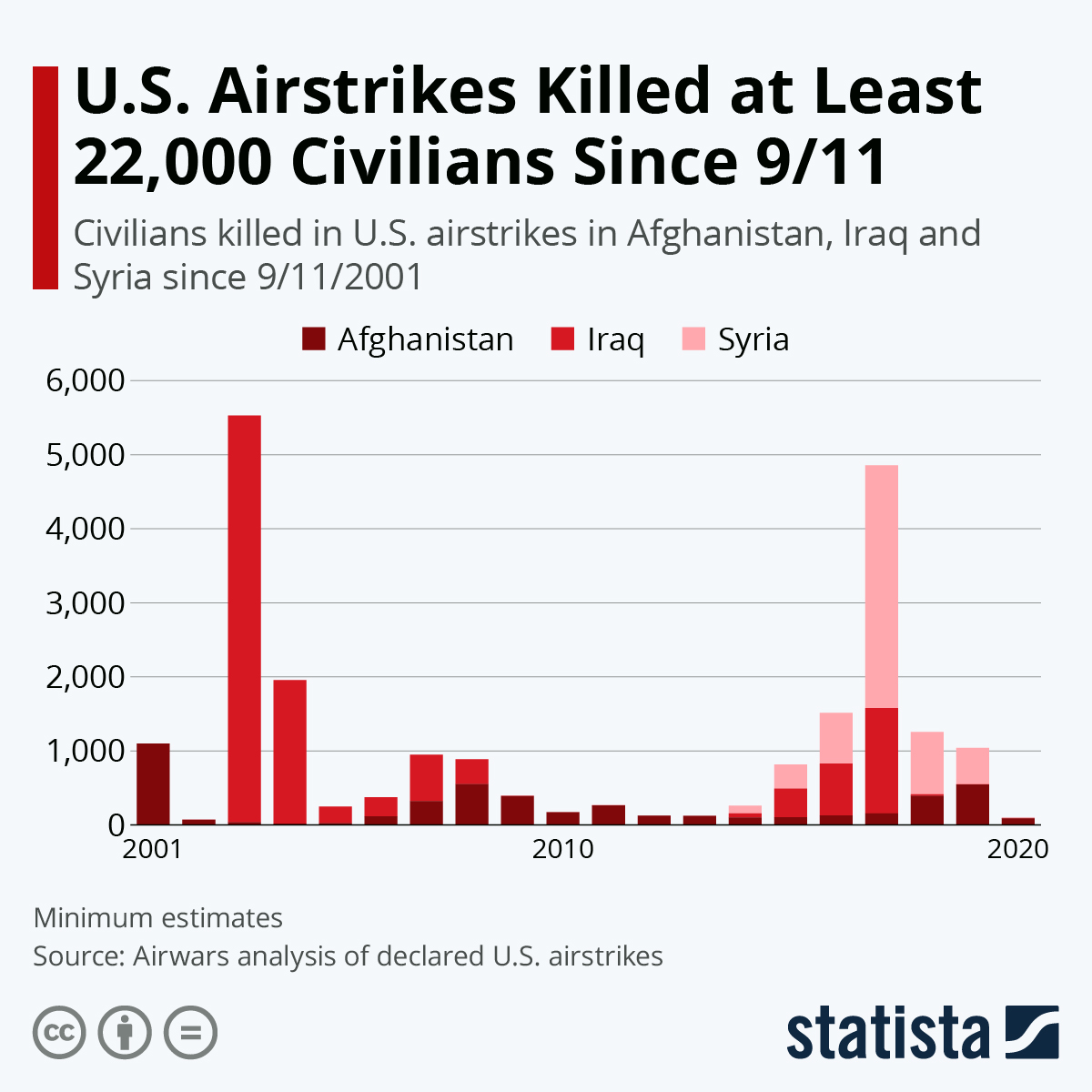
In addition, the US military response to the attacks killed many civilians, dwarfing the 3,000 who were killed in the US on 11 September 2001:
“20 years after the terrorist attacks on New York City’s World Trade Center of Sept 11, 2001, at least 22,000 civilians have been killed in U.S. airstrikes during the war on terror, mainly in Afghanistan, Iraq and Syria. The minimum estimate counts around 11,500 civilian airstrike deaths in Iraq, 5,700 in Syria and 4,800 in Afghanistan. Additional deaths occurred in Somalia, Yemen, Pakistan and Libya. The maximum estimate by UK NGO Airwars, which analyzed declared U.S. airstrikes since 2001, is more than twice as high at around 48,000.”
Now, twenty years later, the Taliban are back in power in Afghanistan, Iraq has a government strongly influenced by Iran, and terrorism continues to be the instrument of choice for many international groups but also for a disturbingly large number of white supremacists in the US. As we remember the grief of 11 September, we should also realize that we allowed that grief to lead us into a series of policies that addressed none of the causes of that sorrow. And more than likely deepened and aggravated those causes.
US President Biden gave a speech yesterday announcing the end of the US role in the war in Afghanistan. It was probably an unnecessary speech since the news reports and videos since 14 August have thoroughly documented the exodus of Americans, Afghans, and allied citizens from the country. The politics of the end of an unsuccessful war are complicated and subject to the strong desire to forget the war as soon as possible. When Saigon fell in April 1975, then President Ford did not give a speech but rather issued a statement that was incredibly brief given the passions surrounding the war:
“During the past week, I had ordered the reduction of American personnel in the United States mission in Saigon to levels that could be quickly evacuated during an emergency, while enabling that mission to continue to fulfill its duties.
“During the day on Monday, Washington time. the airport at Saigon came under persistent rocket as well as artillery fire and was effectively closed. The military situation in the area deteriorated rapidly.”
“I, therefore. ordered the evacuation of all American personnel remaining in South Viet Nam.
“The evacuation has been completed. I commend the personnel of the Armed Forces who accomplished it, as well as Ambassador Graham Martin and the staff of his mission who served so well under difficult conditions.
“This action closes a chapter in the American experience. I ask all Americans to close ranks, to avoid recrimination about the past. to look ahead to the many goals we share and to work together on the great tasks that remain to be accomplished.”
President Biden’s speech today was an aggressive attempt to defend his decision to withdraw US troops by 31 August. The tone of the speech was admittedly defensive. His critics have made some serious charges about the decision to withdraw: that he abandoned Afghan allies and Afghan women and girls, placed US troops in jeopardy, blindsided NATO allies with the abruptness of the withdrawal, dishonored the sacrifice of the soldiers who were killed or wounded in the war, provided the Taliban with state of the art weaponry, and destroyed the credibility of US commitments in the future.
There was no reason for President Biden to be defensive. Losing a war is a difficult passage for any state, but the war in Afghanistan was lost many years ago and Biden made few decisions that were consequential in the conduct of the war. Given that his predecessor had already agreed to withdraw US troops in exchange for a promise by the Taliban not to attack US soldiers, there was very little Biden could do except break Trump’s agreement and renew combat with the Taliban. Dexter Filkins was interviewed by Terry Gross on National Public Radio in March 2021 and made these comments:
“FILKINS: The deal itself is simple, but it kind of sets off this cascade of other things which are not so simple. But the deal basically says the Taliban won’t kill any Americans, and we won’t attack the Taliban. And if all goes well and the Taliban agree not to support any kind of terrorism against the United States or not to allow terrorists in the country or any kind of bases, the United States will leave and go to zero and take out all of its forces by May 1…..
“And so the whole thing was kind of unconventional, but there’s an agreement. It was signed in February of last year, February 2020. And it says that the United States will pull out all of its forces by May 1. And what’s remarkable about it is that since February 2020, no American soldiers have been killed in Afghanistan. So the Taliban have, in fact, held to their word.”
Trump enjoyed the cessation of hostilities but made no preparations to avoid any of the negative consequences experienced by Biden in the last two weeks. Thus, when critics of the Biden decision make the point that continuing the US presence in Afghanistan was relatively costless. they are ignoring the special circumstances of that armistice. It is true that Biden could have ripped up the Trump agreement, but that would have meant the return of hostilities and the commensurate risks to American troops.
President Biden made the correct decision to withdraw before the Taliban resumed hostilities. And he should be applauded for getting 5,000 Americans and 124,000 Afghans out under horrific conditions. Ending the war was unquestionably in the US national interest and, given the total collapse of the Afghan government, in the Afghan national interest. Afghanistan was never destined to become a liberal state under a military occupation and it was, and is, foolish to pretend otherwise.
We have been flooded with news reports on the US withdrawal from Afghanistan and the apparent victory of the Taliban in taking control of the country. I have been struck by how many “experts” have emerged with a number of fanciful “what should have happened” scenarios in the face of a genuine humanitarian crisis. Over time we will learn more of the decision-making process of the Biden Administration and whether the President made a flawed decision to withdraw US forces precipitously.
I will wait for much more evidence before I determine how accurate these assessments are. But I am not at all reluctant to think that these assessments are less important than the more important question of why the US invaded and occupied Afghanistan in 2001. All the Sturm und Drang over Biden’s decision obscures the central fact that the US effort at “nation-building” was a colossal and expensive failure. What makes this fact so disturbing is that the US should have learned that lesson in the Vietnam War.
There once was a recognition that the failure should not be repeated. Colin Powell articulated the conditions necessary to support and sustain a military intervention in the future so that the US military would never find itself in a no-win situation. Powell outlined what came to be known as the “Powell Doctrine“. In Powell’s own words:
“In time, just as I came to reexamine my feelings about the war, the Army, as an institution, would do the same thing. We accepted that we had been sent to pursue a policy that had become bankrupt. Our political leaders had led us into a war for the one-size-fits-all rationale of anticommunism, which was only a partial fit in Vietnam, where the war had its own historical roots in nationalism, anticolonialism, and civil strife beyond the East-West conflict. Our senior officers knew the war was going badly. Yet they bowed to groupthink pressures and kept up pretenses, the phony measure of body counts, the comforting illusion of secure hamlets, the inflated progress reports. As a corporate entity, the military failed to talk straight to its political superiors or to itself. The top leadership never went to the secretary of defense or the president and said, “This war is unwinnable the way we are fighting it.” Many of my generation, the career captains, majors and lieutenant colonels seasoned in that war, vowed that when our turn came to call the shots, we would not quietly acquiesce in halfhearted warfare for half-baked reasons that the American people could not understand or support.”
The Powell Doctrine had the following questions to answer before the US would intervene in the future:
1. Is a vital national security interest threatened?
2. Do we have a clear attainable objective?
3. Have the risks and costs been fully and frankly analyzed?
4. Have all other nonviolent policy means been fully exhausted?
5. Is there a plausible exit strategy to avoid endless entanglement?
6. Have the consequences of our action been fully considered?
7. Is the action supported by the American people?
8. Do we have genuine broad international support?
The problem with the Powell Doctrine was that these conditions were so strict that it would be highly unlikely that the US would use military force in the future and that outcome proved to be unacceptable to those who wished to keep the US military and to those who wished to profit from military spending.
After the US invaded Iraq in 2003 and overthrew its leader, Saddam Hussein, the US found itself in the position of determining a strategy to guide its operations in Iraq. Essentially, the invasion vitiated the precepts of the Powell Doctrine and the US found itself in the position of trying to rebuild Iraq. General David Petraeus (whose Princeton Ph.D. dissertation was entitled “The American Military and the Lessons of Vietnam”) rewrote the counterinsurgency manual for the US Army: “He took up the task of rewriting the military’s counterinsurgency manual. The new manual, which was published last month, presents a thoroughly researched and innovative rethinking of counterinsurgency in the post-Sept. 11 world — a reassessment of strategy based on the history of counterinsurgency stretching from ancient Rome to the French debacle in Algeria to America’s experience in Vietnam.” One can read the entire manual which is entitled “The Field Manual on Counterinsurgency Operations“.
“A leading voice in the Conservative camp is Colonel Gian Gentile, a Berkeley graduate with a doctorate in history from Stanford, who currently teaches at West Point. Gentile has two tours in Iraq under his belt. During the second, just before the Petraeus era, he commanded a battalion in Baghdad.
Writing in the journal World Affairs, Gentile dismisses as ‘a self-serving fiction’ the notion that Abrams in 1968 put the United States on the road to victory in Vietnam; the war, he says, was unwinnable, given the ‘perseverance, cohesion, indigenous support, and sheer determination of the other side, coupled with the absence of any of those things on the American side.’ Furthermore, according to Gentile, the post-Vietnam officer corps did not turn its back on that war in a fit of pique; it correctly assessed that the mechanized formations of the Warsaw Pact deserved greater attention than pajama-clad guerrillas in Southeast Asia.
“Gentile also takes issue with the triumphal depiction of the Petraeus era, attributing security improvements achieved during Petraeus’s tenure less to new techniques than to a ‘cash-for-cooperation’ policy that put ‘nearly 100,000 Sunnis, many of them former insurgents, … on the U.S. government payroll.’ According to Gentile, in Iraq as in Vietnam, tactics alone cannot explain the overall course of events.
“All of this forms a backdrop to Gentile’s core concern: that an infatuation with stability operations will lead the Army to reinvent itself as ‘a constabulary,’ adept perhaps at nation-building but shorn of adequate capacity for conventional war-fighting.
The Petraeus Doctrine guided US operations in Afghanistan almost perfectly. And therein lies the humanitarian tragedy we are witnessing in Afghanistan.
Afghanistan was likely the nation less amenable to US influence, or, to be more precise, to any outside influence. In 2017 Akhilesh Pillalamarri wrote:
“Afghanistan is a notoriously difficult country to govern. Empire after empire, nation after nation have failed to pacify what is today the modern territory of Afghanistan, giving the region the nickname “Graveyard of Empires, ” even if sometimes those empires won some initial battles and made inroads into the region. If the United States and its allies decide to leave Afghanistan, they would only the latest in a long series of nations to do so. As the British learned in their 1839-1842 war in Afghanistan, it is often easier to do business with a local ruler with popular support than to support a leader backed by foreign powers; the costs of propping up such a leader eventually add up. The closest most historical empires have come to controlling Afghanistan was by adopting a light-handed approach, as the Mughals did. They managed to loosely control the area by paying off various tribes, or granting them autonomy. Attempts at anything resembling centralized control, even by native Afghan governments, have largely failed.”
Since 2001 the US has invested the lives of many soldiers and civilians and likely more than $1 trillion in an effort to build an Afghan army capable of resisting the Taliban. But those efforts were a spectacular failure as evidenced by the quick collapse of the Afghan national army. Some argue that the Afghan military folded because the Afghan government abruptly fled the country. There is some truth to that explanation but the soldiers in the Afghan army certainly knew that their government was not nearly as bad as the Taliban. Kori Schake explains the reason for the US failure:
“But our efforts to train foreign militaries also fail because of shortcomings particular to American policy choices. The U.S. tends to undertake large-scale train-and-equip programs when we don’t want to do the fighting ourselves; that has been the story in Iraq and Afghanistan. But sending that signal heartens adversaries and weakens the very forces we’re attempting to help. We convey the limits of our intentions.
“The same message is transmitted by assigning the training task solely to the military. The surges of military forces in both Iraq and Afghanistan were supposed to have civilian counterparts. Remember General Stanley McChrystal claiming that we were bringing “government in a box” to Afghanistan when he took over command of allied forces there? Neither surge, in Iraq or Afghanistan, delivered on its aims to strengthen civilian governance, which is essential for military training programs not to outpace and thereby undermine their civilian counterparts.”
We have known for some time that the training program was not going to be successful. In 2019 The Washington Post published what have come to be known as the “Afghanistan Papers” (using the Vietnam Pentagon Papers as an analog). Craig Whitlock describes the conclusions of those documents:
“A confidential trove of government documents obtained by The Washington Post reveals that senior U.S. officials failed to tell the truth about the war in Afghanistan throughout the 18-year campaign, making rosy pronouncements they knew to be false and hiding unmistakable evidence the war had become unwinnable.
“The documents were generated by a federal project examining the root failures of the longest armed conflict in U.S. history. They include more than 2,000 pages of previously unpublished notes of interviews with people who played a direct role in the war, from generals and diplomats to aid workers and Afghan officials.
“Since 2001, more than 775,000 U.S. troops have deployed to Afghanistan, many repeatedly. Of those, 2,300 died there and 20,589 were wounded in action, according to Defense Department figures.”
Ultimately, the emptiness of the US program led to the success of the Taliban. Douglas London, the CIA’s Counterterrorism Chief for South and Southwest Asia until 2019, outlines the US failure, not the Taliban’s victory:
“And in grading their own homework, the U.S. defense establishment only exacerbated the problem. While it’s little surprise the Department of Defense was unwilling to objectively evaluate the resolve and capacity of those they trained, equipped, and advised to resist a forthcoming Taliban offensive, their rose-colored depictions of achievement over 20 years flew in the face of reality, and was consistently challenged by the CIA’s more gloomy, albeit realistic projections.”
I would rather point to the US belief in American exceptionalism as the main cause of the failure. That belief, and the parochialism of the American perspective, was captured in the speech given by former President George W. Bush in his State of the Union Address in 2002. Bush celebrates the US ideology as universal, ignoring the long and distinguished history and culture of the Afghan people:
“America will lead by defending liberty and justice because they are right and true and unchanging for all people everywhere.
“No nation owns these aspirations, and no nation is exempt from them. We have no intention of imposing our culture. But America will always stand firm for the non-negotiable demands of human dignity: the rule of law; limits on the power of the state; respect for women; private property; free speech; equal justice; and religious tolerance.”
This belief was maintained by subsequent Presidents Obama. Trump, and Biden. Until the US divests itself of the self-serving assumption that everyone in the world wants to be an American, it is likely that the mistake of Afghanistan, like the mistake of Vietnam, will be forgotten.
 World Politics News