For the third time, the US has vetoed a UN Security Council resolution demanding an immediate cease-fire in the conflict in the Gaza Strip. Instead, the US proposed a resolution that asked for “a temporary humanitarian cease-fire as soon as practical” and for the release of hostages. The more stringent resolution was proposed by Algeria and received 13 affirmative votes (Great Britain abstained). The US stands alone with Israel in opposition to an immediate cease-fire.
There is absolutely no justification for the US obstruction. It claimed that the Algerian resolution would jeopardize the current negotiations on the release of the hostages, but there is no credible evidence that those negotiations are making any progress whatsoever. Curiously, the US alternative resolution (which has not yet been submitted, but The Guardian claims to have seen a draft copy) “determines that under current circumstances a major ground offensive into Rafah would result in further harm to civilians and their further displacement including potentially into neighbouring countries, which would have serious implications for regional peace and security, and therefore underscores that such a major ground offensive should not proceed under current circumstances”. It seems that the US is at least calling for an immediate cease-fire with respect to the situation in Rafah.
Israel has said that it will conduct a military operation into Rafah by the beginning of Ramadan (in early March) if the hostages are not released. There are about 1.4 million Palestinians in Rafah and they have literally no place to go if the Israeli assault occurs. There are indications that Egypt is building a protected area in its Sinai territory which suggests that there is some sort of arrangement to push the Palestinians into this area when an assualt happens. According to Le Monde:
“According to the Sinai Foundation for Human Rights NGO, which revealed the existence of this construction site on February 12, the location is intended to accommodate Palestinian refugees, should Egypt face a mass exodus from Gaza. Local contractors told the NGO that they had been commissioned to carry out the work by the company Sons of Sinai, owned by businessman Ibrahim El-Argani, who is close to the Egyptian army. The 7-meter-high walls are to be built under the supervision of military engineers and a heavy security presence.
“Egyptian sources have confirmed on condition of anonymity to The Wall Street Journal that a walled enclosure with the capacity for more than 100,000 people has been set up. An Egyptian source told Le Monde that the fear of facing an influx of displaced persons in the event of an Israeli offensive on the town of Rafah was behind this decision. However, Diaa Rashwan, head of the government’s communications department, denied the existence of such a project. He pointed out that Egypt is opposed to any forced displacement of Gazans on its territory due to the war between Israel and Hamas in the Palestinian enclave.””Egyptian sources have confirmed on condition of anonymity to The Wall Street Journal that a walled enclosure with the capacity for more than 100,000 people has been set up. An Egyptian source told Le Monde that the fear of facing an influx of displaced persons in the event of an Israeli offensive on the town of Rafah was behind this decision. However, Diaa Rashwan, head of the government’s communications department, denied the existence of such a project. He pointed out that Egypt is opposed to any forced displacement of Gazans on its territory due to the war between Israel and Hamas in the Palestinian enclave.”
The Sinai Foundation for Human Rights has published a photo which outlines the areas that are being built up to handle refugees. The white area of the photo is where there is current construction; the green area is the total area under consideration for holding refugees.
There is no hard information about Israeli plans for those currently in Rafah, but the Egyptian construction suggests that there is consideration for pushing the refugees onto Egyptian territory. Such displacement is perilous: there is no guarantee that the Palestinians will be allowed back into the Gaza, opeing the possibility that the Netanyahu government may be considering settlements in the Strip. The Associated Press describes the history of previous displacements in the history of the region:
“Displacement has been a major theme of Palestinian history. In the 1948 war around Israel’s creation, an estimated 700,000 Palestinians were expelled or fled from what is now Israel. Palestinians refer to the event as the Nakba, Arabic for “catastrophe.”
“In the 1967 Mideast war, when Israel seized the West Bank and Gaza Strip, 300,000 more Palestinians fled, mostly into Jordan.
“The refugees and their descendants now number nearly 6 million, most living in camps and communities in the West Bank, Gaza, Lebanon, Syria and Jordan. The diaspora has spread further, with many refugees building lives in Gulf Arab countries or the West.
“After fighting stopped in the 1948 war, Israel refused to allow refugees to return to their homes. Since then, Israel has rejected Palestinian demands for a return of refugees as part of a peace deal, arguing that it would threaten the country’s Jewish majority.”
Representatives Pressley and Raskin sent a letter to the Biden Administration on 18 January 2024 asking for the US government to reiterate its opposition to forced displacement of Palestinians. It reads, in part:
“We write to support the Biden administration’s continued strong opposition to any consideration of the idea of forced transfer of Palestinians out of Gaza. We appreciate President Biden’s clear commitment, in calls with Egyptian President Abdel Fattah Al-Sisi and Jordanian King Abdullah II, to ensure that Palestinians in Gaza will not be displaced to any other nation. We also welcome Vice President Harris’ assurance that ‘under no circumstances will the United States permit the forced relocation of Palestinians from Gaza or the West Bank, the besiegement of Gaza, or the redrawing of the borders of Gaza.’ Additionally, we were glad to see you reiterate the administration’s firm opposition to the forcible displacement of Palestinians during a recent press conference in Doha.”
The US is abdicating its responsibility to uphold international law and its moral obligation to protect the lives of innocents. Further, it is relinquishing its already limited influence on the countries in the Middle East. There is also little evidence to support the idea that the US has a reliable ally in an Israeli government ruled by Netanyahu. The US is pursuing a policy that leaves it with no dependable friends in the region.
The Guardian has published an analysis of the destruction in the Gaza Strip since 8 October 2023. It is an interactive map which explains the significance of the targeting practices of the Israeli Army, including before and after photos of various sites. It is safe to say that we are witnessing urban destruction comparable (if not worse) to the destruction of Dresden and Tokyo in World War II. The red areas on the map are areas that the Israeli Defense Forces have bombed or attacked.
I am not at all qualified to assess what this satellite image actually conveys. To my untrained eye, however, it seems that there are no safe places in the Gaza. Furthermore, the close-up photos in the article also indicate significant destruction of the little agricultural land, including olive orchards, available in the Strip. The Guardian summarizes its close analysis of three neighborhoods in the Strip:
“Using satellite imagery and open-source evidence, the investigation found damage to more than 250 residential buildings, 17 schools and universities, 16 mosques, three hospitals, three cemeteries and 150 agricultural greenhouses.
“Entire buildings have been levelled, fields flattened and places of worship wiped off the map in the course of Israel’s war against Hamas in Gaza, launched after the Hamas attack on Israel on 7 October.
“The destruction has not only forced 1.9 million people to leave their homes but also made it impossible for many to return. This has led some experts to describe what is happening in Gaza as “domicide”, defined as the widespread, deliberate destruction of the home to make it uninhabitable, preventing the return of displaced people. The concept is not recognised in law.”
The New York Times has a similar article, but one which focuses on “controlled demolitions”, which are explosions that do not occur in hot pursuit of the enemy but rather are planned explosions to deny the enemy access to buildings in the future. Such destruction also means that civilians will not have access to these buildings when the active military conflict ends. The World Bank estmates that almost 50% of the residential buildings in the Strip have been damaged beyond repair. The Times of Israel summarizes the damages so far:
“Some 45 percent of residential buildings in the Gaza Strip have been destroyed since war erupted between Israel and Hamas on October 7, leaving over 1 million people homeless, according to a World Bank study based on satellite images and media accounts.
“According to data collected by the international body, over 60% of residential buildings in the Gaza Strip, or 132,590 structures, have been damaged amid the war, which has seen Israel bombard the enclave from land, air and sea for over three months in a campaign to destroy the Hamas terror group and free hostages kidnapped on October 7.
“The figure includes 99,601 structures reported to have been destroyed and rendered uninhabitable, out of a projected 218,656 residential buildings in the Strip before the war, according to the World Bank’s estimates.”
It seems clear that the Gaza Strip will not be habitable for many years. The question over what the Netanyahu government foresees for the future of this territory remains unanswered. But there are growing voices within the Netanyahu government that wish to see Israel take full control of the Strip and open it up to Israeli settlements. As reported by The Washington Post:
“As Israel rains bombs down on Gaza, nearly a dozen Zionist organizations have agitated to return to the Gaza settlements from which they were expelled in 2005 as Israel moved to ‘disengage’ from the enclave. The idea has been dismissed by Prime Minister Benjamin Netanyahu as ‘unrealistic,’ but such views are beginning to enter the Israeli mainstream.
“Since Oct. 7, settlers in the West Bank are feeling an increasing sense of impunity for attacks on Palestinians. In the past two months, armed settlers have raided 15 herding communities, destroying houses, tearing down tents and displacing more than 1,200 people. The United States and Britain have imposed visa bans on the settlers implicated in the assaults.”
That outcome cannot be allowed. The United Nations Charter outlaws wars of conquest, a stance that tried to overturn one of the most common historical justifications for war. But in both Ukraine and the Gaza Strip, it appears as if states still cling to that justification. Conquest must be categorically repudiated by the international community. And an immediate and total cease-fire should be the first step toward that objective.
“Total victory requires eliminating the terrorist leaders and destroying Hamas’s military and governing capabilities. Total victory requires returning our hostages home. Total victory requires that Gaza be demilitarized, under Israel’s full security control, with Israeli control over everything that enters Gaza. These are also the fundamental conditions for ‘the day after’.”
“The decades of Israeli-Palestinian conflict, he declared during the primetime appearance at the Kirya military base in Tel Aviv, are ‘not about the absence of a state, a Palestinian state, but rather about the existence of a state, a Jewish state.’
“’All territory we evacuate, we get terror, terrible terror against us,’ he said, citing Gaza, southern Lebanon and parts of Judea and Samaria (the West Bank). Therefore, ‘in any future arrangement, or in the absence of an arrangement,’ he said, Israel must maintain ‘security control’ of all territory west of the Jordan River — meaning, Israel, the West Bank and Gaza. ‘That is a vital condition.’
“He acknowledged that this ‘contradicts the idea of sovereignty [for the Palestinians]. What can you do? I tell this truth to our American friends.’”
That sounds an awful lot like “from the River to the Sea”. It is also in near total opposition to the possibility of a two-state solution, which remains the official US position on what should occur on the ‘day after’. I think that the Prime Minister has made it clear that he will do whatever he thinks is necessary for Israeli security, regardless of what the US or other allies think. That position is the essence of sovereignty. But it is exactly the position that Netanyahu thinks should be denied to a Palestinian state.
The US and the EU should state publicly that if Israel does not recommit to the Oslo Accords, including the 5 year limit for the creation of a Palestinian state, that they will no longer grant any more financial aid. If the Israeli government believes that its security requires the subordination of 7 million Palestinians, then it should be prepared to pay the price for that security from its own revenues.
It’s a cold, slushy, and melancholy day in Massachusetts. The type of day where I do not really want to know about what’s going on in the world. So–music instead.
I wrote about the South African case brought by South Africa to the International Court of Justice which accuses Israel of threatening genocide and requests a provisional cease-fire in the Gaza Strip. The brief states that….
“The facts relied on by South Africa in this application and to be further developed in these proceedings establish that — against a background of apartheid, expulsion, ethnic cleansing, annexation, occupation, discrimination, and the ongoing denial of the right of the Palestinian people to selfdetermination — Israel, since 7 October 2023 in particular, has failed to prevent genocide and has failed to prosecute the direct and public incitement to genocide. More gravely still, Israel has engaged in, is engaging in and risks further engaging in genocidal acts against the Palestinian people in Gaza. Those acts include killing them, causing them serious mental and bodily harm and deliberately inflicting on them conditions of life calculated to bring about their physical destruction as a group. Repeated statements by Israeli State representatives, including at the highest levels, by the Israeli President, Prime Minister, and Minister of Defence express genocidal intent. That intent is also properly to be inferred from the nature and conduct of Israel’s military operation in Gaza, having regard inter alia to Israel’s failure to provide or ensure essential food, water, medicine, fuel, shelter and other humanitarian assistance for the besieged and blockaded Palestinian people, which has pushed them to the brink of famine.”
The brief totals 84 pages and it is a well-reasoned complaint against the state of Israel, not only in the current conflict in the Gaza, but also for its occupation of territories since the war in 1967. It is not an easy read, but it is worth the effort. The brief asks for an early decision for a cease-fire, arguing that the determination of actual genocide is a decision that will require more time but that the facts at this time demand a case-fire without that final decision. Israel argued that its actions are based upon the principle of the right of self-defense and that the South African brief “grossly distorted” the facts.
Israeli Prime Minister Netanyahu denounced the suit. According to the Public Broadcast System, News Hour:
“Israel will pursue its war against Hamas until victory and will not be stopped by anyone, including the world court, Prime Minister Benjamin Netanyahu said in a defiant speech Saturday, as the fighting in Gaza approached the 100-day mark.
“Netanyahu spoke after the International Court of Justice at The Hague held two days of hearings on South Africa’s allegations that Israel is committing genocide against Palestinians, a charge Israel has rejected as libelous and hypocritical. South Africa asked the court to order Israel to halt its blistering air and ground offensive in an interim step.
“’No one will stop us, not The Hague, not the axis of evil and not anyone else,’ Netanyahu said in televised remarks Saturday evening, referring to Iran and its allied militias.”
Even if the International Court of Justice demands a provisional cease-fire, it can only refer that demand to the UN Security Council. If the matter goes that far, it will be a decisive moment for the United States. It will have to decide whether to veto a resolution demanding a cease-fire. It does seem, however, that the Biden Administration is beginning to lose patience with Israeli policy.
Once again, the US is facing a budget crisis as some hard-line Republican members of the House of Representatives are threatening to block any proposal that does not address the growing deficit in the Federal budget. The Washington Post details the size of the deficit:
“From August 2022 to this July, the federal government spent roughly $6.7 trillion while bringing in roughly $4.5 trillion. That represents a total increase in spending of 16 percent relative to last year and a 7 percent decrease in revenue, according to the Committee for a Responsible Federal Budget.”
These Republicans identify spending as the problem, but it more likely that revenues are declining becuase of tax cuts over the last 25 years. The Center for American Progress gives the specifics on how tax revenues have declined, even as spending as remained somewhat flat:
“Tax cuts initially enacted during Republican trifectas in the past 25 years slashed taxes disproportionately for the wealthy and profitable corporations, severely reducing federal revenues. In fact, relative to earlier projections, spending is down, not up. But revenues are down significantly more. If not for the Bush tax cuts4 and their extensions5—as well as the Trump tax cuts6—revenues would be on track to keep pace with spending indefinitely, and the debt ratio (debt as a percentage of the economy) would be declining. Instead, these tax cuts have added $10 trillion to the debt since their enactment and are responsible for 57 percent of the increase in the debt ratio since 2001, and more than 90 percent of the increase in the debt ratio if the one-time costs of bills responding to COVID-19 and the Great Recession are excluded. Eventually, the tax cuts are projected to grow to more than 100 percent of the increase.”
This insight needs to be kept in mind as the debate in Congress mindlessly repeats the same insipid mantras about how the US is living beyond its means. There is a great deal of money that escapes the attention of the Internal Revenue Service. Common Dreams, a reliable lefty think-tank, gives a rough idea of how much revenue is being lost to the IRS:
“Citing ‘alarming’ data provided by the federal government about the prevalence of tax evasion among the richest Americans, U.S. Sen. Ron Wyden on Thursday called on the Internal Revenue Service to crack down on ‘particularly brazen’ high-income tax cheats and noted that Democratic initiatives have already helped to begin addressing the problem.
“Writing to IRS Commissioner Danny Werfel, the Oregon Democrat and chair of the Senate Finance Committee cited data provided by the agency regarding taxes filed from 2017-20.
“More than 1.4 million wealthy Americans have still not filed their taxes for those years, Wyden said, with the total amount owed to the federal government reaching ‘a whopping $65.7 billion’—almost enough to fund a universal childcare program for one year or a universal school lunch program for more than two years.
“Nearly 1,000 people who earn $1 million per year or more have yet to file their tax returns, but Wyden wrote that the ‘most alarming’ revelation in the data provided to his committee by the IRS ‘was the extraordinary amount of unpaid taxes owed by a small subset of ultra-wealthy non-filers,’ with the 2,000 highest-earning tax dodgers currently owing $923 million.”
Moreover, the rich pay a substantially lower percentage of their income in taxes than do the poor. The effect is quite noticable when one looks at state and local taxes in the US. The Institute on Taxation and Economic Policy did an analysis of how wide the discrepancy actually is:
As the budget debate nears the 11th hour we should be telling Congress to take effective action to make everyone in the US pay their fair share. But do not hold your breath–the Congress is intent on bringing back feudalism.
It seems to me that Israeli Prime Minister is trying to goad Iran into war. A drone attack in Beirut assassinated Saleh Al-Arouri,deputy head of the political bureau of Hamas, on Tuesday. Al-Arouri acted as a liaison between Hamas and Hezbollah in Lebanon and was a critical figure in Hamas. Although Israel has not taken responsibility for the act, it seems clear that there are few other possibilities. And that act was followed by two bomb explosions near the tomb of Iranian general Qasem Soleimani which killed almost 100 people who were observing the 4th anniversary of Soleimani’s assassination by US forces. Again, Israel has not taken responsibility for the bombing, but it seems likely that Israel coordinated the attack.
The attacks elicited responses from both Hezbollah and Iran. The Washington Post reports:
“Hezbollah chief Hasan Nasrallah said in an address Wednesday that Israel should expect ‘a response and punishment’ a day after the death of senior Hamas leader Saleh Arouri in a suspected Israeli drone strike in a Beirut suburb. Hezbollah, an Iranian-backed militant group based in Lebanon, has traded fire with Israel in recent weeks, though the Lebanese government said it was urging Hezbollah to show restraint. ‘If the enemy thinks of waging a war on Lebanon,’ Nasrallah said, they ‘will regret it.’”
The New York Times reports on the reaction from Iran:
“Iran’s supreme leader, Ayatollah Ali Khamenei, issued a statement blaming the attack on Iran’s ‘malicious and criminal enemies,’ but stopped short of naming any group or country. Mr. Khamenei vowed that Iran’s enemies should know that ‘this tragedy will have a strong response.’
“While no group has claimed responsibility for the attack, Iran’s president, Ebrahim Raisi, seemed to blame the country’s archrivals, the United States and Israel. ‘We tell the criminal America and Zionist regime that you will pay a very high price for the crimes you have committed and will regret it,’ he said.”
It is no secret that Netanyahu has long regarded Iran as an “existential threat” to Israel and opposed the multilateral deal known as the Joint Comprehensive Plan of Action which was designed to prevent Iran from developing nuclear weapons (an agreement that US President Trump unilaterally abrogated in 2017). Netanyahu has supported a military action against Iran for a long time and he regards Iran as the main supporter of Hamas, something which is unquestionably true. And earlier this year. Fox News reported that Israel was preparing for an attack to destroy Iranian nuclear facilities:
“Israel will prepare for possible action against Iran’s nuclear facilities after a series of secret meetings between the prime minister and leaders from the defense and intelligence ministries, according to a leaked report.
“‘Israel will not allow Iran to become nuclear,’ Brigadier-General (Reserves) Amir Avivi, founder and chairman of the Israeli Defense Security Forum, told Fox News Digital. ‘As we are witnessing the continued unhindered progress of the Iranian military nuclear program with weapons-grade enrichment, Israel is readying its credible military option.’
“Israeli Prime Minister Benjamin Netanyahu held five meetings with his defense and intelligence chiefs, as well as the head of Mossad, to discuss the possible attack, local news outlet Channel 12 reported. The report did not name any source, and The Times of Israel speculated that officials could have leaked the report in order to make clear the country’s resolve and intent.”
It is not clear why Netanyahu would want to attack Iran at this particular point in time given the current action in the Gaza which is already straining the Israeli economy. But it could be that Netanyahu thinks that his current abysmal standing in the opinion polls in Israel could be bolstered by a successful attack on Iran and might ultimately vindicate his hawkish policies. Moreover, it is not clear to me that either Hezbollah or Iran would want to engage in open conflict with Israel. But both of those parties are now in a very difficult position given the atrocities that are occurring in the Gaza.
If my paranoid fears turn out to be true (and I don’t think I’ve ever wanted to be proven so wrong), the US should wash its hands of Israeli military action. Under no circumstances should the US come to the aid of Israel in a war against Iran, no matter what provocations are assumed to be Iranian-inspired.
“South Africa is gravely concerned with the plight of civilians caught in the present Israeli attacks on the Gaza Strip due to the indiscriminate use of force and forcible removal of inhabitants. Furthermore, there are ongoing reports of international crimes, such as crimes against humanity and war crimes, being committed as well as reports that acts meeting the threshold of genocide or related crimes as defined in the 1948 Convention on the Prevention and Punishment of Genocide, have been and may still be committed in the context of the ongoing massacres in Gaza.
“South Africa has repeatedly stated that it condemns all violence and attacks against all civilians, including Israelis. Moreover, South Africa has continuously called for an immediate and permanent ceasefire and the resumption of talks that will end the violence arising from the continued belligerent occupation of Palestine.
“As a State Party to the Convention on the Prevention and Punishment of the Crime of Genocide, South Africa is under a treaty obligation to prevent genocide from occurring.
“Therefore, at a special meeting held on 8 December 2023, Cabinet directed that the International Court of Justice in The Hague be approached to obtain an order directing Israel, which is also a State Party, to refrain from any acts that may constitute genocide or related crimes under the Convention. An application in this regard was filed before the Court on 29 December 2023 in which the Court is requested to declare on an urgent basis that Israel is in breach of its obligations in terms of the Genocide Convention, should immediately cease all acts and measures in breach of those obligations and take a number of related actions.”
Needless to say, Israel strongly condemned the move. In an X (formerly known as Twitter) post, Lior Haiat, a spokesperson for the Israeli foreign ministry, argued that:
“Israel rejects with disgust the blood libel spread by South Africa in its application to the International Court of Justice (ICJ).
“South Africa’s claim lacks both a factual and a legal basis, and constitutes a despicable and contemptuous exploitation of the Court.
“South Africa is cooperating with a terrorist organization that is calling for the destruction of the State of Israel.
“The Hamas terrorist organization – which is committing war crimes, crimes against humanity and sought to commit genocide on 7 October – is responsible for the suffering of the Palestinians in the Gaza Strip by using them as human shields and stealing humanitarian aid from them.
“Israel is committed to international law and acts in accordance with it, and directs its military efforts solely against the Hamas terrorist organization and the other terrorist organizations cooperating with Hamas.
“Israel has made it clear that the residents of the Gaza Strip are not the enemy, and is making every effort to limit harm to civilians and to facilitate the entry of humanitarian aid to the Gaza Strip.
“We call on the International Court of Justice and the international community to completely reject South Africa’s baseless claims.”
It is difficult to imagine a more incendiary claim to the Israelis than the charge of genocide. Moreover, the historical record of conflicts being labelled “genocide” by an International tribunal is thin despite a number of cases in which the word has been applied by observers in the 20th century: The Armenian case in 1915; the Holodomor of the Ukrainian people launched by the Soviet Union in 1932-33; the Holocaust against Jews in Europe during World War II; the war by Pakistan against the independence of Bangladesh in 1971; the Cambodian genocide prosecuted by the Khmer Rouge in 1975-79; the Bosnian conflict in 1992-95; the Tutsi genocide in Rwanda in 1994; and the ongoing genocide against the Royhingya in Myanmar. Only the Holocaust against the Jews in Europe during World War II has ever been judged genocide by an International tribunal.
Interestingly, as I write this post, major news outlets in the US, such as the New York TImes and the Washington Post, have yet to use a headline to announce this news. That delay (of about 4 hours) suggests that sensitivities in the US will require a very careful vetting of the news. Nonetheless, other outlets, such as the Hindustan Times and Reuters, have made the story quite prominent on their web pages.
I suspect that this case will move very slowly in the International Court of Justice so there is little immediate legal action likely (although a ceasefire is urgently needed and way overdue). But the pressure on Israel and the US will become even more intense. The Israelis try very hard to conform to the laws of war, but their rules of engagement are too relaxed. Using 2000 lb bombs near hospitals is a war crime, even if the enemy has tunnels near or under the buildings–the presumed benefit of killing a few of the enemy is far outweighed by the clear harms to people who are vulnerable and are not in the building by choice. The stunning estimate that 70% of the dead in the Gaza are women and children suggests that the distinction between combatants and non-combatants is not being rigorously enforced.
A major determinant of how this war will be judged is how the conflict finally ends. If it turns out that many Palestinians are permanently displaced and that some Israelis try to establish settlements in the Gaza, then the judgment will be harsh and unforgiving.
The Israeli newspaper, Haaretz, has published a study on the effects so far of the Israeli air campaign against Hamas in the Gaza Strip done by by Yagil Levy, a sociology professor at the Open University of Israel. Unfortunately, the newspaper is behind a subscription lock, so I am relying on the coverage of the study offered by The Guardian. The conclusions of the study are sobering:
“The aerial bombing campaign by Israel in Gaza is the most indiscriminate in terms of civilian casualties in recent years, a study published by an Israeli newspaper has found….
“In the first three weeks of the current operation, Swords of Iron, the civilian proportion of total deaths rose to 61%, in what Levy described as ‘unprecedented killing’ for Israeli forces in Gaza. The ratio is significantly higher than the average civilian toll in all the conflicts around the world during the 20th century, in which civilians accounted for about half the dead, according to Levy.
“’The broad conclusion is that extensive killing of civilians not only contributes nothing to Israel’s security, but that it also contains the foundations for further undermining it,’ Levy concluded. ‘The Gazans who will emerge from the ruins of their homes and the loss of their families will seek revenge that no security arrangements will be able to withstand.’”
Unfortunately, calls for a cease-fire were thwarted by a US veto at the UN Security Council. The US was the only dissenting vote against the resolution, much to the chagrin of important US allies as reported by the Washington Post:
“Washington’s allies, including from the Western and Arab worlds, largely reaffirmed their support for an immediate humanitarian cease-fire in the Gaza Strip — distancing themselves from the Biden administration’s decision Friday to block a U.N. Security Council resolution calling for a cease-fire.
“The U.S.’s veto of the resolution, which also would have called for the release of hostages and for humanitarian access to Gaza, drew condemnation from some world leaders Saturday.
“Palestinian Authority President Mahmoud Abbas said the veto made the United States responsible for the bloodshed of Palestinians and complicit in ‘genocide, ethnic cleansing and war crimes committed by the Israeli occupation forces.’ Others, including Human Rights Watch and Doctors Without Borders, echoed the idea that U.S. has become complicit in the deaths in Gaza.
“U.S. allies, including France and Japan, also expressed disappointment that the resolution had not passed.”
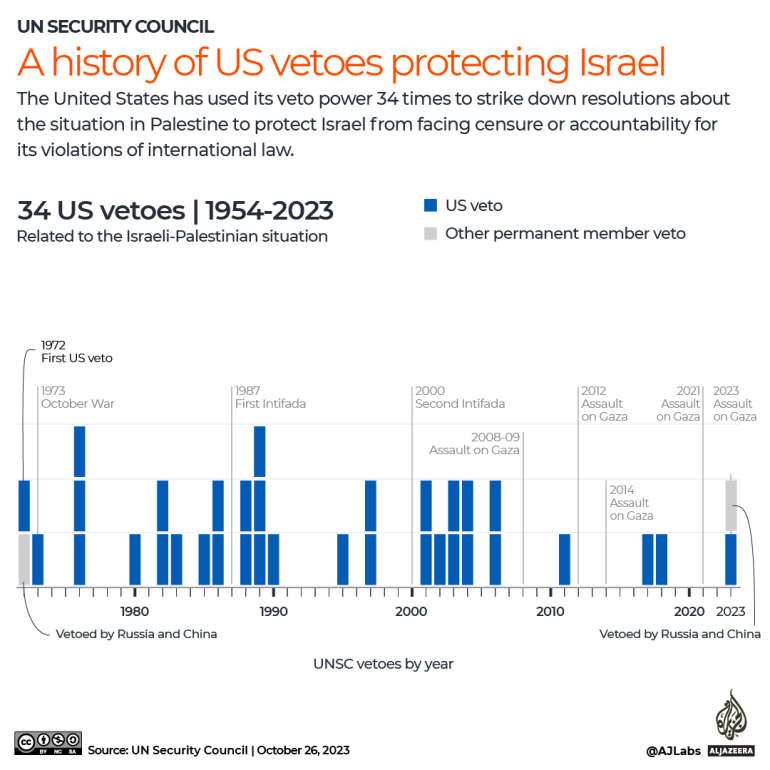
The US has cast a veto on many occasions since 1954 and 34 of those vetoes were to support the Israeli position in the Israel-Arab dispute. According to the Associated Press. “U.S. deputy ambassador Robert Wood called the resolution ‘imbalanced’ and criticized the council after the vote for its failure to condemn Hamas’ Oct. 7 attack on Israel in which the militants killed about 1,200 people, mostly civilians, or to acknowledge Israel’s right to defend itself. He declared that halting military action would allow Hamas to continue to rule Gaza and ‘only plant the seeds for the next war.’”
The US veto is indefensible. The Gaza Health Ministry only counts bodies and thus far it has collected over 17,000. The number of bodies buried in the rubble remains unknown and will likely never be known. The vast majority of the dead are women and children. And the Israeli objective of “eliminating” Hamas remains unattainable.




 World Politics News