In 1917, US President Wilson asked the US Congress to declare war against Germany. There were many incidents that provoked Wilson to seek the declaration. His Presidential Campaign of 1916 was adamantly opposed to US participation in the war that had raged in Europe since August 1914. But Wilson’s justification for this change was more deeply rooted in his belief that wars were initiated by leaders who felt little constraints on their ability to use war for spurious reasons:
“We have no quarrel with the German people. We have no feeling towards them but one of sympathy and friendship. It was not upon their impulse that their government acted in entering this war. It was not with their previous knowledge or approval. It was a war determined upon as wars used to be determined upon in the old, unhappy days when peoples were nowhere consulted by their rulers and wars were provoked and waged in the interest of dynasties or of little groups of ambitious men who were accustomed to use their fellow men as pawns and tools.”
It is not at all clear that Wilson’s diagnosis for the causes of war were accurate but they were based on a long-standing tradition in political thought stimulated by Immanual Kant’s pamphlet, Perpetual Peace, which was published in 1795. Kant’s argument was straightforward. Kant believed that the leaders of a country reaped all the benefits of war, such as the expansion of territory, without paying the real price of war. Ordinary people bear the real costs of war (through taxes, conscription, and destruction of property) and would therefore oppose going to war if they were given an effective voice in making decisions. To Wilson, expanding democracy was the most effective way to secure peace.
The meeting yesterday between leaders of the US and Russia in Saudi Arabia was exactly the type of scenario that both Kant and Wilson found compelling. There were no members of the Ukrainian government, nor were there any representatives of other European states. Moreover, the discussion centered on several issues which were decidedly peripheral to the conflict that has been ongoing for three years. According to the Associated Press:
“In an interview with The Associated Press, Secretary of State Marco Rubio said that the two sides agreed broadly to pursue three goals: to restore staffing at their respective embassies in Washington and Moscow, to create a high-level team to support Ukraine peace talks, and to explore closer relations and economic cooperation.”
Two of these three goals are broad issues that relate exclusively to the US-Russian relationship. Both the US and Russia are more interested in normalizing relations, and Ukraine in that context is nothing more than an impediment. But Ukraine and Europe do not view Ukraine in that context. Their context is that Russia ruthlessly invaded Ukraine with no real provocation and has waged a brutal war against the civilian population in Ukraine. At the press conference in Saudi Arabia, both Secretary of State Rubio and National Security Adviser Waltz gave lip service to the idea that there is a need to involve Ukraine and Europe in the negotiations but there was no indication whatsoever whether Trump was concerned about those issues.
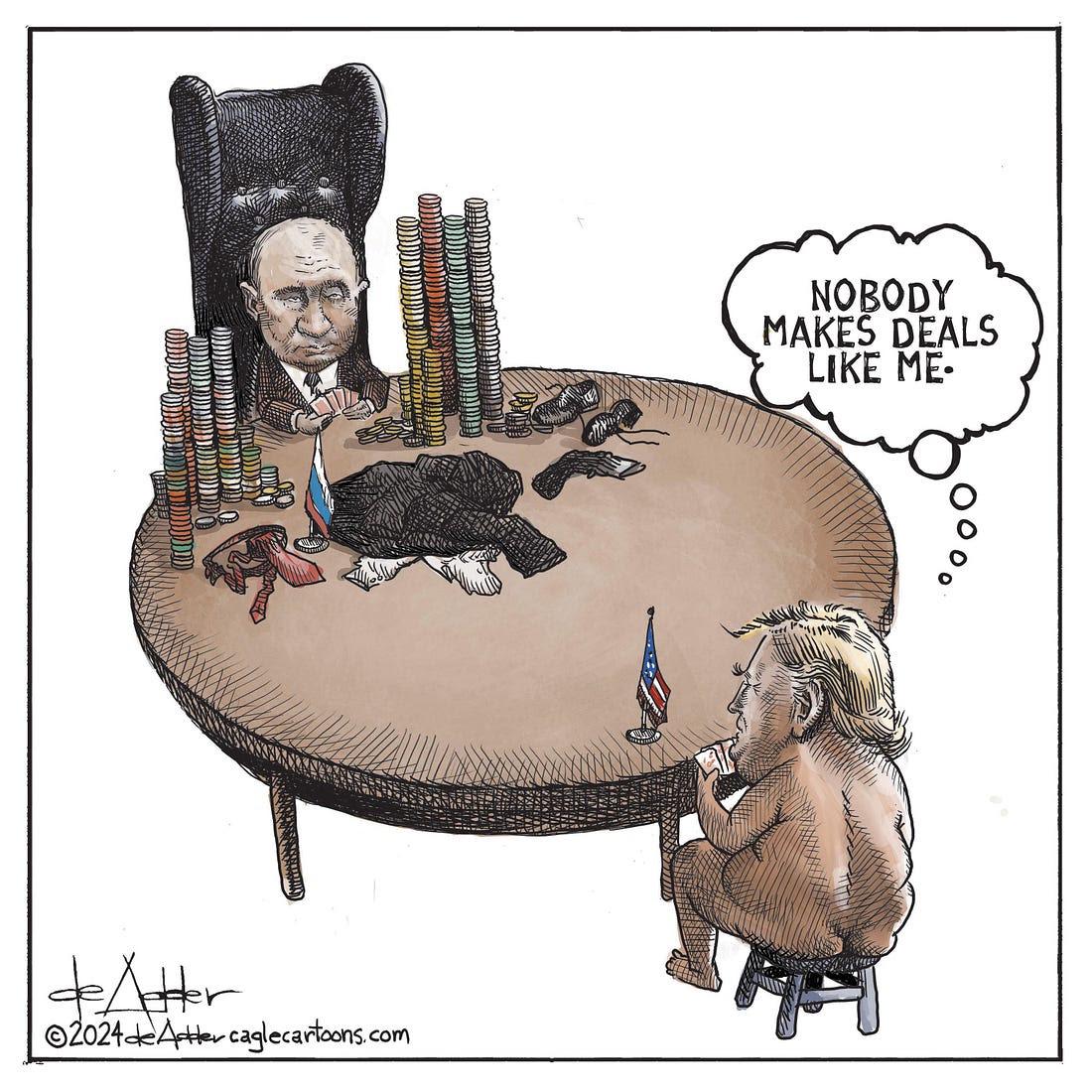
As I indicated in my previous post, Trump has yet to extract any concessions from Putin. Instead, he has already conceded on the two principal issues for Putin: control over wide swathes of Ukrainian territory and a promise that Ukraine would not be allowed to join NATO. These concessions are profound and are on the scale that is usually made by a side that has been routed in war. But Russia has fared dismally in proving its military prowess. The Economist reports:
“Any assessment of Russia’s negotiating position should start with the military situation. Its army has performed dismally. The pace of advance is excruciatingly slow: since last July it has struggled to take the town of Pokrovsk, where current losses are staggering. Most of its gains were in the first weeks of the war. In April 2022, following Russia’s retreat from the north of Ukraine, it controlled 19.6% of Ukrainian territory, and its casualties (dead and wounded) were perhaps 20,000. Today Russia occupies 19.2% and its casualties are 800,000, reckon British sources.”
Trump has declared Ukraine’s unconditional surrender without securing any guarantees that Ukraine’s future sovereignty will be protected, and that condition will only weaken US credibility in the future. Inevitably, those states–not only in Europe but also in Asia, Southeast Asia, Africa, and Latin America–who rely upon US power to keep stability will lose faith in the US and will either resort to self-reliance in defense (most likely, the possession of a nuclear weapon) or will find other protectors (China and Russia are eager to fill a US vacuum).
Trump’s abject surrender to Putin, however, is a greater tragedy. He has seriously damaged US relations with its European allies, and all other states now have legitimate doubts about the integrity of US promises. The world is significantly less safe because of his foolish infatuation with Putin.
 World Politics News
Leave a comment