Over the weekend, Israeli Prime Minister Netanyahu sat for an interview with ABC News. In that interview, he indicated that Israel would maintain a security presence in the Gaza Strip after the conflict dies down (presumably after Hamas is “eliminated”):
“I think Israel for an indefinite period will have the overall security responsibility because we’ve seen what happens when we don’t have it. When we don’t have that security responsibility, what we have is the eruption of Hamas terror on a scale that we couldn’t imagine.”
The United States has indicated that it does not support an indefinite occupation of the territory, although it has waffled on whether it would support a temporary reoccupation. From the US State Department press briefing on 7 November:
QUESTION: Okay. And then if I could ask about some comments that Netanyahu made yesterday —
MR PATEL: Sure.
QUESTION: — about who should govern Gaza when fighting is over, he said he thinks Israel for an indefinite period will have overall security responsibility. What’s your take on those comments? Have you sought any clarification from the Israeli Government about what they meant by that? Do you have any concerns?
MR PATEL: So we, of course, engage with our partners in the Israeli Government about a numerous number of things, especially currently as this situation continues to be ongoing. I would refer you to the prime minister’s office for further elaboration on that particular quote. Our viewpoint is that Palestinians must be at the forefront of these decisions, and Gaza is Palestinian land and it will remain Palestinian land. And generally speaking, we do not support reoccupation of Gaza, and neither does Israel. Secretary Blinken was fairly clear about that during his travels as well.
But it’s important to note that, at the same time, we agree with Israel that there is no returning to the October 6th status quo. Israel and the region must be secure, and Gaza should and can no longer be a base from which to launch terror attacks against the people of Israel or anyone else. And so we’re working with partners on various scenarios – on interim governance, on security parameters, on security situations in Gaza – for once this crisis recedes. But I’m not going to get ahead of that process or get into it from here.
Netanyahu’s statement gives no inkling on whether Israel will honor international law which requires an occupying power to provide for the well-being of people held in the occupation. The United Nations Office of the High Commissioner on Human RIghts issued a summary of the obligations of an occupying power in 2017:
“The duties of an occupying power are spelled out primarily in the 1907 Hague Regulations (articles 42-56), the Fourth Geneva Convention, and Additional Protocol I to the Four Geneva Conventions. The overarching principle is that an occupant does not acquire sovereignty over an occupied territory and therefore any occupation must only be a temporary situation. The occupant has an obligation to ensure the well-being of the population, and is prohibited from making permanent changes to the territory in the judicial, economic, or social spheres. The main duties of the occupying power under international law can be summarised as follows:
The occupying power must respect the laws in force in the occupied territory, unless they constitute a threat to its security or an obstacle to the application of the international law of occupation.
The occupying power must take measures to restore and ensure, as far as possible, civil life and public order and safety.To the fullest extent of the means available to it, the occupying power must ensure sufficient hygiene and public health standards, as well as the provision of food and medical care to the population under occupation.
The population in occupied territory cannot be forced to enlist in the occupier’s armed forces. Collective or individual forcible transfers of population from and within the occupied territory are prohibited.
Transfers of the civilian population of the occupying power into the occupied territory, regardless whether forcible or voluntary, are prohibited.
Collective punishment and measures of intimidation are prohibited.The taking of hostages is prohibited.
Reprisals against protected persons or their property are prohibited.
The confiscation of private property by the occupant is prohibited.The destruction or seizure of enemy property is prohibited, unless absolutely required by military necessity during the conduct of hostilities.
Cultural property must be respected.
People accused of criminal offences shall be provided with proceedings respecting internationally recognised judicial guarantees (for example, they must be informed of the reason for their arrest, charged with a specific offence and given a fair trial as quickly as possible).
Food and medical supplies may be requisitioned exclusively for the use of the occupation forces and administration personnel themselves (i.e., not for purposes of export outside of the occupied territory and not for the benefit of anyone beyond the occupying personnel, unless necessary for the benefit of the population under occupation itself) and only if the needs of the civilian population have been taken into account.
These are heavy responsibilities, particularly the requirement that “the occupying power must ensure sufficient hygiene and public health standards, as well as the provision of food and medical care to the population under occupation.” It is not clear that the Israeli population will be willing to pay for the needs of the 2.1 million people who lived in the Gaza prior to the war. Indeed, it is not clear that those who fled the war and fled to the southern part of the Gaza will be allowed to return to the northern part of the Strip.
I see no evidence that Prime Minister Netanyahu has made any concrete plans after the violence stops. We do have access to a memo written by the Israeli Ministry of Intelligence on 13 October 2023. That memo outlines three options for the future:
Option A: The population remaining in Gaza and the import of Palestinian Authority (PA) rule.
Option B: The population remaining in Gaza along with the emergence of a local Arab authority.
Option C: The evacuation of the civilian population from Gaza to Sinai
The memo recommends Option C: “The option that will yield positive, long-term strategicoutcomes for Israel, and is an executable option. It requiresdetermination from the political echelon in the face of internationalpressure, with an emphasis on harnessing the support of the United Statesand additional pro-Israeli countries for the endeavor’
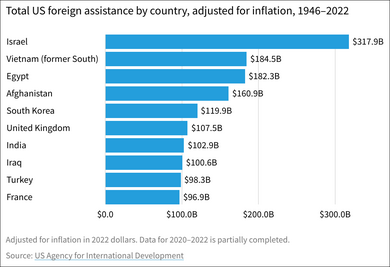
I sincerely doubt that the rest of the world will support Option C, but the critical determinant is whether the US will approve the option. The Biden Administration should make clear to Israel that it will not support Option C under any circumstances. If pressed on the matter, the US should end its support for Israel’s military operations. The Netanyahu government will then have to decide whether it accepts the end of the annual support the US gives Israel (around $3.5 billion a year).
 World Politics News
Thank you Vinnie for all this information.
LikeLike